
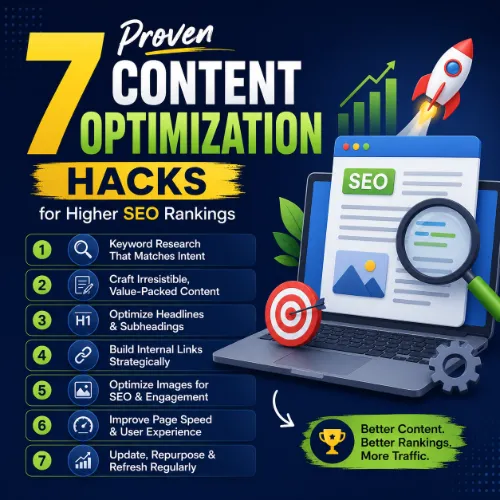
content optimization hacks Key Takeaways
Instead of optimizing a page for " content optimization hacks " with a broad tutorial, an SEO expert checks whether the SERP favors listicles.
- The most effective content optimization hacks start with deep keyword research and intent matching, not guesswork.
- Structuring content for featured snippets and People Also Ask boxes can double your organic visibility without building new pages.
- Regularly auditing existing content with fresh internal links and updated data keeps your site competitive in shifting search landscapes.
Why Content Optimization Hacks Matter in 2025
Search engines now evaluate hundreds of signals before ranking a page. While backlinks and domain authority remain important, on-page content optimization hacks often determine whether a well-researched article reaches the first page or gets buried. The difference between a top-five result and an also-ran frequently comes down to how well you match search intent, structure your headings, and maintain freshness. For a related guide, see 11 X (Twitter) SEO Growth Hacks: Proven Tactics for 2026.
Below are seven SEO content optimization tips that successful SEO teams use daily. Each hack comes with a clear explanation and a practical example so you can adapt it to your own content.
Hack 1: Match Search Intent Before You Write a Word
Keyword volume matters, but intent matters more. Every query falls into one of four categories: informational, navigational, commercial, or transactional. If your content type does not align with the intent behind the keyword, rankings will suffer.
How to identify intent
Search for your target keyword and study the top ten results. Are they blog posts, product pages, listicles, or tutorials? The dominant format tells you what Google considers the right answer. For example, a query like “best running shoes for flat feet” returns commercial comparison articles, not beginner guides. If you write a generic informational post, you are competing against the wrong format.
Practical example
Instead of optimizing a page for “content optimization hacks” with a broad tutorial, an SEO expert checks whether the SERP favors listicles. If it does, reformatting the page as a numbered list with bold takeaways immediately improves alignment with user expectations. For a related guide, see 14 Proven Ways to Earn Editorial Links (Expert Guide).
Hack 2: Target Featured Snippets and People Also Ask Boxes
Featured snippets occupy position zero and drive high click-through rates. SEO content optimization tips that target snippets often involve answering a specific question concisely, using a table, or providing a step-by-step list.
Steps to claim a snippet
Identify a question that already shows a snippet for a related term. Write a direct answer in 40–60 words, then follow with supporting detail. Use an H2 or H3 heading that exactly matches the question. Wrap actionable steps in an ordered list. Tables work well for comparison snippets such as price, features, or pros vs. cons.
Real-world result
One SEO editor rewrote a 300-word section into a four-point numbered list under the heading “How do I optimize my content for SEO?” Within two weeks, the page captured a featured snippet for a related keyword and saw a 70% increase in organic clicks.
Hack 3: Refresh and Republish Old Content
Search engines favor fresh content. Yet many site owners publish new posts while their best-performing articles collect dust. Content optimization hacks include a regular content audit schedule to identify pages with declining traffic or outdated statistics.
What to update
Replace old data with current numbers, add new examples, expand thin sections, and improve internal links. Update the publish date and notify Google via the URL inspection tool. Republishing a strong article often produces faster gains than creating a new post from scratch.
Practical example
A B2B blog about “SEO trends” saw traffic drop 40% over six months. After updating statistics, adding a section on AI overviews, and refreshing internal links to newer articles, traffic recovered within three weeks and eventually surpassed the original peak.
Hack 4: Build Topic Clusters with Smart Internal Linking
Search engines understand topical authority when related pages link to a central pillar. Instead of writing isolated articles, plan content clusters around broad topics such as “content optimization hacks”.
How to structure a cluster
Create one comprehensive pillar page that covers the broad subject in depth. Then publish supporting articles that target specific subtopics (e.g., “How to optimize meta descriptions” or “Best tools for content audits”). Each supporting page links back to the pillar, and the pillar links out to each supporting page.
Why it works
Internal links pass authority and help Google understand the relationship between pages. A well-linked cluster often ranks for dozens of related keywords instead of just one.
Hack 5: Optimize for Readability and Skimmability
Even the best content fails if readers bounce after ten seconds. SEO content optimization tips emphasize formatting that accommodates scanning behavior.
Formatting checklist
- Use short paragraphs of two to four sentences.
- Include descriptive subheadings every 200–300 words.
- Add bullet points or numbered lists for key takeaways.
- Incorporate bold text sparingly to highlight essential terms.
- Keep sentences under 25 words when possible.
Readability tools
Tools like the Hemingway Editor or Yoast readability analysis flag long sentences and passive voice. Running a page through one of these tools before publishing cuts bounce rates and increases time on page.
Hack 6: Leverage Schema Markup for Richer SERP Results
Structured data helps search engines understand your content and often leads to enhanced results like review stars, FAQ snippets, or recipe cards. For a listicle about content optimization hacks, implementing FAQ schema or Article schema can boost click-through rates significantly.
Simple implementation
Use Google’s Structured Data Markup Helper or a plugin like Schema Pro to add schema without writing code. Test your markup using the Rich Results Test tool to confirm it is valid.
Real numbers
Case studies from SEO agencies show that pages with FAQ or HowTo schema see an average 30% higher click-through rate than plain results, even when ranking in the same position.
Hack 7: Analyze Competitor Gaps with a Content Audit
Your competitors already rank for terms you target. A content gap analysis reveals which topics they cover that you do not, or which of their pages outrank yours and why.
How to run a gap analysis
Use an SEO tool (such as Ahrefs or Semrush) to compare your domain with a competitor. Export keywords where the competitor ranks in the top 20 and your site does not appear. Prioritize terms with decent search volume and low to medium keyword difficulty. Then create or update content specifically for those gaps.
Example
An online marketing blog discovered that a competitor ranked for “SEO content optimization tips” while they did not. By publishing a targeted article with that exact phrase in the H1 and covering subtopics the competitor missed, they moved from not ranking to position six in three months.
SEO Entities and Their Functions
Understanding the entities that influence content optimization helps you prioritize efforts. Below are key entities and what they reveal.
- Keyword entities: Organic keywords, keyword difficulty (KD), and search volume show demand, competition, and ranking opportunity. Use them to decide which content optimization hacks to apply first.
- Page entities: Top pages by traffic and best by links reveal which URLs already earn visibility. Optimizing these pages often yields faster wins than building new content from scratch.
- SERP entities: Featured snippets, People Also Ask boxes, and AI Overviews indicate the format Google rewards. If a snippet exists for your target keyword, structure your content to claim it.
- Competitor entities: Competing domains and content gap opportunities show where rivals win traffic. Use this data to guide your content refresh or new article strategy.
- Technical SEO entities: Crawl issues, redirect chains, and Core Web Vitals affect indexability and user experience. Fixing technical problems ensures your optimized content actually gets crawled and ranked.
Useful Resources
- Google’s Guide to Creating Helpful, Reliable, People-First Content
- Ahrefs: Content Optimization Guide for Higher Rankings
Applying these seven content optimization hacks consistently will sharpen your content’s relevance, improve user engagement, and boost your chances of earning top rankings. Start with intent matching and readability formatting, then layer in snippet targeting, internal linking, and regular content refreshes. The SEO landscape changes fast, but a solid optimization routine keeps your content competitive.
Frequently Asked Questions About content optimization hacks
What are content optimization hacks ?
Content optimization hacks are strategic techniques that improve a page’s relevance, readability, and technical signals to help it rank higher and attract more engaged visitors.
How do content optimization hacks differ from basic SEO?
Basic SEO often focuses on keywords and meta tags. Content optimization hacks go deeper by addressing search intent, user experience, schema, internal linking structure, and content freshness.
Can content optimization hacks work for old pages?
Yes. Updating outdated statistics, improving headings, adding internal links, and refreshing examples are effective content optimization hacks for existing content.
How long does it take to see results from content optimization?
Results vary by competition and site authority, but many SEOs see improvements within two to six weeks after implementing content optimization hacks like intent matching or snippet targeting.
Do I need a tool to apply content optimization hacks ?
While not mandatory, tools like Ahrefs, Semrush, or Yoast help identify keyword gaps, readability issues, and technical errors that make content optimization hacks more precise.
What is the most important content optimization hack?
Matching search intent is widely considered the most critical content optimization hack because it determines whether your page satisfies the user’s core need.
How many keywords should I target per page?
Focus on one primary keyword and two to three related secondary keywords per page. Over-optimizing for many keywords dilutes relevance and can hurt rankings.
Does content length affect content optimization?
Length alone is not a ranking factor, but comprehensive content often performs better because it covers subtopics, answers follow-up questions, and signals expertise.
What is a featured snippet?
A featured snippet is a concise answer displayed at the top of Google search results. Content optimization hacks often target these snippets with direct answers and structured lists.
How do internal links help content optimization?
Internal links distribute authority across your site, help search engines discover related pages, and encourage visitors to explore more content. They are a fundamental part of content optimization.
Should I change the URL when updating content?
No. Changing the URL breaks existing backlinks and confuses search engines unless you set up a 301 redirect. Keep the URL stable and update the page content and meta tags instead.
What is a content cluster?
A content cluster is a group of related articles that link to a central pillar page. This structure signals topical authority and helps search engines understand your expertise on a subject.
How often should I refresh my content?
For evergreen topics, review content every six to twelve months. For news or trend-based content, updates may be needed quarterly or even monthly to stay accurate.
Can AI-generated content benefit from content optimization hacks ?
Yes, but AI-generated content still requires human editing for accuracy, tone, and coherence. Applying content optimization hacks such as intent alignment and readability formatting improves its performance.
What is a content audit?
A content audit is a systematic review of your existing pages to identify which ones need updating, consolidation, or removal. It is a core practice behind effective content optimization hacks.
Do images affect content optimization?
Yes. Optimized images with descriptive file names, alt text, and compressed file sizes improve page load speed and accessibility, both of which support content optimization goals.
What is search intent?
Search intent is the goal behind a user’s query. It can be informational, navigational, commercial, or transactional. Matching intent is one of the most powerful content optimization hacks.
How do I find content gaps in my niche?
Use competitor analysis tools to compare keywords where rivals rank but your site does not. Prioritize topics with decent search volume and low competition to close content gaps.
What is a meta description?
A meta description is a short summary (under 160 characters) that appears below the title in search results. While not a direct ranking factor, it influences click-through rates and should include your target keyword.
Can content optimization hacks hurt my rankings?
If applied incorrectly—such as keyword stuffing, over-optimizing headings, or using irrelevant schema—they can harm rankings. Focus on user experience and natural language to avoid penalties.