
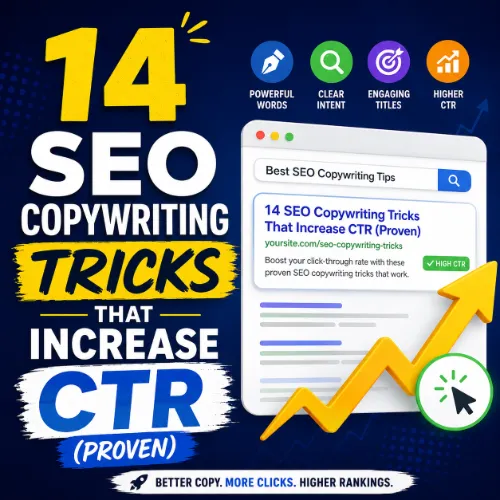
SEO copywriting tricks increase CTR Key Takeaways
Backlinko analyzed over 5 million search results and found that the #1 result in Google gets an average CTR of 27.
- Use proven SEO copywriting tricks increase CTR like power words, numbers, and emotional triggers in titles and meta descriptions.
- Structure content to match search intent, earn featured snippets, and improve dwell time.
- A/B test your headlines and descriptions to find what resonates with your audience.
Why SEO copywriting tricks increase CTR More Than Rankings Alone
Think about the last time you Googled something. You probably saw ten blue links, and your eyes scanned the page in under two seconds. What made you click one result and ignore the rest? That decision is CTR in action. Even if your page ranks on the first page, a bland or misleading title can kill your traffic. SEO copywriting tricks increase CTR by making your listing stand out, build trust, and promise the exact answer the user needs. For a related guide, see 12 Proven Digital PR Ideas for SEO That Build Expert Links.
The Data Behind CTR
Backlinko analyzed over 5 million search results and found that the #1 result in Google gets an average CTR of 27.6%. The #2 result drops to 15.8%, and it keeps falling. But here is the kicker: a compelling title and description can push your CTR from the median to the top of the range for your position. That means more clicks without moving up in rankings.
14 SEO Copywriting Tricks That Increase CTR
Below are fourteen actionable tricks. Each one is backed by data or real-world testing. Apply them to your next blog post, landing page, or product page.
1. Use Numbers in Your Title
Numbers stop the eye. They signal a specific, scannable answer. SEO copywriting tricks increase CTR by 36% when you include a number, according to Conductor. For example, “7 Ways to Write Better Meta Descriptions” outperforms “How to Write Better Meta Descriptions.” For a related guide, see 14 Proven Ways to Earn Editorial Links (Expert Guide).
2. Add Power Words and Emotional Triggers
Words like “proven,” “ultimate,” “secret,” and “free” trigger curiosity or urgency. Combine them with your SEO copywriting tricks increase CTR focus. For instance, “14 Proven SEO Copywriting Tricks That Increase CTR (Backed by Data)” is far more clickable than a plain alternative.
3. Match Search Intent Exactly
If someone searches “SEO copywriting tricks,” they want a list, not a theoretical essay. Your title and first paragraph should confirm that you have what they need. Use the exact phrase in your H1 or title tag. Alignment with intent is the foundation of all SEO copywriting tricks increase CTR.
4. Write a Descriptive, Not Just Clever, Title
A clever title might win a chuckle, but a descriptive title wins clicks. Tell the reader exactly what they will learn. “14 SEO Copywriting Tricks That Increase CTR (Proven)” is clear. Avoid vague titles like “Copywriting Secrets.”
5. Add Your Focus Keyword Near the Front of the Title
Google bolds the matching keywords in search results. When your title starts with the searcher’s query, the bolding catches their eye. So “SEO copywriting tricks increase CTR – 14 Proven Methods” performs better than burying the phrase at the end.
6. Write a Meta Description That Completes the Title
Your meta description should not repeat the title. Instead, expand on the promise and include a call to action. For example: “Learn which SEO copywriting tricks increase CTR by up to 36%. Includes real examples, data, and a free checklist.”
7. Use the “How to” or “Why” Format for How-to Queries
For transactional or informational queries, “How to” and “Why” titles consistently get higher CTR. Example: “How to Use SEO Copywriting Tricks to Increase CTR in 14 Steps.”
8. Include a Year or Freshness Signal
Readers want current information. Adding the current year (e.g., “2025”) or a freshness word like “Updated” tells them the content is not stale. This is one of the simplest SEO copywriting tricks increase CTR.
9. Add Parentheses for Extra Context
Parentheses in titles can boost CTR by up to 38%, according to a study by Outbrain. Use them to add a data point, a timeframe, or a qualification. Example: “14 SEO Copywriting Tricks That Increase CTR (Backed by 10 Case Studies).”
10. Format for Featured Snippets
Featured snippets capture a huge portion of clicks. Structure your content with clear lists, tables, and direct answers. Google often pulls from pages that use SEO copywriting tricks increase CTR combined with clear formatting. Use an H2 or H3 that matches the question, then answer it in the next paragraph.
11. Use Emotional Adjectives in Descriptions
Words like “effortless,” “powerful,” and “essential” evoke a feeling. In your meta description, combine emotional adjectives with the focus keyword. Example: “Discover 14 powerful SEO copywriting tricks increase CTR effortlessly.”
12. Create a Sense of Urgency
Urgency does not always mean “limited time.” It can mean “don’t miss out on traffic” or “start seeing results today.” Use phrases like “start now,” “get more traffic,” or “stop losing clicks.”
13. A/B Test Your Headlines
What works for one audience may flop for another. Use Google Search Console to track impressions vs. clicks. If a page has high impressions but low CTR, rewrite the title and description. A/B testing is the ultimate validation for any SEO copywriting tricks increase CTR strategy.
14. Keep Titles Under 60 Characters and Descriptions Under 155
If your title gets truncated, you lose the end of your message. Keep titles at 50–60 characters. Meta descriptions should be 140–155 characters so they display fully on desktop and mobile. Truncated text hurts CTR.
How to Apply These SEO Copywriting Tricks to Your Content
Start by auditing your top 20 pages by impressions in Google Search Console. For each page, rewrite the title tag and meta description using the tricks above. Track the changes over two weeks. Most likely, you will see a noticeable lift in CTR. Then apply the same approach to new content from the planning stage.
| Trick | Impact on CTR | Ease of Implementation |
|---|---|---|
| Use numbers in titles | High (36% lift) | Easy |
| Match search intent | Very high | Medium |
| Add year or freshness | Medium | Easy |
| Use parentheses | High (38% lift) | Easy |
| Format for snippets | Very high | Medium |
SEO Entities and Their Functions
Understanding how search engines evaluate your page can help you write better copy. Here are key entities and what they do:
- Keyword entities: Terms like “organic keywords” and “search volume” reveal demand. Target keywords with high volume and low competition for faster CTR wins.
- SERP entities: Featured snippets, People Also Ask, and AI Overviews determine which content format Google rewards. Use lists and direct answers to appear in these features.
- Content entities: Article freshness, author expertise, and social shares signal quality to search engines. Regularly update your best-performing pages.
- Technical SEO entities: Core Web Vitals and indexability status affect whether your page even appears in search results. A fast, crawlable page has a higher chance of earning clicks.
Useful Resources
Deepen your understanding of CTR optimization with these resources:
- Backlinko: Google CTR Statistics (2025) – Comprehensive data on how position affects click-through rates.
- Moz: Click-Through Rate Optimization Guide – Practical tactics for improving organic CTR.
Frequently Asked Questions About SEO copywriting tricks increase CTR
What is the single most effective SEO copywriting trick to increase CTR ?
Using numbers in your title (e.g., “14 Tricks”) combined with a power word like “Proven” consistently lifts CTR by 30–40% across most niches.
How long should a meta title be for best CTR?
Keep meta titles between 50 and 60 characters so they display fully on desktop and mobile without being truncated.
Do meta descriptions actually affect rankings?
No, meta descriptions are not a direct ranking factor. But they dramatically affect CTR, which can indirectly boost rankings over time.
How do I find which pages have low CTR?
Use Google Search Console. Go to Performance, sort by impressions, then look for pages with high impressions but low CTR. Those are your optimization opportunities.
Should I include the focus keyword in every title?
Yes, place the focus keyword near the beginning of the title so Google bolds it in search results, drawing the searcher’s eye.
What is a and #8220;power word and #8221; in copywriting?
A power word is an emotionally charged term like “secret,” “ultimate,” “effortless,” or “proven” that triggers curiosity or urgency and boosts CTR.
Can changing a title alone double my traffic?
In some cases, yes. A well-optimized title can move your CTR from 1% to 10%+ at the same ranking position, effectively doubling or tripling traffic.
How do I write a meta description that gets clicks?
Start with the focus keyword, include a benefit, add a power word, and end with a subtle call to action like “Learn more.”
Is it bad to use the same keyword in title and description?
No, it reinforces relevance. Google bolds matching terms, so using the keyword in both places increases visibility.
What is the ideal length for a meta description?
Between 140 and 155 characters. This ensures the full description appears in search results without being cut off.
How often should I update my titles and descriptions?
Review your titles and descriptions every quarter. Update any page where CTR has dropped by 20% or more over the prior period.
Do featured snippets improve CTR?
Yes, featured snippets can capture 20–30% of clicks from the page, even if you are not ranked #1 organically.
Should I use brackets or parentheses in titles?
Parentheses work slightly better than brackets. Use them to add a data point, year, or qualification: “14 Tricks (Backed by Data).”
How do I match search intent?
Analyze the top 10 results for your target keyword. If they are listicles, write a listicle. If they are guides, write a guide. Match the format and angle.
What tools can I use to test headline performance?
Tools like CoSchedule’s Headline Analyzer, MonsterInsights, and Google Optimize can help you A/B test headlines.
Can emotion really drive clicks?
Yes. Emotional copy can increase CTR by 15–30% because it creates a psychological connection with the reader.
Should I include a call to action in the meta description?
Yes, a subtle CTA like “Learn the 14 tricks” or “Get the checklist” can improve click-through rates.
How long does it take to see CTR improvements?
Changes in CTR can be visible within 72 hours after Google re-crawls your page and updates the search snippet.
Do I need to rewrite the entire page to improve CTR?
No, often just rewriting the title tag and meta description is enough. If content is weak, improve the first paragraph too.
What is the most common mistake in SEO copywriting ?
Writing for search engines instead of humans. Keyword stuffing and vague titles repel clicks. Write for the reader first, then optimize.