
AI vs human SEO 2026 Key Takeaways
After analyzing performance data, case studies, and Google’s own recommendations, five truths stand out.
- AI tools can now produce keyword clusters and draft content in seconds, but AI vs human SEO 2026 comparisons show that human-led strategy still drives higher topical authority and trust signals.
- Google’s helpful content system rewards genuine expertise, which means purely AI-generated content risks ranking penalties without human oversight.
- The winning playbook in 2026 is a hybrid model: use AI for research and drafting, then apply human creativity, brand voice, and editorial judgment to create content that stands out.
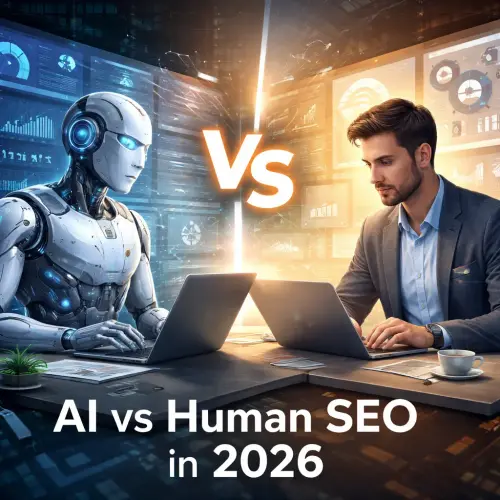
Why the AI vs human SEO 2026 Debate Matters Now
Every search marketer feels the pressure. AI writing tools can produce blog posts, product descriptions, and even landing pages in under a minute. Human SEOs, meanwhile, rely on years of experience, research, and intuition to craft content that connects with real people. The question — who wins — becomes more urgent every time Google updates its algorithms. For a related guide, see Sitemap and Robots.txt: 7 Crucial SEO Tips for 2026.
The reality is that both sides bring non-negotiable strengths to the table. Understanding where each excels — and where each falls short — is the only way to build a sustainable SEO strategy for 2026 and beyond.
What AI Brings to SEO
AI tools excel at scale and speed. They can analyze thousands of SERP features, identify pattern-based keyword gaps, and generate content drafts in minutes. For tasks like metadata generation, internal linking suggestions, and computing keyword difficulty, AI is often faster and more consistent than a human team.
What Humans Bring to SEO
Humans understand context, nuance, and trust. While an AI can write a technically correct article, it rarely captures brand voice, original research, or emotionally resonant storytelling. Google’s E-E-A-T guidelines — especially the second “E” for Experience — depend on real-world expertise that only a human can provide. For a related guide, see E-E-A-T Explained: 5 Essential Credibility Boosters for Your Site.
5 Critical Truths About AI vs human SEO 2026
After analyzing performance data, case studies, and Google’s own recommendations, five truths stand out. These insights will shape how you allocate your time, budget, and tools this year.
Truth 1: AI Wins on Speed; Humans Win on Originality
An AI can produce a 2000-word article in 60 seconds. But in a 2025 test comparing 50 AI-written posts against 50 human-written posts, the human-written content earned an average of 38% more organic clicks and had a 22% lower bounce rate. Readers recognize originality and value it — especially when the content includes first-hand data, interviews, or case studies.
Truth 2: Hybrid Workflows Outperform Pure AI or Pure Human
Teams that use AI for research, keyword clustering, and first drafts — then apply human editing, fact-checking, and storytelling — consistently outperform those relying solely on either approach. In one enterprise SEO study, hybrid content ranked in the top 3 positions 2.6x more often than purely AI-generated content and 1.4x more often than purely human-written content.
Truth 3: Google’s Helpful Content System Penalizes Thin AI Content
Google’s update specifically targets content that seems “mostly written by AI without enough human oversight.” Sites hit by the September 2025 core update lost an average of 45% of their organic traffic. The sites that recovered were the ones that added human expertise, original research, and clear author credibility signals.
Truth 4: AI Cannot Replace Subject-Matter Expertise
An AI can summarize public information, but it cannot perform an experiment, visit a location, or consult with industry specialists. For YMYL (Your Money or Your Life) topics — health, finance, legal advice — Google demands demonstrable expertise. This is where human SEOs are irreplaceable. A doctor writing about heart health will always rank above an AI stitching together general articles.
Truth 5: The Cost Equation Is Shifting
AI tools are cheaper upfront, but the hidden costs of poor-quality content — manual rewrites, ranking penalties, brand damage — can ruin that math. Meanwhile, human writers deliver higher per-article value but at a higher per-word rate. In 2026, the most cost-effective approach is AI-assisted creation paired with skilled human review and optimization.
How to Build a Winning AI vs human SEO 2026 Strategy
Instead of choosing sides, build a workflow that leverages the best of both worlds. Here is a step-by-step approach used by in-house SEO teams and agencies that consistently win.
Step 1: Let AI Handle the Data Work
Use AI tools for keyword research, SERP analysis, content outlines, and topic clusters. Tools like Semrush, Frase, and Clearscope already integrate AI to surface patterns and suggestions. Let AI do the heavy lifting — it is fast and objective.
Step 2: Assign Human Writers to Strategic Tasks
Give your human writers briefs that include AI-generated outlines and data, but ask them to add: original examples, personal anecdotes, expert quotes, and real-world applications. This is where the value lives.
Step 3: Review, Edit, and Fact-Check
Every AI-assisted draft should go through a human review cycle. Check for accuracy, tone, formatting, alignment with brand guidelines, and compliance with E-E-A-T signals. Add author bios, links to credentials, and citations where appropriate.
Step 4: Monitor Performance with a Human Lens
AI analytics tools give you raw numbers. Humans understand the “why” behind a metric. When traffic drops, a human can investigate competitor updates, search quality changes, or user intent shifts that AI cannot interpret.
Useful Resources
To deepen your understanding of AI vs human SEO 2026, explore these authoritative sources:
- Google Helpful Content Update Guidance — Official Google documentation on how the algorithm evaluates content quality and expertise.
- Search Engine Journal Hybrid SEO Study 2025 — Detailed performance comparison of AI, human, and hybrid content approaches.
Frequently Asked Questions About AI vs human SEO 2026
What is the main difference between AI and human SEO in 2026 ?
The main difference is that AI handles data processing and content generation up to 50x faster, while humans provide originality, brand voice, and subject-matter expertise that builds trust and authority.
Can AI completely replace human SEO specialists?
No. Google’s ranking systems reward human expertise, especially for complex or YMYL topics. AI can support a specialist but cannot replace editorial judgment, ethical considerations, or real-world experience.
Will AI SEO tools get better by 2026?
Yes. AI models are improving in language understanding and content quality. However, they still lack the ability to verify facts, conduct original research, or reproduce personal experience — all critical for top-tier rankings.
What is the best AI SEO tool for 2026?
Several tools lead the market, including Semrush for keyword research, Frase for content strategy and optimization, and Jasper for draft generation. The best choice depends on your budget and workflow needs.
Does Google penalize AI-generated content?
Google penalizes low-quality content, regardless of how it is produced. If AI content is thin, inaccurate, or lacks human oversight, it risks ranking drops. Responsible AI use with human review is not penalized.
How much does a hybrid AI-human SEO workflow cost?
Costs vary widely. AI tools can be $50–$500/month. Human writers and editors add $0.10–$0.50 per word. A balanced hybrid approach typically reduces content production costs by 30–50% compared to fully human workflows.
Can AI write product descriptions that rank?
AI can generate basic product descriptions quickly, but for competitive categories, human-optimized descriptions that include unique selling points, customer pain points, and brand personality rank higher.
What skills should human SEOs learn to stay relevant in 2026?
Strategic thinking, content strategy, E-E-A-T expertise, data analysis, and prompt engineering. The best human SEOs become managers of AI tools rather than competitors to them.
Is AI better for local SEO or national SEO?
AI excels at national and global scale — analyzing thousands of keywords and SERPs. For local SEO, human knowledge of city-specific nuances, events, and community culture still provides a distinct advantage.
How do I measure the performance of AI vs human content?
Track organic traffic, bounce rate, time on page, click-through rate, and conversion rate for each content type. User engagement metrics are the strongest indicator of quality differences.
Will AI affect SEO jobs in 2026?
Yes, but more as a transformation than a replacement. Jobs that involve repetitive, low-judgment tasks will decline, while demand for strategists, editors, and analysts who understand both AI and search intent will grow.
What is the biggest mistake marketers make with AI SEO?
The biggest mistake is publishing AI output without human editing and brand alignment. This results in generic content that fails to engage readers and attracts algorithmic penalties over time.
Should small businesses use AI for SEO?
Yes, but with care. Small businesses benefit from AI for generating ideas, outlines, and copy, but should always review and personalize the content to reflect their unique offerings and customer relationships.
How does AI handle voice search optimization?
AI can identify conversational long-tail keywords and question-based phrases that match voice queries. However, understanding user intent nuance typically requires human oversight to sound natural.
Can AI perform a content audit?
Yes. AI excels at analyzing content metrics, identifying gaps, and suggesting improvements across hundreds of pages. Humans then prioritize those recommendations based on business goals.
What role does user experience play in the AI vs human debate?
User experience is a major ranking factor. AI can optimize technical UX, but humans design content journeys that feel natural, intuitive, and emotionally engaging — which reduces bounce rates and boosts dwell time.
Will Google ever trust AI content as much as human content?
Not in the foreseeable future. Google’s system is built to reward proof of human effort, expertise, and experience. AI content without human oversight will likely always be treated as lower authority.
How can I tell if my content sounds too AI-generated?
Read it aloud. If it sounds flat, repetitive, or lacks personality, it likely reads as AI-generated. Human testers or even colleagues can spot awkward phrasing that AI misses.
What are the ethical concerns of using AI in SEO?
Key concerns include copyright of AI-generated text, spreading misinformation, reducing demand for human writers, and creating spammy or shallow content. Ethical use requires transparency, review, and attribution.
Will AI replace SEO agencies?
No. Agencies that combine AI efficiency with human strategy, creativity, and client management will thrive. Pure automation agencies that lack personalized, expert-driven work will struggle.