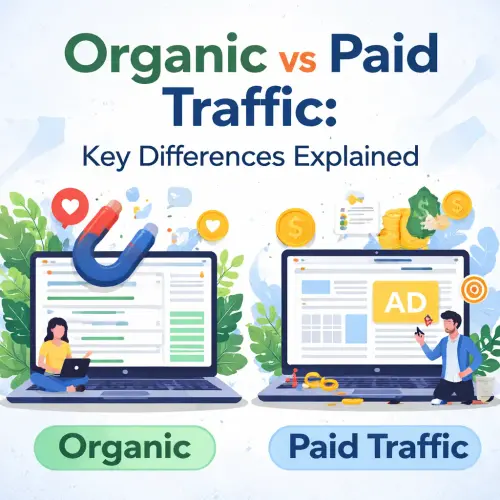
Understanding the difference between organic vs paid traffic is fundamental to building a successful digital marketing strategy. Organic traffic is earned visibility from search engines like Google through unpaid efforts, while paid traffic is purchased visibility through advertising platforms.
Organic traffic is free but requires significant time and effort to build through SEO.
Paid traffic provides immediate, targeted results but stops when your budget runs out.
The most effective marketing strategies often combine both approaches for sustainable growth.
In the world of digital marketing, two primary traffic sources dominate the conversation: organic and paid. Every website owner, from bloggers to Fortune 500 companies, must navigate the choice between building a lasting presence through search engine optimization (SEO) or buying immediate visibility through pay-per-click (PPC) advertising. This isn’t about choosing one over the other permanently, but rather understanding their distinct roles. By comparing organic vs paid traffic across key dimensions, you can allocate your resources wisely and build a resilient online presence that drives sustainable business growth. Read also: Blog.
Defining Organic and Paid Traffic
Before diving into the comparison, let’s establish clear definitions for these two fundamental traffic sources.
What is Organic Traffic?
Organic traffic refers to visitors who arrive at your website through unpaid search engine results. When someone types a query into Google, Bing, or another search engine and clicks on a result that isn’t labeled as an “Ad,” that’s organic traffic. This traffic is earned through the merit of your content and your website’s overall authority. The primary driver of organic traffic is Search Engine Optimization (SEO), which involves optimizing your website’s content, technical structure, and backlink profile to rank higher for relevant keywords.
Paid traffic encompasses any visitors who come to your site as a direct result of a paid advertising campaign. The most common form is Pay-Per-Click (PPC) advertising, where you bid on keywords and pay a fee each time someone clicks your ad. These ads appear at the top of search engine results pages (SERPs), clearly marked with an “Ad” label, or on other platforms like social media (Facebook Ads, LinkedIn Ads) and display networks. You have complete control over the audience, budget, and messaging, but the traffic ceases the moment you stop paying. A Google Ads campaign targeting “emergency plumber near me” is a classic example of paid traffic designed for immediate, high-intent leads.
Key Differences Between Organic and Paid Traffic
The core distinction between organic vs paid traffic can be broken down into several critical operational and strategic factors. The following table provides a high-level comparison before we explore each point in detail.
Dimension
Organic Traffic
Paid Traffic
Primary Cost
Time, expertise, and resources (SEO)
Direct advertising spend (PPC)
Time to Results
Slow (months to years)
Immediate (hours to days)
Control and Predictability
Low (algorithm-dependent)
High (budget and targeting control)
Targeting Precision
Broad (based on content topic)
Highly Granular (demographics, intent, behavior)
Sustainability
High (long-term asset)
Low (stops when funding stops)
User Perception and Intent
High trust, informational intent
Commercial intent, lower inherent trust
Cost: Investment vs. Expense
The financial model is the most apparent difference. Organic traffic is often called “free” traffic, but this is misleading. The cost is not in direct payments per click but in the significant investment of time, skilled labor (SEO specialists, content creators), and tools required to achieve and maintain rankings. It’s a capital investment in a business asset—your website’s authority.
Conversely, paid traffic is an operational expense. You pay a platform (like Google Ads or Meta) a defined cost-per-click (CPC) or cost-per-impression (CPM). Your traffic volume is directly tied to your daily or monthly budget. This makes costs highly predictable but also recurring.
Time to Results: The Tortoise and the Hare
This is where the analogy is perfect. Paid traffic is the hare. You can set up a campaign, get approval, and start driving targeted visitors to a landing page within a day. It’s the ultimate tool for speed, perfect for product launches, promotions, or capitalizing on timely trends.
Organic traffic is the tortoise. Building domain authority, creating comprehensive content, and earning quality backlinks is a marathon, not a sprint. It can take 6 to 12 months of consistent effort to see substantial organic growth. However, once achieved, the results compound over time.
Control and Predictability
With paid traffic, you have immense control. You decide exactly which keywords trigger your ads, who sees them (by location, device, time of day, and detailed demographics), what your ad copy says, and what your daily spend cap is. This makes forecasting traffic and costs relatively straightforward.
Control in organic traffic is indirect. You control your inputs—the quality of your content and technical SEO—but you cannot control Google’s algorithm. Core updates can shift rankings overnight. While best practices lead to predictable growth, there’s always an element of uncertainty, making it less suitable for campaigns requiring guaranteed visibility on a specific date.
Targeting Capabilities
Paid platforms excel at granular targeting. Beyond keywords, you can target users based on their interests, life events, income bracket, or whether they’ve visited your site before (retargeting). This is powerful for reaching a specific niche audience.
Organic targeting is broader and topic-based. You create content that answers questions for a particular audience. While you can optimize for user intent (informational, commercial, navigational), you cannot exclude specific demographics from finding your page in search results.
Long-Term Sustainability and Value
This is the heart of the strategic difference. A well-ranking piece of content for organic traffic is a perpetual asset. It can attract visitors, generate leads, and build brand authority for years with minimal ongoing maintenance. The value accumulates.
Paid traffic has no residual value. The moment you pause your campaign, the traffic and its benefits vanish entirely. It is a channel for generating immediate outcomes, not for building a lasting equity.
When to Use Organic vs Paid Traffic Strategies
The choice between organic vs paid traffic isn’t binary. The most sophisticated businesses use them in concert. Here’s a guide on when to prioritize each.
Prioritize Organic Traffic (SEO) When:
You have a limited advertising budget but can invest time. Startups and bootstrapped businesses often begin with SEO.
You’re building a brand for the long haul. You want to establish thought leadership and deep trust in your industry.
Your customers have a long research cycle. For considered purchases (like B2B software or high-end services), users consume extensive organic content before buying.
You target high-volume, informational keywords. Questions like “how to,” “what is,” and “why does” are ideally captured through SEO.
Prioritize Paid Traffic (PPC) When:
You need immediate results. Launching a new product, promoting a seasonal sale, or needing quick lead generation.
You want to test messages, offers, or landing pages. PPC provides fast feedback loops for conversion rate optimization.
You’re targeting high-commercial-intent keywords. Terms like “buy,” “price,” or “near me” indicate a user ready to convert, making the CPC cost worthwhile.
You need precise targeting for a niche audience. Reaching a specific job title in a specific industry on LinkedIn, for example.
You want to supplement organic efforts. Use PPC for keywords where you rank on page 2 organically to “steal” page 1 visibility while you work on improving your SEO rank.
Practical Examples in Action
Let’s make this concrete with two scenarios:
Example 1: A Local Bakery
The bakery wants more wedding cake inquiries. An organic traffic strategy involves creating a detailed blog post optimized for “wedding cake design ideas [City Name]” and building local citations. This builds long-term visibility. A simultaneous paid traffic strategy runs Google Ads for “wedding cake baker near me” during peak wedding planning season (spring) to capture immediate, high-intent customers. The PPC campaign funds itself through sales while the SEO asset grows.
Example 2: A SaaS Company
The company sells project management software. Its organic traffic foundation is a robust blog and resource center answering questions like “how to improve team productivity” and “agile project management basics,” attracting users early in their journey. Its paid traffic strategy uses LinkedIn Ads to target “Project Managers” at mid-sized tech companies with a demo offer, capturing users at the decision stage. The organic content nurtures leads, while the paid ads accelerate the pipeline.
Useful Resources
To deepen your understanding of these traffic sources, consider these authoritative external resources:
Google’s Search Central documentation is the definitive source for understanding how organic search works and best practices for SEO.
The WordStream PPC University offers a comprehensive library of free guides and resources for mastering paid advertising across different platforms.
Conclusion: A Balanced Approach Wins
The debate of organic vs paid traffic is ultimately a false choice. Viewing them as competing strategies limits your potential. Instead, see them as complementary tools in your marketing toolkit. Paid traffic is your spear—precise, fast, and perfect for capturing high-value opportunities immediately. Organic traffic is your foundation—a slowly built, enduring asset that establishes credibility and provides sustainable fuel for growth.
The most resilient and successful digital marketing strategies invest in both. Use PPC to test markets, accelerate growth, and capture commercial intent. Use SEO to build brand authority, own your niche, and create a marketing engine that works for you 24/7. By understanding the key differences outlined here, you can strategically allocate your budget and efforts to build a traffic portfolio that drives both immediate results and long-term business success.
Frequently Asked Questions About Organic vs Paid Traffic
Is organic traffic really free?
No, organic traffic is not free in terms of resources. While you don’t pay per click, it requires a significant investment in time, expertise (SEO specialists, content writers), and often tools for keyword research and analytics. The cost is upfront and ongoing for content creation and optimization.
Which is better for a brand new website, SEO or PPC?
For a brand new site with zero authority, PPC is often the better starting point. It allows you to drive immediate traffic and test conversions while you simultaneously work on building your site’s SEO foundation, which will take months to yield results.
Can paid traffic help my organic rankings?
Not directly. Google has stated that paid ads do not influence organic search rankings. However, paid traffic can indirectly help by driving users to your site who may link to it, share your content, or engage with it positively—signals that can contribute to SEO.
How do I know if my organic or paid traffic is converting better?
You must use an analytics platform like Google Analytics. Set up goal tracking for conversions (purchases, sign-ups, etc.). You can then segment your reports by “Acquisition” channel to see the conversion rate and cost-per-conversion for organic search versus paid search.
What is the typical cost difference between organic and paid clicks?
The cost per click (CPC) for paid search varies wildly by industry and keyword competitiveness, ranging from a few cents to over $50. An organic click has no direct CPC, but the cumulative cost of achieving that click through SEO efforts must be calculated over time.
Why does my paid traffic convert at a higher rate than organic?
This is common. Paid ads often target users with high commercial intent (e.g., “buy running shoes”), while organic content may attract users in the research phase (e.g., “how to choose running shoes”). The user’s mindset at the moment of the click is different.
How long does it take to see results from SEO?
For a new website, it typically takes 4 to 12 months of consistent, high-quality SEO work to see significant organic traffic growth. For competitive niches, it can take longer. SEO is a long-term strategy.
Can I do SEO and PPC for the same keywords?
Yes, this is a common and effective strategy called “brand defense” or “owning the SERP.” By having both a paid ad and an organic listing for your target keywords, you dominate more real estate on the search results page, increasing your brand visibility and click-through share.
What happens to my paid traffic if I stop paying?
It stops immediately. Paid traffic is 100% dependent on your active budget. There is no residual traffic once a campaign is paused or the budget is exhausted, unlike organic traffic which can continue indefinitely.
Does social media traffic count as organic or paid?
It can be either. Traffic from unpaid posts on your social media profile is considered organic social traffic. Traffic generated from paid social media advertising campaigns (Facebook Ads, etc.) is classified as paid social traffic in your analytics.
Which requires more ongoing maintenance, SEO or PPC?
Both require ongoing work but of different kinds. PPC requires daily or weekly budget monitoring, bid adjustments, and ad copy testing. SEO requires continuous content creation, technical site audits, and backlink building. PPC management is often more hands-on and reactive.
Is SEO or PPC better for local businesses?
Local businesses benefit immensely from both. Local SEO (Google Business Profile optimization, local citations) is essential for long-term visibility. Local PPC (Google Local Service Ads, geo-targeted search ads) is perfect for capturing immediate demand, especially for service-based businesses like plumbers or lawyers.
Can I start with PPC and then switch to SEO?
Absolutely. Many businesses use PPC to validate a market, understand which keywords convert, and generate initial revenue. They then use those insights to build a content and SEO strategy targeting the most profitable and popular keywords, creating a more sustainable traffic source.
What are the biggest risks of relying solely on organic traffic ?
The biggest risk is algorithm volatility. A major Google algorithm update can suddenly drop your rankings and traffic with little warning. Sole reliance on organic also means you have no quick way to generate traffic for new initiatives or to offset a temporary ranking drop.
What are the biggest risks of relying solely on paid traffic ?
The primary risk is cost scalability and lack of equity. As competition increases, your cost-per-click rises, making growth expensive. You also build no lasting asset—if you stop paying, your business visibility disappears entirely, which is a significant vulnerability.
How do I measure the ROI of organic traffic ?
Calculate the total cost of your SEO efforts (personnel, tools, content production) over a period. Then, track the revenue generated from organic search conversions during that same period. The ROI is (Revenue – SEO Cost) / SEO Cost. Attribution modeling in analytics is key for accuracy.
What is the role of content in organic vs paid traffic ?
High-quality content is the absolute cornerstone of organic traffic. For paid traffic, content is still crucial but takes the form of compelling ad copy and highly optimized landing pages designed for a single conversion action.
Can I use paid traffic data to inform my SEO strategy?
Yes, this is a powerful tactic. Your PPC campaign data shows you exactly which keywords drive conversions and at what cost. You can use this data to prioritize which high-converting keywords to create in-depth, SEO-optimized content for, ensuring your organic efforts are focused on commercially valuable terms.
Is email marketing considered organic or paid traffic ?
Email marketing is generally considered a separate, owned channel. However, traffic from email clicks is typically grouped under “Email” in analytics, distinct from both organic and paid search. It’s a direct channel you control.
For an e-commerce store, should I focus more on SEO or PPC for product pages?
Use both strategically. Invest in SEO for your category pages and high-volume product lines to build a sustainable base. Use PPC for new product launches, specific high-margin products, and for retargeting users who abandoned their cart, providing an immediate sales boost.