
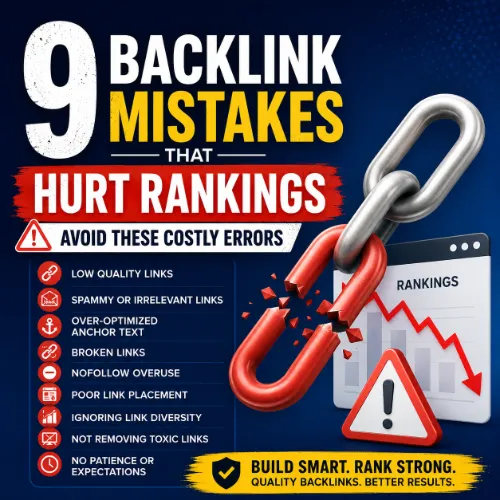
backlink mistakes Key Takeaways
Backlinks remain one of the strongest signals of authority for search engines, but pursuing them without a solid strategy can do more harm than good.
- Buying or exchanging links remains the most dangerous of all backlink mistakes and can lead to Google penalties.
- Ignoring dofollow versus nofollow balance and anchor text diversity weakens your link profile’s natural appearance.
- A regular backlink audit is essential to catch toxic or broken links before they hurt your domain authority.
What Are the Most Common backlink mistakes and Why Do They Matter?
Every SEO professional knows that backlinks are a cornerstone of search rankings. Yet many website owners and marketers still fall into traps that undermine their efforts. Understanding backlink mistakes that hurt rankings is the first step toward a healthy, penalty-proof link profile. Let’s explore each mistake in detail and learn the right way to build links that stand the test of time.
Mistake #1: Buying Links from Low-Quality Sources
Purchasing links from link farms, private blog networks (PBNs), or low-authority directories violates Google’s Webmaster Guidelines. This is arguably the most punitive of all backlink mistakes because it can result in a manual action or algorithmic demotion. Instead of buying, invest in creating content that naturally earns mentions and shares from reputable sites. For a related guide, see 11 SEO Lessons From Websites That Lost Millions of Clicks (Avoid These Mistakes).
Solution: Focus on earning links through guest posting on authoritative domains, creating original research, or building relationships within your niche. Use Google’s Search Console to disavow any suspicious links you may have acquired unknowingly.
Mistake #2: Ignoring Link Relevance
A backlink from a site in an unrelated industry holds far less value than one from a relevant, topical authority. For example, a link to a dental clinic from a car dealership website looks unnatural and provides minimal ranking benefit. Ignoring relevance is one of those backlink mistakes that hurt rankings because search engines consider the context of the linking page.
Solution: Prioritize outreach to websites that cover topics related to yours. Use tools to analyze the topical authority of a prospective domain before pitching your content.
Mistake #3: Overusing Exact-Match Anchor Text
When too many backlinks use the same exact-match anchor text—such as “best running shoes” pointing to a page exactly about that topic—Google may see it as manipulative. This is one of the subtle backlink mistakes that can trigger algorithmic filters like Penguin.
Solution: Diversify your anchor text portfolio. Use branded anchors (e.g., “Nike Running”), generic phrases (e.g., “click here”), natural partial matches (e.g., “top running shoes”), and bare URLs. A healthy ratio mimics organic link growth.
Mistake #4: Building Links Only to the Homepage
Many beginners focus all their link-building efforts on their homepage. While that page matters, internal pages—especially product pages or pillar content—benefit greatly from targeted backlinks. This oversight ranks among backlink mistakes that hurt rankings for your most important content.
Solution: Distribute links across your site. Identify your top-performing or highest-converting pages and build link-worthy assets around them. Use internal linking to pass authority from your homepage to deeper pages.
Mistake #5: Neglecting Nofollow and Dofollow Balance
A link profile made up entirely of dofollow links looks inorganic. Natural profiles include a mix of nofollow links from social media, forums, and some editorial sources. Trying to avoid nofollow links entirely is a common backlink mistakes that can raise red flags. For a related guide, see 12 Local SEO Mistakes to Avoid: Expert Guide for Higher Rankings.
Solution: Accept and even seek out valuable nofollow links from high-traffic sites like Wikipedia or Medium. They still drive referral traffic and brand visibility, and a natural ratio typically includes 30%–50% nofollow links.
Mistake #6: Ignoring Broken or Lost Backlinks
Broken backlinks—links pointing to pages that return 404 errors—waste link equity and frustrate users. Similarly, when a site removes your link, you may lose valuable authority. Failing to monitor these is a quiet but damaging backlink mistakes.
Solution: Use a backlink audit tool to identify broken links on your site. Implement 301 redirects to relevant, live pages. For lost links, reach out to the site owner politely to request reinstatement or offer updated content.
Mistake #7: Not Conducting Regular Link Audits
Backlink profiles change constantly. Toxic links from spammy sites can appear without your knowledge, dragging down your domain authority. Skipping regular audits is one of the most costly backlink mistakes that hurt rankings.
Solution: Schedule a backlink audit every three to six months. Use tools like Google Search Console or Ahrefs to review new and lost links. Disavow any harmful domains immediately.
Mistake #8: Focusing on Quantity Over Quality
In the early days of SEO, more links meant better rankings. Today, a single link from a high-authority site like Forbes or a .edu domain can outperform dozens of low-quality links. Prioritizing volume is still one of the most persistent backlink mistakes among new SEOs.
Solution: Set quality thresholds. Aim for links from domains with a minimum Domain Rating (DR) of 30–40, relevant content, and genuine editorial context. A few strong backlinks will move the needle far more than hundreds of weak ones.
Mistake #9: Failing to Track Link Metrics and Performance
Finally, many website owners build links blindly without measuring their impact on organic traffic, keyword rankings, or conversions. Without data, you cannot refine your strategy. This final item on our list of backlink mistakes that hurt rankings is easily avoided with proper tracking.
Solution: Set up UTM parameters for link-building campaigns. Monitor changes in organic traffic to pages that received new links. Use rank-tracking tools to see if your keyword positions improve after earning a high-authority link.
SEO Entities and Their Functions
Understanding the entities behind link analysis helps you make better decisions:
- Backlink entities: Referring domains, referring pages, anchor text, and dofollow/nofollow status. These reveal how many unique sites link to you and what they say about your content.
- Metrics entities: Domain Rating (DR), URL Rating (UR), and referring domains count. They summarize the authority of a site or page and help you prioritize prospects.
- Link building entities: Link opportunities, broken link prospects, and unlinked mentions. These turn raw data into actionable outreach lists.
- Competitor entities: Competing domains and link intersect domains show where rivals earn links and where you can catch up.
Useful Resources
For deeper reading on avoiding toxic links and building a clean link profile, visit these authoritative sources:
Frequently Asked Questions About backlink mistakes
What is the most common backlink mistake?
The most common mistake is buying links from low-quality sources, which violates Google guidelines and can lead to penalties.
How many backlinks do I need to rank?
There is no magic number. A few high-quality, relevant links often outperform hundreds of low-quality ones.
Can too many backlinks hurt my rankings?
Yes, if they come from spammy sources or use manipulative anchor text, they can trigger a penalty.
What is a backlink audit?
A backlink audit is the process of reviewing all links pointing to your site to identify toxic, broken, or lost links.
How often should I audit my backlinks?
Most experts recommend auditing every three to six months, or after any significant link-building campaign.
What is a nofollow link?
A nofollow link has a rel=”nofollow” attribute telling search engines not to pass authority. They still drive traffic and appear natural.
Should I disavow bad backlinks?
Only disavow links if you have a manual penalty or a large number of toxic links. Otherwise, Google ignores many low-quality links naturally.
What is anchor text diversity?
Anchor text diversity means using a mix of branded, generic, partial-match, and exact-match phrases rather than the same phrase every time.
Does link relevance matter for SEO?
Yes. Links from relevant, authoritative sites carry more weight than links from unrelated niches.
Can I recover from a backlink penalty?
Yes, by identifying and removing toxic links, submitting a reconsideration request (if manual), and building clean links going forward.
What is a toxic backlink?
A toxic backlink comes from a spammy, irrelevant, or low-authority site. It can harm your rankings if present in large numbers.
Are paid backlinks ever safe?
Google explicitly forbids buying links that pass PageRank. Sponsored links with rel=”nofollow” or rel=”sponsored” are acceptable.
What is the difference between dofollow and nofollow?
Dofollow links pass link equity (PageRank), while nofollow links do not. Both are valuable for a natural profile.
How do I find broken backlinks?
Use a backlink checker tool like Ahrefs or SEMrush to filter for broken links. Then set up 301 redirects to relevant pages.
Should I link to other sites from my content?
Yes. Outbound links to authoritative sources can improve your content’s credibility and may encourage reciprocal linking.
What is link intersect analysis?
Link intersect analysis identifies sites that link to multiple competitors but not to you, offering promising outreach targets.
How do I track backlink performance?
Use Google Search Console to monitor new links, and tools like Ahrefs to track changes in referring domains and organic traffic.
What is Domain Rating (DR)?
Domain Rating is an Ahrefs metric that estimates a site’s overall backlink authority on a 0–100 scale.
Can social media links help SEO?
Social media links are typically nofollow, but they drive traffic and brand visibility, which can lead to organic backlinks.
What is the best way to build backlinks in 2025?
Focus on creating high-quality, original content—such as data studies, comprehensive guides, or infographics—that people want to reference and link to naturally.