
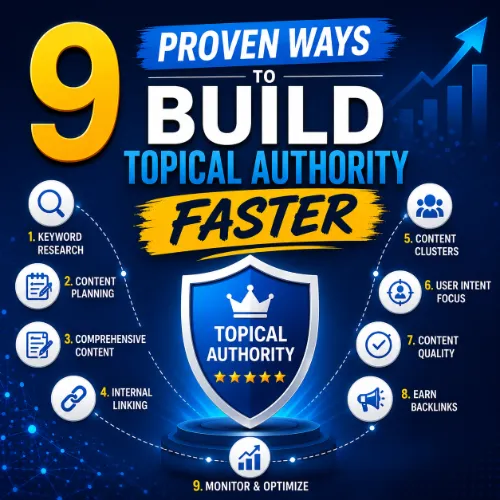
build topical authority faster Key Takeaways
To build topical authority faster , you need a systematic content strategy that moves beyond one-off articles and toward deep, interconnected expertise.
- Focus on topic cluster SEO rather than random keyword targeting to signal expertise.
- Prioritize quality over quantity: one thorough, cited guide outperforms ten thin posts.
- Earn external links and brand mentions to reinforce your authority signal.
Why You Need to Build Topical Authority Faster
Topical authority tells search engines that your site is the go-to resource for a specific subject. When you build topical authority faster, you accelerate organic traffic growth, earn higher click-through rates, and reduce dependency on paid ads. In 2025, Google’s algorithms increasingly reward comprehensive topic coverage and consistent publication across related subtopics.
By building topical authority faster, you position your brand as a trusted expert, which also improves conversion rates because visitors arrive with more trust in your content. The following nine strategies provide a clear roadmap.
1. Start With a Pillar Content Strategy
Topic cluster SEO begins with a single, massive “pillar” page that covers the core subject in-depth. From that pillar, create cluster pages that address specific subtopics, linking back to the pillar. This internal linking structure signals breadth and depth to Google.
Example: A Home Renovation Site
Pillar: “Ultimate Guide to Kitchen Remodeling.” Cluster pages: “Choosing Countertop Materials,” “Cabinet Hardware Trends,” “Budgeting for a Kitchen Renovation.” Each cluster links to the pillar. This approach helps you build topical authority faster because every piece reinforces the same core topic. For a related guide, see 15 Proven Ways to Build Topical Authority: Santollucky 2026 Guide.
2. Map Your Content to Search Intent
Every keyword has an intent: informational, commercial, transactional, or navigational. To build topical authority faster, align each article with what the searcher truly needs. For an informational query like “how to replace a faucet,” provide step-by-step instructions and diagrams. For a commercial query like “best kitchen faucets 2025,” include comparison tables. Matching intent reduces bounce rates and increases dwell time, both signals of authority.
3. Publish Consistently on a Single Topic
Spreading your content across ten unrelated topics dilutes your authority. Instead, concentrate your editorial calendar on one core topic for at least 90 days. Publishing 3–4 articles per week on that topic helps you build topical authority faster than publishing one article per week across ten topics. Use a content calendar tool to track your output and ensure steady momentum.
4. Build Dedicated Topic Clusters
Your pillar page is only the beginning. For topic cluster SEO, you need at least 15–20 cluster pages that each cover a unique subtopic. Link every cluster page to the pillar and to related cluster pages. This internal mesh tells Google that your site deeply understands the subject. It also creates a better user experience because readers can easily navigate between related articles.
Track Cluster Performance
Use Google Search Console to monitor which cluster pages drive impressions and clicks. Expand clusters where you see early traffic; consolidate clusters that underperform. This iterative process helps you build topical authority faster by doubling down on what works.
5. Earn High-Quality Backlinks from Relevant Sites
Backlinks remain a cornerstone of SEO authority strategies. When authoritative sites link to your pillar or cluster pages, they vouch for your expertise. Focus on earning links from sites in your niche, not from generic directories. Tactics include guest posting on relevant blogs, creating linkable assets (infographics, original research), and reaching out to journalists who cover your topic.
One original study or survey can generate dozens of natural backlinks, significantly accelerating your authority-building timeline.
6. Prioritize E-E-A-T Content Signals
Google’s E-E-A-T framework rewards content that demonstrates Experience, Expertise, Authoritativeness, and Trustworthiness. To build topical authority faster:
- Include author bios with credentials and links to their professional profiles.
- Cite authoritative sources, such as academic papers or government data.
- Update content regularly with fresh information and new examples.
- Add a clear publication date and last-updated date.
These signals build trust with both readers and search engines, speeding up authority recognition.
7. Leverage Internal Linking Architecture
A strong internal linking strategy ensures that link equity flows to your most important pages. Link from high-traffic blog posts to newer pillar or cluster pages. Use descriptive anchor text that includes your target keywords. For topic cluster SEO, every cluster page should link to the pillar and to at least two other related cluster pages. This structure reinforces the semantic relationships between topics.
8. Use Structured Data to Enhance SERP Presence
Schema markup helps search engines understand your content’s context. Use FAQ schema, Article schema, and HowTo schema where appropriate. When Google displays rich results — such as featured snippets or People Also Ask boxes — your authority perception increases because users see your content highlighted. This can drive more clicks, which in turn helps you build topical authority faster.
9. Monitor, Analyze, and Iterate
Finally, authority building is not a set-it-and-forget-it process. Use tools like Google Search Console, Ahrefs, or Semrush to track keyword rankings, organic traffic, and backlink growth. Identify which topics are gaining traction and double down on them. Use search volume trends to spot emerging subtopics before competitors do. Continuously expanding your coverage on winning subtopics is the surest way to build topical authority faster.
SEO Entities and Their Functions
Understanding the entities that influence your authority helps you make smarter decisions. Here are the key ones mentioned in this guide:
- Keyword entities: Search volume, keyword difficulty (KD), and traffic potential help you prioritize which subtopics to cover for topic cluster SEO.
- Backlink entities: Referring domains and dofollow vs. nofollow links let you evaluate which backlinks actually pass authority.
- Page entities: Best by links or best by traffic reports show which cluster pages are earning the most authority, guiding your next content moves.
- SERP entities: Featured snippets, People Also Ask, and AI Overviews indicate what format Google rewards for your topic, helping you optimize cluster pages accordingly.
- Technical SEO entities: Crawl issues and indexability status ensure your pillar and cluster pages are actually accessible to search engines.
Useful Resources
- Google’s guide to creating helpful, reliable, people-first content — official documentation on E-E-A-T and content quality signals.
- Ahrefs guide on topic clusters — detailed examples of how to structure pillar and cluster pages for maximum impact.
Frequently Asked Questions About build topical authority faster
What is topical authority in SEO?
Topical authority is the level of expertise a website demonstrates on a specific subject. Google evaluates it through factors like content depth, internal linking, backlinks, and consistency of publication across related subtopics.
How long does it take to build topical authority ?
With consistent effort (3–4 articles per week targeting the same topic), you can begin seeing authority signals within 3–6 months. However, full authority in a competitive niche may take 12–18 months.
What is a topic cluster?
A topic cluster is a content strategy where a central “pillar” page covers a broad topic, and multiple “cluster” pages cover specific subtopics. All cluster pages link back to the pillar, signaling depth to search engines.
Do I need backlinks to build topical authority ?
Not strictly, but backlinks accelerate the process. They act as votes of confidence from other sites, helping Google recognize your content as authoritative faster than relying solely on on-page signals.
Can I build topical authority with only blog posts?
Yes, blogs are the most common format. But you can also use videos, podcasts, infographics, and tools to demonstrate expertise. The key is consistent, high-quality content on one core topic.
Is E-E-A-T the same as topical authority ?
E-E-A-T (Experience, Expertise, Authoritativeness, Trustworthiness) is Google’s framework for evaluating content quality. Topical authority is closely related, as demonstrating E-E-A-T signals contributes to building authority on a topic.
How does internal linking help topical authority ?
Internal linking connects related content, helping search engines see the breadth of your coverage on a topic. It also distributes link equity throughout your site, strengthening the authority of all linked pages.
What is a pillar page?
A pillar page is a comprehensive, long-form article that covers the core subject of a topic cluster. It typically covers the topic broadly and links out to multiple cluster pages for deeper dives.
Should I publish every day to build authority fast?
Consistency matters more than frequency. Publishing quality content 3–4 times per week is more effective than publishing daily low-quality posts. Focus on depth and usefulness over volume.
What is a content cluster vs. a topic cluster?
These terms are used interchangeably. Both refer to a strategy where a central pillar page links to multiple related cluster pages covering subtopics.
Can I build topical authority without a blog?
Yes. Product pages, knowledge bases, video series, and tools can all demonstrate expertise on a topic. The key is publishing thorough, helpful content that covers the subject comprehensively.
How do I choose topics for clusters?
Use keyword research tools to find subtopics with decent search volume but low to moderate competition. Also consider questions your audience asks, which often surface as People Also Ask queries.
Does page speed affect topical authority ?
Indirectly, yes. Core Web Vitals are part of Google’s page experience signals, which influence rankings. A slow site can hurt rankings, making it harder for your authoritative content to be seen.
What is the difference between authority and ranking?
Authority is the overall trust and expertise your site has on a topic. Ranking refers to where your page appears in search results for a specific query. Authority helps you rank across many related queries.
Can I outsource content and still build authority?
Yes, but you need to ensure writers are experts in your niche. Provide detailed briefs, style guides, and editorial oversight. Always include an author bio with credentials when possible.
How do I measure topical authority ?
Track organic traffic growth for your core topic, number of keywords ranking in the top 10, backlink growth from relevant sites, and user engagement metrics like dwell time and pages per session.
Does guest posting help build topical authority ?
Yes, when done on relevant, authoritative sites. Guest posts allow you to earn backlinks, reach new audiences, and position yourself as an expert in the field, all of which accelerate authority building. For a related guide, see 12 Proven Digital PR Ideas for SEO That Build Expert Links.
What is semantic SEO?
Semantic SEO is the practice of optimizing content for topics and meaning, not just keywords. It involves covering related terms, entities, and user intent, which is exactly what topic cluster SEO does.
Should I update old content for authority?
Absolutely. Updating outdated statistics, adding new examples, and improving readability signals to Google that your content stays fresh and relevant. It’s a low-effort way to maintain authority.
Can a single article build topical authority ?
Not alone. Authority requires breadth and depth across multiple related articles. A single great article can start the process, but you need a cluster of content to signal comprehensive expertise.