
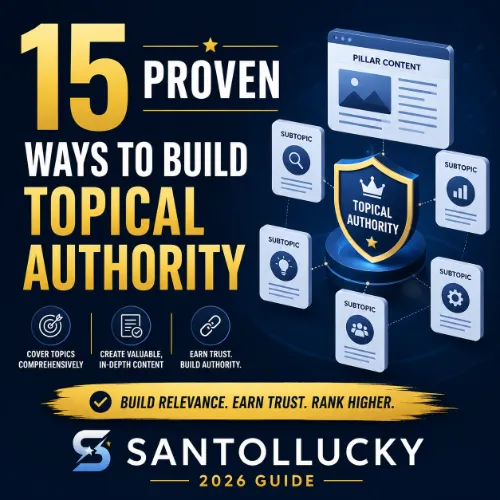
build topical authority Key Takeaways
Write one long-form pillar page on your core topic, then link to 5–10 detailed cluster posts.
- To build topical authority , you need a focused content strategy, not random blog posts.
- A lucky link from a high-authority site works best when your content already proves deep expertise.
- Consistency, depth, and internal linking are the backbone of topical relevance in 2026.
Why You Need to build topical authority in 2026
Search engines are smarter than ever. They don’t just count backlinks—they evaluate whether your site truly owns a topic. When you build topical authority, you signal to Google that you are the most reliable source. That translates to higher rankings, more organic traffic, and, yes, a little luck with link building. For a related guide, see 15 Advanced SEO Strategies Experts Use.
Think of Santollucky 2026: the idea that luck finds those who are prepared. The same is true for SEO. If your content is thorough and trustworthy, the lucky links will come naturally. Below are 15 ways to make that happen.
Our Top 15 Ways to build topical authority
These strategies range from foundation-level site structure to advanced content tactics. Mix and match what fits your niche and resources. For a related guide, see 12 Advanced Internal Linking Strategies for Better SEO.
1. Choose One Core Topic and Own It
Pick a narrow niche that you can cover exhaustively. For example, instead of “digital marketing,” focus on “email marketing for eCommerce startups.” This focus helps you build topical authority
faster.</p> Write one long-form pillar page on your core topic, then link to 5–10 detailed cluster posts. This structure physically demonstrates expertise to both users and search engine crawlers. For a related guide, see 11 SEO Data Points You Must Track for Smarter Decisions. Schedule one high-quality post per week. Consistency signals commitment and helps you build a library of related articles that interlink naturally. Search engines reward freshness. Go back to your top-performing articles every six months and add new data, examples, or insights. This is a simple way to build topical authority without starting from scratch. Every time you publish, link to at least three relevant older posts. Use descriptive anchor text like “improve email open rates” instead of “click here.” This builds a semantic web of expertise. Conduct a survey, analyze data, or publish unique statistics. Original research gets cited more often than opinion pieces. When others link to your data, you build topical authority through genuine citations. Write for established sites in your exact niche. Include one contextual link back to your pillar page. This is still one of the most effective link-building strategies in 2026. Start a newsletter, a private forum, or an active social media group. Engaged followers amplify your content and increase your credibility as an expert. Identify 20–30 common questions your audience asks. Create a dedicated FAQ page or a series of posts answering each one. These often land in featured snippets, which further build topical authority. Match your content format to what users want: listicles for comparisons, guides for how-to, reviews for purchasing decisions. Satisfying intent improves dwell time and reduces bounce rate. Quote or interview recognized authorities in your field. Share the content with them—they may link to it or share it with their audience. This gives you a “luck” boost via association. Add schema markup to your content. FAQ schema, HowTo schema, and Article schema help search engines understand your topic deeply and may increase click-through rates. Tools like Ahrefs show you keywords your competitors rank for but you don’t. Create better content targeting those gaps. This method is a shortcut to build topical authority in areas you are missing. Turn a blog post into a YouTube video, a podcast episode, an infographic, and a LinkedIn carousel. Each format reaches a different audience segment and reinforces your expertise. Every quarter, audit your content to find gaps, thin posts, or outdated articles. Fill those gaps with new, in-depth content. This iterative process ensures you continuously build topical authority. Santollucky 2026 is not about hoping for the best. It is about creating conditions where luck can strike. When you build topical authority, high-authority sites are more likely to notice your content and link to it. That lucky link becomes a natural result of your hard work, not a random event. For example, a site that consistently publishes research-based guides on “email deliverability” will eventually attract links from marketing SaaS companies, newsletters, and even forums. That is the intersection of authority and luck. Understanding key SEO entities helps you make smarter decisions when you build topical authority. Here are a few: To deepen your understanding of topical authority and link building, explore these resources: Remember: luck is not random when you build topical authority. Santollucky 2026 is about preparing your site so deeply that the right people naturally discover and link to your content. Start with one topic, one pillar page, and one cluster post. Then keep building. Good luck! Topical authority refers to a website’s perceived expertise on a specific topic. It is built by creating comprehensive, interconnected content that demonstrates deep knowledge. It varies by niche. With consistent effort (publishing 1–2 quality posts per week), you can start seeing results within 6 to 12 months. Yes, a pillar page acts as a central hub. It organizes your content and helps search engines understand the scope of your expertise. Backlinks accelerate authority, but you can still build topical authority through internal linking, quality content, and user engagement signals. There is no magic number. Aim for at least 20–30 in-depth articles covering all subtopics within your chosen niche. Yes, Google evaluates authority at the domain level. However, strong topical authority on one subtopic can lift other pages on your site. Domain authority is a metric based on link quantity and quality, while topical authority is about content depth and relevance. Yes, but start with a narrow subtopic. For example, if “weight loss” is too competitive, focus on “ketogenic recipes for beginners.” Yes, keeping content fresh shows search engines and users that your information is current and reliable. Internal links connect related posts, creating a semantic structure that signals expertise across your content. Long-form content (1,500+ words) often covers topics more comprehensively, which can help build authority. But quality matters more than length. Select a broad topic that aligns with your business, has sufficient search volume, and can be broken into several subtopics. Indirectly, yes. Social shares can increase visibility and drive traffic, which may lead to backlinks and brand mentions. A content cluster consists of multiple interlinked posts that cover subtopics around a central pillar page. This structure strengthens topical authority. Not necessarily. Free tools like Google Search Console and Google Trends can help. Paid tools like Ahrefs speed up the process. Matching content to search intent (informational, navigational, commercial) improves user satisfaction, which signals relevance and authority to Google. Yes, but it is harder. Each new topic requires dedicated content and links. It is often better to focus on one or two closely related topics. A lucky link is a backlink that appears seemingly by chance—for example, when someone discovers your content and links without you outreaching. Good topical authority increases the odds. Consistency is key. Publishing at least one high-quality post per week is a realistic goal for most businesses. Trying to cover too many unrelated topics at once. Stick to one core topic until you become the recognized expert.2. Create a Pillar Page with Cluster Content
3. Publish Consistently, Not Randomly
4. Update Older Content to Stay Current
5. Use Internal Links That Tell a Story
6. Earn Links with Original Research
7. Guest Post on Relevant Niche Sites
8. Build a Community Around Your Topic
9. Answer Questions in Depth (FAQ Strategy)
10. Optimize for Search Intent, Not Just Keywords
11. Earn Mentions from Industry Experts
12. Use Structured Data for Rich Results
13. Monitor Competitor Content Gaps
14. Repurpose Content Across Formats
15. Track Your Topical Coverage with a Content Audit
How Luck and Link Building Work Together
SEO Entities and Their Functions
Entity Role in Topical Authority Pillar Page Central hub that links to all cluster content on a topic Cluster Content Detailed posts that cover subtopics and link back to the pillar Internal Links Create semantic relationships between content pieces Backlinks External votes of confidence that boost domain authority Useful Resources
Frequently Asked Questions About build topical authority
What is topical authority in SEO?
How long does it take to build topical authority ?
Do I need a pillar page for topical authority ?
Can I build topical authority without backlinks?
How many articles do I need to be a topical authority ?
Does Google evaluate topical authority site-wide?
What is the difference between topical authority and domain authority?
Can I build topical authority in a competitive niche?
Do I need to update old content to maintain topical authority ?
What role does internal linking play in topical authority ?
Are long-form articles better for topical authority ?
How do I choose a topic for my pillar page?
Can social media help build topical authority ?
What is a content cluster?
Do I need expensive tools to build topical authority ?
How does search intent affect topical authority ?
Can one site have multiple topical authority areas?
What is a and quot;lucky link and quot; in SEO?
How often should I publish to build topical authority ?
What is the biggest mistake when building topical authority ?