Google understands entities Key Takeaways
Google’s shift from keywords to entities has transformed how search engines interpret content.
- Google understands entities by mapping relationships in the Knowledge Graph, not just matching keywords.
- Structured data, topical clusters, and link signals help Google recognize your content’s entities.
- Local SEO, brand mentions, and semantic HTML all play a role in how Google recognizes entities on your site.
Why Google Understands Entities Matters for Modern SEO
For years, SEO revolved around keyword density and exact-match phrases. Today, Google’s algorithms focus on entities—concrete things like people, places, products, and concepts—and the relationships between them. When Google understands entities, it can match your content to user intent more accurately, even if the exact keywords don’t appear. This shift rewards websites that build topical authority, use structured data correctly, and earn genuine brand signals. Understanding how Google recognizes entities gives you a competitive edge in 2026. For a related guide, see 10 Hidden Google Ranking Signals You Must Not Ignore in 2026.
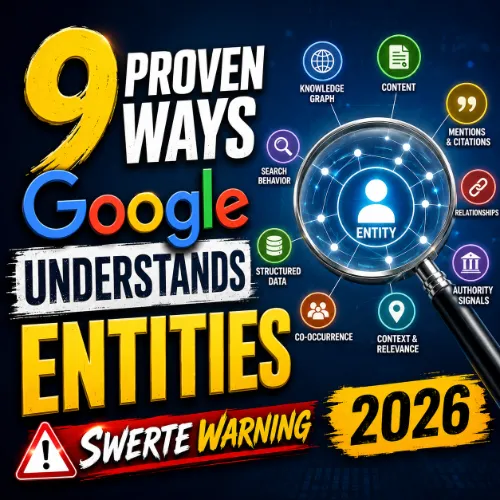
9 Proven Ways Google Understands Entities
1. The Knowledge Graph Connects Entities to Your Content
Google’s Knowledge Graph is a massive database of entities and their interconnections. When you publish content about a specific entity—like a person, brand, or location—Google cross-references it with existing Knowledge Graph entries. For example, if you write about “Leonardo da Vinci,” Google links your page to the entity for the artist, his paintings, and his historical context. To leverage this, ensure your content includes clear entity references and links to authoritative sources like Wikipedia, which Google trusts for entity validation.
Practical takeaway: Add internal links to related entities on your site and external links to well-known entity pages (e.g., Britannica, Wikipedia) to reinforce entity associations.
2. Structured Data Tells Google Exactly What Entities Exist
Schema markup is the most direct way to signal entities. Using schema types like Person, Organization, Product, or LocalBusiness tells Google exactly what each page represents. When you implement JSON-LD structured data, Google can extract entity attributes—like a person’s birth date, a product’s price, or a business’s address—and include them in rich results, Knowledge Panels, and AI Overviews.
Practical takeaway: Use Google’s Structured Data Testing Tool to validate your markup. Focus on schema types that match your core entities, such as Article for news or Recipe for food blogs.
3. Topic Clusters Build Entity Relationships
Google doesn’t see your pages in isolation; it evaluates how they cluster around entities. A topic cluster—a pillar page covering a broad entity along with multiple supporting articles—shows Google that your site is an authority on that subject. For instance, a pillar page about “blockchain” with subpages on “smart contracts,” “cryptocurrency mining,” and “decentralized finance” signals entity depth and connectivity.
Practical takeaway: Create a hub-and-spoke structure. Use your pillar page to introduce the main entity, then link to detailed subtopic pages. Each subtopic page should link back to the pillar.
4. Brand Mentions and Links Establish Entity Authority
When Google finds your brand name mentioned across reputable sites—alongside links—it strengthens the entity identity of your brand. Unlinked brand mentions also count as entity signals, especially when they appear in trustworthy contexts. This is why digital PR and outreach matter for entity-based SEO.
Practical takeaway: Monitor brand mentions using tools like Google Alerts or Ahrefs. Encourage guest posts, interviews, and news coverage that naturally include your brand name.
5. Content Silos Organize Entities for Google’s Crawlers
Creating content silos—groups of interconnected pages around a specific entity—helps Google understand your site’s entity architecture. For example, if you run a travel blog, you might have a silo for “Italy” with subpages on “Rome attractions,” “Tuscany wineries,” and “Italian cuisine.” Each page links to other pages in the silo, reinforcing the entity of “Italy” as a travel destination.
Practical takeaway: Plan your site navigation and internal linking to reflect clear entity silos. Avoid mixing unrelated entities within a single silo.
6. Google’s Natural Language Processing Detects Entity Context
Google uses BERT and MUM models to understand the context around entities. These algorithms analyze surrounding words to differentiate between, say, “Apple” the fruit and “Apple” the company. When you provide clear context—using modifiers, definitions, and related terms—Google can accurately identify which entity you mean.
Practical takeaway: When writing about ambiguous entities, include disambiguating context early in the content. For example, write “Apple Inc., the technology company” instead of just “Apple.”
7. Local Entities Depend on Consistent Citations and Name, Address, Phone (NAP) Data
For local SEO, Google recognizes entities like businesses, landmarks, and neighborhoods. Consistent NAP information across directories, review sites, and your own website tells Google that your business entity is legitimate. Inconsistent data confuses Google and weakens entity signal.
Practical takeaway: Use a tool like Moz Local or Yext to audit your local citations. Ensure your business name, address, and phone number are identical everywhere.
8. Entities Reveal Themselves Through Co-Occurrence Patterns
Google observes which entities often appear together on authoritative pages. For instance, if many high-quality pages about “SEO” also mention “Ahrefs” and “backlinks,” Google builds a relationship between those entities. By including co-occurring entities naturally in your content, you reinforce that your page belongs in the same semantic space.
Practical takeaway: Research entity co-occurrence using tools like LSIGraph or by analyzing top-ranking pages. Include complementary entities in your content without forcing them.
9. User Interaction Signals Validate Entity Relevance
When users click, read, and engage with your content about a specific entity, Google interprets those interactions as validation that your page correctly represents that entity. Metrics like dwell time, click-through rate, and low bounce rate tell Google your entity coverage is accurate and useful.
Practical takeaway: Write genuine, comprehensive content that fully satisfies user intent for the entity. Use clear headings, lists, and media to improve engagement metrics.
SEO Entities and Their Functions
Understanding how Google recognizes entities requires knowledge of the key SEO entities that influence entity signals. Below are the most relevant entity types and how they function in entity-based SEO.
Website / Domain entities: Root domains, subdomains, and URL-level analysis identify whether authority belongs to the whole site, a section like blog.example.com, or a single page. This helps Google attribute entity strength to the correct level.
Keyword entities: Organic keywords, search volume, keyword difficulty (KD), and SERP features show demand and competition for entity-related queries. Targeting entity-specific long-tail keywords often yields stronger entity signals.
Backlink entities: Referring domains, anchor text, and dofollow/nofollow links build entity trust. Links from sites that are themselves strong entity authorities (e.g., Wikipedia, .edu domains) carry more weight.
Content entities: Articles, authors, topics, and publication dates help Google evaluate editorial quality and topical authority. Author entities with established expertise (e.g., a published researcher) boost content credibility.
SERP entities: Featured snippets, People Also Ask, and AI Overviews reveal the content formats Google rewards for entity queries. Creating structured, concise answers increases chances of capturing these features.
Technical SEO entities: Crawl issues, canonicals, Core Web Vitals, and indexability status ensure Google can access and process your entity-rich content. Blocked pages can’t contribute to entity understanding.
Local SEO entities: Country databases, city-specific keywords, and local packs connect campaigns to geography. Consistent NAP data is the foundation for local entity recognition.
Brand / Topic entities: Brand mentions, parent topics, and related terms clarify semantic relationships. A strong brand entity helps Google associate your content with relevant queries.
Useful Resources
Explore these resources to deepen your understanding of how Google processes entities:
- Google’s Structured Data Guidelines — Official documentation on how to markup entities for better search visibility.
- Ahrefs Guide to Entity SEO — In-depth article covering entity relationships, Knowledge Graph, and practical SEO tactics.
Frequently Asked Questions About Google understands entities
What does it mean when Google understands entities?
It means Google recognizes specific objects, concepts, people, or places in your content and connects them to its Knowledge Graph, improving relevance and search accuracy.
How does Google recognize entities without exact keywords?
Google uses natural language processing (NLP) and context clues like synonyms, related terms, and co-occurring entities to identify the intended entity even when keywords differ.
Is structured data required for entity recognition?
Not strictly required, but highly recommended. Structured data provides explicit signals that speed up entity extraction and increase the likelihood of earning rich results.
Can Google understand entities from images and videos?
Yes. Google uses computer vision and speech recognition to identify entities in visual and audio content. Proper alt text, captions, and transcripts help reinforce those entities.
What role does the Knowledge Graph play in entity understanding?
The Knowledge Graph is Google’s database of entities and relationships. When your content matches an existing entity, Google can display rich snippets, Knowledge Panels, and authoritative overviews.
How do internal links help Google recognize entities?
Internal links connect related pages, forming entity clusters that signal depth of coverage. This helps Google understand the scope and authority of your content around a subject.
Do external links to authority sites improve entity signals?
Yes. Linking to authoritative entity sources like Wikipedia or official brand sites helps Google associate your content with trusted entity definitions.
What is an entity cluster in SEO?
An entity cluster is a group of interconnected pages all focusing on the same core entity, such as a pillar page and supporting subtopic articles. It demonstrates topical authority.
How can I make my brand a recognized entity on Google?
Consistent brand mentions, a well-structured website, high-authority backlinks, and presence on trusted platforms like Wikipedia and Crunchbase help establish brand entity status.
Does Google understand entities differently for local search?
Yes. Local entities include businesses, landmarks, and regions. They rely heavily on consistent NAP data, local citations, and Google Business profile signals.
Can thin content hurt entity recognition?
Absolutely. Thin content offers insufficient context for Google to identify entities accurately. Comprehensive, well-researched content yields stronger entity signals.
What is the difference between a keyword and an entity?
A keyword is a search term, while an entity is a distinct object or concept. Google can understand entities from multiple keywords and synonyms, not just exact matches. For a related guide, see How to Find Keywords Using Google Keyword Planner.
How long does it take for Google to recognize new entities?
It varies. If you use clear structured data and link to existing Knowledge Graph entities, recognition can happen within days. Without signals, it may take weeks or months.
Does entity SEO help with voice search?
Yes. Voice search queries often involve natural language around entities. Pages with strong entity signals are more likely to be featured in voice search results.
Can entity understanding lead to featured snippets?
Frequently. Google often pulls featured snippets from pages that clearly define and describe entities. Clear entity-focused Q and A formatting increases your odds.
What tools can help me analyze entity coverage?
Tools like Ahrefs, SEMrush, Google Search Console, and inLinks help you audit entity mentions, gaps, and relationships on your site.
Is entity understanding the same as semantic search?
Related but not identical. Semantic search focuses on meaning and intent, while entity understanding is about recognizing and connecting specific objects within that meaning.
How do co-occurring entities influence rankings?
When your content frequently includes entities that often appear together in authoritative contexts, Google strengthens the topical relevance of your page.
Does Google understand fictional entities like characters?
Yes. Google recognizes fictional entities such as book characters, movie characters, and fictional places, especially if they have dedicated Wikipedia pages or frequent mentions.
What is the biggest mistake SEOs make with entity optimization?
Focusing only on keywords without building an entity-driven content strategy. Entity optimization requires structured data, topical depth, and genuine authority signals.