
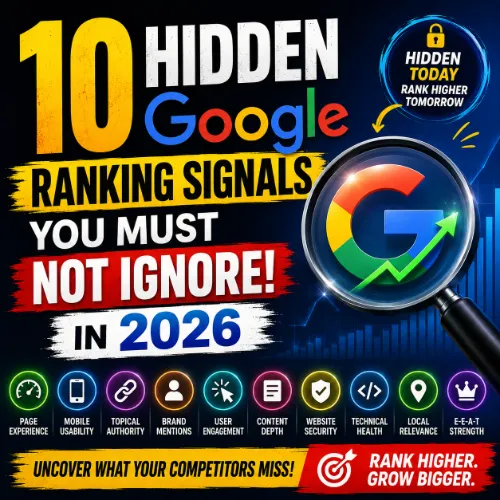
hidden Google ranking signals Key Takeaways
Why it’s hidden: Google doesn’t publish bookmark counts, but Chrome syncs bookmark data with Google’s servers.
- hidden Google ranking signals like Chrome bookmark density and scroll-depth data are real, not myths.
- User engagement metrics (dwell time, bounce rate) now carry more weight than most people realize.
- Simple technical tweaks — such as fixing orphan pages and optimizing internal anchor context — can produce immediate ranking shifts.
Why hidden Google ranking signals Matter More in 2026
Google’s algorithm is no longer a simple keyword-matching machine. It’s a neural network that interprets behavior, context, and intent. While basic ranking factors like title tags and heading structures remain essential, the edge today comes from signals that aren’t listed in any official guide. These uncommon SEO ranking factors often explain why a page with fewer backlinks outranks a content hub with thousands of referring domains. Understanding them lets you optimize with precision rather than guesswork. For a related guide, see 7 Social Signals That Boost Visibility: Proven Warning Signs.
How User Behavior Became a Ranking Input
Google has access to Chrome browser data, Android app usage, and Search interaction logs. It tracks how real people interact with results. Clicks, scrolls, hovers, and even the time between a search and a page close all feed into what Google calls “NavBoost.” Pages that signal high user satisfaction get a subtle but persistent boost. Ignoring these behavioral hidden Google ranking signals means leaving organic traffic on the table.
10 hidden Google ranking signals You Should Audit Today
Below are the 10 signals that fly under the radar. Each one includes a short explanation, why it’s hidden, how it impacts rankings, and a practical tip you can apply immediately.
1. Chrome Bookmark Density
Why it’s hidden: Google doesn’t publish bookmark counts, but Chrome syncs bookmark data with Google’s servers. A high number of bookmarks for a given URL relative to its traffic signals lasting value.
Impact on rankings: Pages with strong bookmark-to-visitor ratios tend to hold top positions longer, especially in “evergreen” niches like finance, health, and reference content.
Practical tip: Add a “Bookmark this page” call-to-action with a simple icon. Track bookmark saves via Google Tag Manager as a custom event.
2. Scroll Depth Percentage
Why it’s hidden: Scroll depth isn’t visible in Google Search Console. You need analytics tools (Google Analytics 4, Hotjar) to measure it, and most SEOs don’t bother. For a related guide, see 10 Google Search Console Reports You Should Use for Smart SEO Wins.
Impact on rankings: Pages where 70%+ of visitors scroll past the fold before bouncing receive a small engagement boost. Google interprets deep scrolling as genuine interest.
Practical tip: Restructure long-form content: add anchor links, a mini-table of contents, and compelling mid-page visuals to encourage continued scrolling.
3. Dwell Time vs. Bounce Rate Ratio
Why it’s hidden: Most SEOs look at bounce rate alone. Google cares more about dwell time — how long a visitor stays before returning to the SERP. A page with a high bounce rate but long dwell time can still rank well.
Impact on rankings: The ratio of dwell time to bounce rate is a stronger engagement signal than either metric alone. A low dwell time with a high bounce rate signals poor content relevance.
Practical tip: Improve your intro paragraph’s hook. Use the “open loop” technique: ask a question or present a surprising statistic that compels the reader to keep reading.
4. Internal Link Anchor Context Diversity
Why it’s hidden: Everyone knows internal links matter, but few analyze whether the anchor text is varied or repetitive. Google penalizes over-optimized internal anchor patterns.
Impact on rankings: Diverse, descriptive anchor text passing through context helps Google understand the target page’s topic without keyword stuffing. It also distributes ranking equity more naturally.
Practical tip: Audit internal links with tools like Ahrefs Site Audit. Avoid using the same anchor text for more than 20% of your internal links to a specific page.
5. Orphan Page Ratio
Why it’s hidden: Orphan pages — pages with no internal links pointing to them — aren’t flagged in standard SEO checklists. Most site crawlers can find them, but SEOs rarely act on them.
Impact on rankings: Orphan pages receive little to no internal ranking equity, making it nearly impossible for them to rank unless they have strong external backlinks. They also waste crawl budget.
Practical tip: Run a crawl with Screaming Frog or Ahrefs. Filter for pages with zero internal inbound links. Either add internal links or redirect them to a relevant parent page.
6. Core Web Vitals Consistency Across Devices
Why it’s hidden: Many SEOs check Core Web Vitals (LCP, CLS, FID/INP) for desktop and mobile separately. The hidden signal is the gap between the two. A massive discrepancy indicates poor responsive optimization.
Impact on rankings: Google evaluates user experience on the device used to search. If mobile LCP is 2 seconds slower than desktop, your mobile rankings suffer disproportionately.
Practical tip: Use Google’s PageSpeed Insights to compare mobile vs. desktop scores. Focus on closing the gap: lazy-load heavy images on mobile, reduce font sizes for smaller viewports, and prioritize critical CSS.
7. Brand Search Volume Correlation
Why it’s hidden: Branded search volume isn’t a direct ranking factor, but the correlation is strong. Google notices when people search for your brand after seeing a non-branded page. It treats that as a trust signal.
Impact on rankings: A steady increase in branded searches (even small) often precedes a rise in non-branded rankings for the same domain. It signals growing authority and recognition.
Practical tip: Set up Google Search Console filters for branded vs. non-branded queries. If branded searches are flat, invest in PR, social mentions, or content syndication that includes your brand name.
8. Social Share Velocity (Not Volume)
Why it’s hidden: Total social shares matter less than how fast they accumulate after publication. A post that gets 500 shares in 24 hours signals freshness and relevance more powerfully than one that gets 5,000 shares over a year.
Impact on rankings: Google’s Freshness algorithm observes social velocity as a proxy for temporal importance. Fast early sharing can amplify a page’s ranking during competitive query windows.
Practical tip: Promote new content aggressively in the first 48 hours: email lists, social pushes, and community posts. Use tools like BuzzSumo to monitor share velocity.
9. YouTube Watch Time on Embedded Videos
Why it’s hidden: Most SEOs embed YouTube videos but don’t track how long viewers actually watch them. Google can correlate watch time on embedded content with page quality.
Impact on rankings: Long watch times (60%+ of video duration) signal that the page provides valuable multimedia content. Short abandonment suggests the video (and possibly the page) is low quality.
Practical tip: Keep embedded videos under 4 minutes, include a compelling thumbnail, and place them near the top of the content. Use YouTube Analytics to see retention rates for each embedded video.
10. Search Snippet Click-Through Rate (CTR) from Organic Results
Why it’s hidden: Google Search Console shows average CTR, but the hidden signal is the CTR for your page relative to its position. A page ranking #3 earning a #1-level CTR sends a strong relevance signal.
Impact on rankings: Google uses CTR as a relevance feedback loop. If searchers click your result disproportionately higher than others at the same position, Google may bump you up.
Practical tip: A/B test title tags and meta descriptions. Use emotional triggers, numbers, and brackets (e.g., “[Study]” or “2026 Guide”) to improve CTR without misleading users.
How to Track These hidden Google ranking signals
Tracking these signals requires tools beyond standard rank trackers. Here’s a quick checklist:
- User engagement: GA4 + Google Tag Manager for scroll depth, dwell time, and bookmark events.
- Internal linking: Ahrefs Site Audit or Screaming Frog to find orphan pages and anchor text patterns.
- Brand awareness: Google Search Console brand query filter plus Google Trends.
- Social velocity: BuzzSumo or native platform insights (Twitter Analytics, LinkedIn Analytics).
- Video performance: YouTube Studio retention reports for embedded content.
SEO Entities and Their Functions
Understanding these entities helps you connect the dots between signals and actionable improvements:
- Website / Domain entities: Root domain and subdomain analysis show whether hidden issues affect the whole site or just a section.
- Keyword entities: Organic keywords with high search volume but low CTR indicate a title tag mismatch. Track keyword difficulty to prioritize low-competition terms.
- Backlink entities: Referring domains and anchor text distributions reveal if your link profile looks natural or over-optimized.
- Page entities: Top pages by traffic vs. top pages by links can expose content that ranks well without many links (a hidden signal in itself).
- Technical SEO entities: Crawl issues, redirect chains, and orphan page counts directly affect how many of these hidden signals Google can even read.
- Engagement entities: Dwell time, scroll depth, and CTR form the behavioral layer that Google increasingly relies on.
Useful Resources
For deeper dives into user engagement and technical audits, these resources are authoritative and regularly updated:
- Google Search Central: Engagement Signals — Official documentation on how user interaction metrics influence rankings.
- Ahrefs: Google Ranking Factors — The Complete List — Data-driven analysis of both common and hidden ranking factors with real-world case studies.
Frequently Asked Questions About hidden Google ranking signals
Final thought: The difference between a good SEO and a great one is the willingness to look beyond the obvious. Start auditing your site for these hidden Google ranking signals this week. Pick just one — orphan pages or scroll depth — and see what changes. You might be surprised how much untapped potential sits in your data.
Frequently Asked Questions About hidden Google ranking signals
What are hidden Google ranking signals ?
Hidden Google ranking signals are non-obvious factors Google uses in its algorithm that most SEOs don’t actively audit, such as scroll depth, brand search correlation, and internal anchor diversity.
Are hidden ranking signals more important than basic SEO factors?
No. Basic factors (content quality, backlinks, site speed) form the foundation. Hidden signals provide the edge when two pages are otherwise equal in quality.
Does Google confirm these hidden signals?
Google rarely confirms specific signals outside of official guidance. But patent filings, statements from Google engineers, and industry experiments strongly support their existence.
How do I measure scroll depth as a ranking signal?
Use Google Tag Manager to set up scroll depth triggers. Send the data to GA4 as an event, then analyze pages with high scroll percentages vs. rankings.
Can dwell time really influence rankings?
Yes. Google’s patent for “user satisfaction signal” describes dwell time as a key metric. Pages with longer average dwell times tend to rank better over time.
What is the bookmark-to-traffic ratio?
It’s the number of Chrome bookmarks for a URL divided by its organic traffic. A high ratio suggests the page is seen as a valuable reference, which Google may reward.
How do I fix orphan pages?
Use a site crawler to find pages with zero internal inbound links. Either add relevant internal links from related content or redirect them to a parent page.
What is internal link anchor context diversity?
It means using varied, descriptive anchor text for links pointing to the same page rather than repeating the same keyword. It helps Google understand the page’s topic naturally.
Does Core Web Vitals inconsistency hurt rankings?
Yes. A big gap between mobile and desktop scores signals poor responsive design, which can lead to lower mobile rankings even if desktop performance is excellent.
How do I increase brand search volume?
Increase brand mentions through content syndication, PR, social media activity, and influencer partnerships. More branded searches correlate with better non-branded rankings.
What tools measure social share velocity?
BuzzSumo, Social Blade, and native platform analytics can track how quickly shares accumulate within the first 24–48 hours after publication.
Does YouTube watch time on embedded videos affect SEO?
Indirectly. Google can correlate watch time with page quality. Videos with high retention signals suggest the page offers valuable multimedia content.
Can I manipulate hidden ranking signals?
You can optimize for them naturally, but gaming them (e.g., fake scroll events) violates Google’s spam policies and can lead to penalties.
What is the best way to improve dwell time?
Write a strong intro that hooks readers, use subheadings to break up text, and include visual assets inline to encourage continued reading.
Do these signals apply to local SEO?
Yes. Many hidden signals (dwell time, scroll depth, brand search correlation) also influence local pack rankings, especially for service-area businesses.
How often should I audit these hidden signals?
Every quarter is a good cadence. User behavior changes over time, and a signal that mattered six months ago may become less relevant.
Are hidden signals the same for every niche?
No. For example, scroll depth matters more for long-form editorial content, while bookmark density is stronger for reference pages like tutorials or glossaries.
What if my hidden signals are strong but my rankings are still low?
Check foundational issues: low-quality backlinks, technical errors, or content that doesn’t match search intent. Hidden signals only amplify good foundations.
Can hidden signals predict a ranking drop?
Often yes. A sudden drop in dwell time or scroll depth can precede a ranking decline by 1–2 weeks, giving you time to intervene.
What is the single most overlooked hidden signal?
Internal link anchor context diversity. Most SEOs focus on external links and ignore how internal anchors shape topic understanding for Google.