
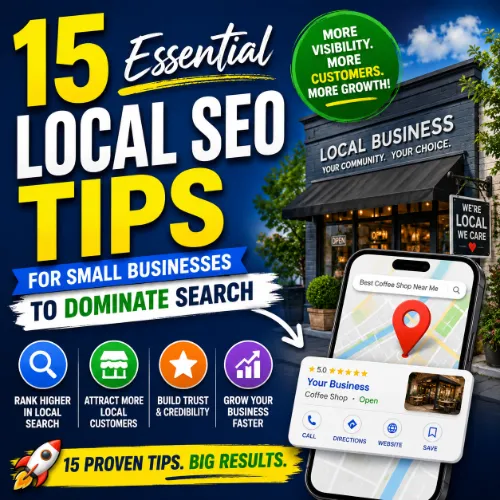
local SEO tips for small businesses Key Takeaways
Local SEO helps small businesses appear in front of nearby customers who are ready to buy.
- Claim and optimize your Google Business Profile with accurate NAP, categories, and photos to rank higher in local packs.
- Encourage customer reviews and respond to every one — reviews are a top ranking factor for local searches.
- Build local citations and backlinks from community sites to strengthen your small business SEO guide foundation.
Why Local SEO Matters for Small Businesses in 2025
When potential customers search for “coffee shop near me” or “best plumber in Austin,” they are showing high purchase intent. If your business does not appear in the local pack or organic results, you are leaving money on the table. Local SEO tips for small businesses are not just about rankings — they are about connecting with your community at the exact moment they need your service.
Unlike broad SEO, local SEO focuses on geographic relevance. Google uses signals like your Google Business Profile (GBP), local citations, reviews, and on-page location signals to determine which businesses to show. The businesses that invest in these local SEO tips for small businesses consistently see higher conversion rates and lower customer acquisition costs.
How to Implement These Local SEO Tips for Small Businesses
Below are 15 actionable tips. Each tip includes a brief explanation and real-world implementation advice so you can start seeing results quickly.
1. Claim and Optimize Your Google Business Profile
Your GBP is the single most important asset for local visibility. Fill out every section: business name, address, phone number (NAP), website, hours, categories, and attributes like “free Wi-Fi” or “wheelchair accessible.”
How to implement: Sign in to Google Business Profile Manager, verify your location, and complete 100% of the profile. Add at least 10 high-quality photos of your storefront, interior, and team.
2. Get Consistent NAP Citations Across the Web
NAP stands for Name, Address, and Phone number. Consistency across directories like Yelp, Bing Places, and Apple Maps signals trust to Google.
How to implement: Use a tool like Moz Local or manually audit your top 10 local directories. Ensure your NAP is identical everywhere — abbreviations like “St.” vs “Street” matter.
3. Encourage and Manage Customer Reviews
Reviews directly influence local pack rankings and buyer trust. A steady stream of positive reviews with keyword-rich responses helps your performance.
How to implement: After a purchase, send a follow-up email with a direct link to leave a review. Respond to every review — thank positive reviewers and professionally address negative ones.
4. Use Local Keywords in Your Website Content
Incorporate city names, neighborhoods, and local landmarks into your page titles, headings, and body text. For example, “best Italian restaurant in North End Boston” outperforms “best Italian restaurant.”
How to implement: Create a separate “Locations” or “Service Area” page listing each area you serve. Use natural language that includes local keywords without keyword stuffing.
5. Build Local Backlinks
Links from local newspapers, community blogs, and chamber of commerce websites boost your domain authority and geographic relevance. For a related guide, see 9 Proven Community SEO Trends in 2026: Smart Strategies to Avoid Risk.
How to implement: Sponsor a local event, join the chamber, or offer a free workshop. These activities often earn a backlink from the organizer’s website.
6. Optimize for Mobile and Voice Search
Most local searches happen on mobile devices, and many are voice-activated. Your site must load fast and be easy to navigate on a small screen.
How to implement: Use Google’s Mobile-Friendly Test. Ensure your contact information is tap-to-call enabled and your menu or service list is easy to read on phones.
7. Create Locally Relevant Content
Blog about local news, events, or customer stories. This signals relevance for local queries and helps you earn featured snippets.
How to implement: Write posts like “Top 5 Things to Do in [City] This Weekend” or “How [Local Business] Helped a Local Nonprofit.”
8. Use Structured Data Markup (Schema)
Local business schema helps search engines understand your address, phone, hours, and reviews. It can enable rich results like star ratings in search snippets.
How to implement: Add LocalBusiness schema to your contact page using JSON-LD. Test with Google’s Rich Results Test tool.
9. Monitor Your Competitors’ Local Strategies
Understanding what local competitors rank for reveals opportunities. Use competitor analysis to find gaps in your own strategy.
How to implement: Search for your main service + city and note which businesses appear in the local pack. Analyze their GBP posts, reviews, and content topics. Fill the gaps.
10. Optimize Your Website’s On-Page Local Signals
Place your NAP in the footer, contact page, and about page. Use title tags that include your city and service.
How to implement: Update your homepage title tag to include your main city and service. Example: “Affordable Plumber | Emergency Service in Denver.”
11. Engage on Social Media Locally
Social signals are not a direct ranking factor, but local engagement increases brand searches and referral traffic, both of which help SEO.
How to implement: Post about local events, tag nearby businesses, and use location-based hashtags on Instagram and Facebook.
12. Collect and Display Customer Testimonials
Testimonials on your website reinforce credibility and can include long-tail local keywords naturally.
How to implement: Dedicate a testimonials page and embed reviews from your GBP onto your homepage using a plugin or widget.
13. Submit to Local Business Directories
Directories like Yelp, Citysearch, and Superpages increase citation volume and improve local pack visibility.
How to implement: Start with the top 5 free directories for your country. For US businesses, that includes Yelp, Yellow Pages, and Manta.
14. Use Google Posts and Updates
Google Posts appear directly in your GBP listing. They can include events, offers, or new products and keep your listing active.
How to implement: Create a new Google Post at least once a week. Include a call-to-action like “Call Now” or “Get Offer.”
15. Track Your Local SEO Performance
Without data, you cannot improve. Track impressions, clicks, and calls from your GBP using Google Business Profile Insights. Also monitor your local organic rankings.
How to implement: Set up a monthly reporting dashboard using Google Data Studio or a simple spreadsheet. Review GBP Insights weekly for changes.
Common Mistakes to Avoid When Applying Local SEO Tips for Small Businesses
Even with the best local SEO tips for small businesses, mistakes can undo your progress. Avoid using fake addresses (virtual offices in a different city), ignoring negative reviews, or keyword stuffing your website. Focus on genuine local relevance and user experience.
Another frequent error is forgetting to update hours during holidays or special events. An outdated listing frustrates customers and can hurt your rankings.
Action Plan: Your Small Business SEO Guide Next Steps
This small business SEO guide is only as valuable as the actions you take. Start with the first three tips this week: claim your GBP, get five new reviews, and add local schema. Within a month, you should see improved visibility in local searches.
Remember, local SEO is an ongoing process — revisit each tip quarterly to stay competitive in your local market.
Useful Resources
Google’s own Google Business Profile Help Center offers official guidance on optimizing your listing.
For a deeper technical dive, see Moz’s guide to local SEO citations to understand citation building best practices.
SEO Entities and Their Functions
Understanding how SEO entities work helps you apply these techniques more effectively. The most relevant ones for local SEO include:
Local SERP packs — These are the map-and-listing boxes that appear for local queries. Optimizing for local packs requires NAP consistency, reviews, and high-quality GBP content.
Keyword difficulty (KD) and search volume — For local keywords, KD is often lower than national terms, making them easier to rank for. Use a keyword research tool to find city-specific keywords with decent volume and low difficulty.
Competing domains and local competitors — Analyzing which businesses rank in your target city reveals content gaps and citation opportunities. Tools like Ahrefs or Semrush can identify which domains link to your competitors but not to you.
Referring domains and broken backlinks — Local backlinks from community sites strengthen your authority. If you find a broken link on a local resource page, you can suggest your content as a replacement.
Brand mentions and unlinked mentions — Mentions of your business name on local blogs without a link are unlinked mentions. Reach out to the site owner to turn them into backlinks.
Frequently Asked Questions About local SEO tips for small businesses
What are local SEO tips for small businesses ?
Local SEO tips for small businesses are actionable strategies to improve a business’s visibility in location-based searches. They focus on Google Business Profile, local citations, reviews, and location-specific content.
How long does it take to see results from local SEO?
Most small businesses see meaningful improvements in local pack rankings within 3 to 6 months of consistent effort, depending on competition and starting point.
Do I need a website for local SEO?
Yes, a website with location-specific content and proper schema markup significantly boosts local search performance compared to relying solely on a Google Business Profile.
Is local SEO worth it for a service-area business?
Absolutely. Service-area businesses like plumbers or landscapers benefit greatly from local SEO because customers search for services near them with high intent to hire.
How many citations do I need for local SEO?
There is no magic number, but 20 to 50 consistent, high-quality citations across relevant directories is a solid target for most local markets.
Can I do local SEO myself or should I hire someone?
Many small business owners start with DIY local SEO using guides like this. If you have the time and desire to learn, it is possible. Hiring an expert is beneficial for competitive markets.
Does local SEO work for online-only businesses?
Local SEO is primarily for businesses with a physical location or service area. Online-only businesses should focus on broader SEO strategies instead.
What is the most important local ranking factor?
Google Business Profile proximity, relevance, and prominence are the three core factors. Reviews and NAP consistency are the most controllable elements.
How do I get more Google reviews?
Ask satisfied customers directly, send a follow-up email with a review link, and consider a review management platform to automate requests.
Should I respond to negative reviews?
Yes, always respond professionally to negative reviews. A thoughtful response shows prospective customers you care about feedback and can mitigate damage.
What is the difference between organic and local SEO?
Organic SEO targets broad search queries globally or nationally. Local SEO optimizes for location-specific queries and relies heavily on Google Business Profile and citations. For a related guide, see 15 Advanced SEO Strategies Experts Use.
Do social media profiles help local SEO?
Indirectly, yes. Social media can increase brand awareness, drive more branded searches, and earn local backlinks, all of which benefit local rankings. For a related guide, see 15 Ways Social Media Helps SEO.
What is a local citation?
A local citation is any online mention of your business’s name, address, and phone number on another website. Listings on directories like Yelp are common examples.
Does Google My Business cost anything?
No, claiming and using Google Business Profile is completely free. Some third-party management tools charge fees for additional features.
Can I have multiple Google Business Profile listings for one business?
Yes, if you have multiple physical locations, each can have its own GBP listing. Service-area businesses can list the areas they serve.
What is the best local SEO tool for small businesses?
Moz Local, Yext, and BrightLocal are popular for citation management. Google Business Profile Insights itself is a powerful free monitoring tool.
How does voice search affect local SEO?
Voice searches are often longer, more conversational, and location-based. Optimizing for question-style phrases (e.g., “where is the nearest…”) helps capture voice traffic.
Should I include my city name in my domain?
It can help, but it is not necessary. A city-specific subdomain (e.g., denver.example.com) or a dedicated city page is often more effective and safer for branding.
What is a local pack in Google search results?
A local pack is a block of three local business listings that appears for location-aware queries. It includes business name, ratings, address, and a map.
How often should I update my Google Business Profile?
Update your profile whenever your hours, contact info, or services change. Posting a weekly Google Post is also recommended for freshness signals.