
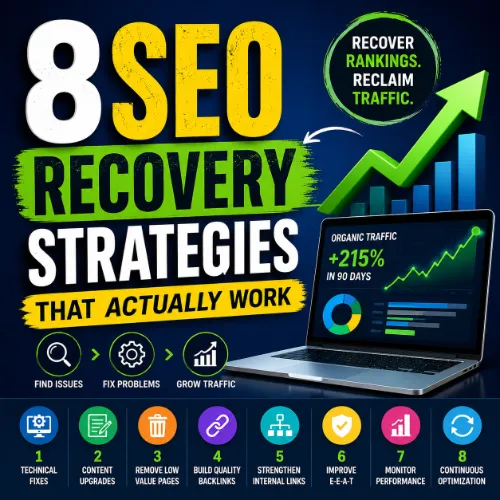
8 SEO Recovery Strategies That Actually Work (With Real Recovery Frameworks)
A sudden drop in organic traffic can be frustrating, but SEO recovery is often possible when you identify the root cause and follow a structured recovery plan.
Whether your rankings declined after a Google Core Update, Helpful Content Update, website migration, technical issue, or backlink loss, the most successful recoveries focus on improving overall website quality rather than chasing shortcuts.
Quick Answer
The most effective SEO recovery strategies are:
- Identify the cause of the traffic loss.
- Fix technical SEO issues.
- Improve content quality and search intent alignment.
- Remove or consolidate low-value content.
- Rebuild authority through quality backlinks.
- Strengthen internal linking.
- Improve E-E-A-T signals.
- Monitor performance and continuously optimize.
Sites that systematically address these areas often recover lost visibility within several weeks to several months, depending on the severity of the issue.
Why SEO Rankings Drop
Before implementing any recovery strategy, it’s important to understand why rankings declined.
Common Causes of SEO Traffic Loss
Google Algorithm Updates
Core Updates, Spam Updates, and Helpful Content Updates can significantly impact rankings.
Technical SEO Problems
Issues such as crawl errors, indexing problems, broken redirects, or slow page speed can reduce visibility.
Content Quality Issues
Thin, outdated, duplicate, or low-value content may struggle to compete in modern search results.
Backlink Loss
Losing authoritative backlinks can weaken a site’s trust and authority signals.
Website Migrations
Improper migrations frequently cause ranking losses due to redirect errors and indexing issues.
Increased Competition
Competitors may have improved their content, authority, or technical SEO.
First Step: Diagnose Before You Fix
Many website owners make the mistake of changing everything at once.
Instead:
- Compare traffic declines against Google update dates.
- Review Google Search Console performance.
- Check recent website changes.
- Audit technical SEO health.
- Evaluate backlink trends.
Accurate diagnosis is the foundation of successful recovery.
Strategy #1: Identify the Root Cause of the Traffic Drop
What to Check
Google Search Console
Review:
- Performance reports
- Coverage reports
- Indexing issues
- Manual actions
- Security issues
Google Analytics 4
Analyze:
- Landing pages that lost traffic
- Conversion declines
- Engagement metrics
- User behavior changes
SEO Tools
Tools such as Ahrefs, Semrush, Screaming Frog, and Sitebulb can help uncover technical and authority-related issues.
Real-World Example
A SaaS company experienced a 35% traffic decline after a website redesign.
The issue wasn’t Google’s algorithm.
The redesign accidentally blocked critical pages through robots.txt, causing deindexation.
Fixing the crawl restrictions restored most rankings within six weeks.
Key Takeaway
Never assume an algorithm update caused your traffic loss until you’ve verified the data.
Strategy #2: Conduct a Comprehensive Technical SEO Audit
Technical issues often create invisible barriers between your content and Google’s crawlers.
Technical SEO Recovery Checklist
Crawlability
Ensure search engines can access important pages.
Check for:
- Robots.txt errors
- Crawl blocks
- Noindex directives
Indexability
Verify critical pages are indexed properly.
Look for:
- Excluded pages
- Canonicalization errors
- Duplicate URLs
Site Performance
Improve:
- Largest Contentful Paint (LCP)
- Interaction to Next Paint (INP)
- Cumulative Layout Shift (CLS)
Mobile Experience
Google uses mobile-first indexing.
Ensure:
- Responsive design
- Fast mobile load times
- Mobile usability compliance
Data Point
Google has repeatedly emphasized page experience and technical accessibility as important factors that help search engines understand and evaluate content effectively.
Recovery Impact
Technical fixes often produce some of the fastest SEO recovery gains because they remove barriers preventing proper crawling and indexing.
Strategy #3: Improve Content Quality and Search Intent Alignment
Modern SEO recovery revolves around content usefulness.
Google’s systems increasingly reward content that demonstrates:
- Experience
- Expertise
- Authoritativeness
- Trustworthiness (E-E-A-T)
Content Improvement Framework
Update Outdated Information
Refresh:
- Statistics
- Research findings
- Screenshots
- Product information
Expand Thin Content
Add:
- Examples
- FAQs
- Expert insights
- Original analysis
Improve Search Intent Match
Ask:
- Does this page answer the searcher’s question?
- Does it solve the user’s problem?
- Is it better than competing pages?
Case Study Example
An affiliate website updated 120 aging articles by:
- Adding expert commentary
- Refreshing data
- Improving internal links
- Expanding FAQs
Within four months, organic traffic increased by approximately 38%.
AI Overview Optimization Tip
Structure content using:
- Question-based headings
- Concise definitions
- Lists
- Step-by-step explanations
This increases the likelihood of appearing in AI-generated summaries.
Strategy #4: Remove, Merge, or Improve Low-Quality Pages
Large websites often accumulate content that no longer provides value.
This can dilute topical authority.
Conduct a Content Audit
Identify pages that:
- Generate little or no traffic
- Have thin content
- Are outdated
- Have overlapping topics
Recovery Options
Improve
Update content that still serves a useful purpose.
Merge
Combine overlapping articles into one comprehensive resource.
Redirect
Redirect obsolete pages to stronger alternatives.
Remove
Delete pages that provide no meaningful value.
Example
Five weak articles about technical SEO audits can often perform better when merged into a single authoritative guide.
Why This Works
Google evaluates websites holistically.
Reducing content bloat often improves overall site quality signals.
Strategy #5: Rebuild Authority Through High-Quality Backlinks
Authority remains an important ranking factor.
If you’ve lost backlinks or competitors have strengthened their link profiles, recovery may require rebuilding authority.
Effective Link Acquisition Methods
Digital PR
Earn mentions from journalists and industry publications.
Original Research
Publish unique studies, surveys, or proprietary data.
Expert Contributions
Provide expert commentary for industry websites.
Resource Pages
Create useful resources worthy of citations.
Avoid These Tactics
- Private Blog Networks (PBNs)
- Paid link schemes
- Spammy guest posting
- Automated link building
Recovery Example
A finance website lost several high-authority backlinks after an industry directory shut down.
Replacing those links through digital PR campaigns restored ranking losses within three months.
Strategy #6: Strengthen Internal Linking Architecture
Internal linking remains one of the most underutilized recovery techniques.
Benefits
Internal links help:
- Distribute authority
- Improve crawl efficiency
- Strengthen topical relevance
- Guide users through content
Internal Linking Best Practices
Link Related Topics
Create logical topic clusters.
Use Descriptive Anchor Text
Help search engines understand page relationships.
Fix Orphan Pages
Ensure every important page receives internal links.
Example Topic Cluster
SEO Recovery Hub
- Technical SEO Recovery
- Content Recovery
- Link Recovery
- Google Update Recovery
- Site Migration Recovery
This structure improves topical authority and semantic relevance.
Strategy #7: Strengthen E-E-A-T Signals
Google’s quality systems increasingly evaluate credibility and trust.
How to Improve E-E-A-T
Showcase Author Expertise
Include:
- Author bios
- Credentials
- Industry experience
Demonstrate Real Experience
Share:
- Case studies
- Testing results
- Practical examples
Cite Reliable Sources
Reference:
- Google Search Central
- Academic research
- Government sources
- Industry studies
Improve Trust Signals
Include:
- Contact information
- Privacy policies
- Editorial guidelines
- Business information
Why This Matters
Sites that demonstrate genuine expertise are more likely to maintain rankings during major algorithm updates.
Strategy #8: Monitor Recovery Progress and Continuously Optimize
SEO recovery is rarely immediate.
Track These Metrics
Organic Traffic
Measure overall visibility trends.
Keyword Rankings
Monitor primary and secondary keywords.
Click-Through Rate (CTR)
Review performance in Search Console.
Indexed Pages
Track indexing growth and losses.
Backlink Acquisition
Monitor authority improvements.
Conversion Metrics
Ensure traffic gains translate into business outcomes.
Recovery Timeline Framework
Month 1
- Identify issues
- Complete technical audit
- Prioritize fixes
Month 2
- Improve content
- Consolidate low-value pages
- Strengthen internal linking
Month 3
- Launch authority-building campaigns
- Monitor recovery indicators
Months 4–6
- Continue content improvements
- Earn backlinks
- Evaluate ranking gains
Important Note
Recovery timelines vary significantly depending on the cause and severity of the traffic loss.
Recovering From Google Core Updates
Many SEO recovery projects involve websites impacted by Google Core Updates.
What Google Recommends
Google generally advises website owners to:
- Focus on content quality
- Demonstrate expertise
- Improve user experience
- Provide original value
What Usually Doesn’t Work
- Massive keyword changes
- Over-optimization
- Artificial link spikes
- Content rewriting without adding value
What Often Works
- Better search intent matching
- Stronger E-E-A-T signals
- Original research
- Improved content depth
Core Update recoveries frequently occur during subsequent updates after meaningful improvements are made.
SEO Recovery Checklist
Week 1
Technical Audit
- Check indexing
- Fix crawl errors
- Review Core Web Vitals
Week 2
Content Audit
- Identify thin content
- Update outdated pages
- Merge duplicates
Week 3
Internal Linking
- Build topic clusters
- Fix orphan pages
Week 4
Authority Building
- Digital PR outreach
- Resource promotion
- Expert contributions
Ongoing
Monitoring
- Rankings
- Traffic
- Conversions
- Indexation
Common SEO Recovery Mistakes
Don’t:
- Panic and change everything at once.
- Delete large amounts of content immediately.
- Buy low-quality backlinks.
- Ignore technical SEO.
- Chase algorithm rumors.
- Focus solely on rankings instead of user satisfaction.
The best recoveries are methodical, data-driven, and user-focused.
Final Thoughts
SEO recovery is not about finding a single magic fix.
The most successful recoveries combine technical improvements, content upgrades, stronger authority signals, strategic internal linking, and enhanced E-E-A-T.
If your website has lost rankings, start by identifying the root cause and then work through a structured recovery plan.
Websites that consistently improve quality, relevance, and user experience often recover stronger than before.
The ultimate goal isn’t simply regaining rankings—it’s building a website that deserves them.
Frequently Asked Questions
1. Can seasonal traffic declines be mistaken for SEO problems?
Yes. Many industries experience predictable fluctuations throughout the year. Before starting an SEO recovery campaign, compare your current traffic against historical year-over-year data to determine whether the decline is seasonal or caused by SEO-related issues.
2. How can I tell if competitors are causing my ranking decline?
Analyze competitor rankings, content updates, backlink growth, and SERP features. If competitors are consistently improving while your site remains unchanged, they may be outperforming you rather than your site being penalized.
3. Does changing website hosting affect SEO performance?
It can. Poor hosting may lead to downtime, slow page speeds, and crawl issues. Upgrading to a reliable hosting provider can improve website performance and support SEO recovery efforts.
4. Can excessive advertisements hurt SEO rankings?
Yes. Aggressive ad placements that interfere with user experience can negatively affect engagement signals and page quality assessments, potentially impacting rankings.
5. Should I update old content or create new content during recovery?
In many cases, updating existing content provides faster results because established pages already have authority, backlinks, and indexing history.
6. Can duplicate content cause a traffic drop?
Duplicate content can confuse search engines about which version to rank. While it rarely triggers penalties, it can dilute ranking signals and reduce visibility.
7. How important are user engagement metrics during SEO recovery?
Metrics such as click-through rate, bounce rate, dwell time, and user interaction can provide insights into content effectiveness and user satisfaction.
8. Can changing URL structures impact rankings?
Yes. Poorly executed URL changes without proper redirects can lead to lost rankings, broken links, and indexing issues.
9. Does website security influence SEO recovery?
Website security contributes to user trust. Sites with malware, security warnings, or HTTPS issues may experience reduced visibility and user confidence.
10. Can AI-generated content hurt SEO recovery efforts?
Not necessarily. AI-generated content can perform well if it is accurate, original, edited by humans, and provides genuine value to users. Low-quality AI content may struggle to rank.
11. What role do featured snippets play in SEO recovery?
Winning featured snippets can help recover lost visibility by increasing exposure and click-through rates, even when traditional rankings remain unchanged.
12. Should I disavow backlinks during SEO recovery?
Only if you identify a substantial number of spammy or unnatural links that may be harming your site’s authority. Most websites do not need frequent disavow actions.
13. Can local SEO issues affect overall website traffic?
Yes. Businesses relying on local search visibility may experience traffic declines due to inaccurate business information, lost reviews, or local ranking changes.
14. How do SERP feature changes impact traffic?
Traffic may decline even if rankings remain stable when Google introduces new SERP features such as AI Overviews, featured snippets, local packs, or video results that alter user behavior.
15. Is recovering from a manual action different from recovering from an algorithm update?
Yes. Manual actions require resolving the specific violation and submitting a reconsideration request, while algorithm-related recoveries usually involve improving site quality and waiting for reevaluation.
16. Can site architecture affect SEO recovery?
A well-organized site structure helps search engines understand content relationships and improves crawl efficiency, which can support recovery efforts.
17. How often should I perform SEO audits during recovery?
Monthly audits are generally recommended during active recovery periods to identify new issues and measure progress.
18. Can social media activity help SEO recovery?
While social signals are not direct ranking factors, increased content visibility, engagement, and brand awareness can indirectly support SEO performance.
19. Does brand reputation influence search visibility?
Strong brand recognition and positive user sentiment can improve trust, increase branded searches, and contribute to long-term SEO success.
20. When should I consider hiring an SEO professional for recovery?
If your website has experienced significant traffic losses, technical complications, manual actions, or repeated recovery failures, consulting an experienced SEO professional can help identify overlooked issues and accelerate recovery.