
Why Is Organic Traffic Dropping? 7 Common Causes and How to Recover Lost Rankings
A drop in organic traffic can be alarming, especially when your website has been consistently generating leads, sales, or readers from search engines. While traffic fluctuations are normal, a sustained decline often indicates an underlying issue that needs attention.
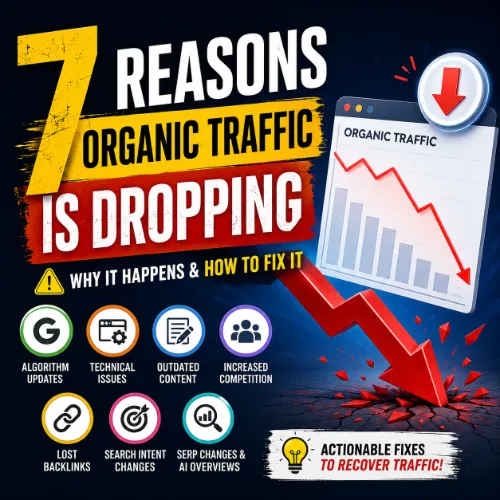
Organic traffic can decrease due to Google algorithm updates, technical SEO problems, content decay, stronger competitors, changing search intent, lost backlinks, or evolving search engine result pages (SERPs). In 2025 and beyond, AI Overviews, featured snippets, local packs, videos, and forum results can also reduce clicks even when rankings remain stable.
This guide explains the seven most common reasons organic traffic is dropping and provides actionable solutions to help you recover visibility and rankings.
Quick Answer: Why Does Organic Traffic Drop?
Organic traffic typically declines because of one or more of the following:
- Google algorithm updates
- Technical SEO issues
- Content becoming outdated
- Increased competition
- Lost backlinks
- Search intent changes
- SERP feature expansion (AI Overviews, snippets, videos, local packs)
The first step is identifying whether the issue affects your entire website or only specific pages.
How to Diagnose an Organic Traffic Drop
Before making changes, determine where the decline is occurring.
Check Google Search Console
Review:
- Total clicks
- Total impressions
- Average CTR
- Average position
Look for pages that experienced the biggest losses.
Analyze Google Analytics
Compare:
- Last 30 days vs previous 30 days
- Year-over-year traffic
- Organic landing pages
- Conversion rates
Identify What Changed
Ask:
- Was there a recent Google update?
- Did the website undergo a redesign?
- Were URLs modified?
- Did competitors publish stronger content?
- Have search results changed?
Once you’ve identified the source, you can begin recovery efforts.
1. Google Algorithm Updates
Google regularly updates its ranking systems to improve search quality.
Major Core Updates can significantly impact websites that lack content quality, expertise signals, or user-focused experiences.
Signs Your Traffic Drop Is Algorithm-Related
- Sudden traffic decline across multiple pages
- Ranking losses sitewide
- No technical issues detected
- Traffic drop aligns with known Google updates
Example
A health website publishing generic content without expert review may lose visibility after a Core Update prioritizing trustworthy medical information.
How to Recover
Improve E-E-A-T Signals
Demonstrate:
- Real experience
- Subject matter expertise
- Author authority
- Trustworthiness
Strengthen Content Quality
Update articles by:
- Adding firsthand insights
- Including expert commentary
- Expanding topical coverage
- Removing thin content
Improve User Experience
Focus on:
- Faster page speed
- Mobile optimization
- Clear navigation
- Helpful content structure
2. Technical SEO Problems
Technical issues can prevent search engines from crawling, indexing, and ranking pages properly.
Common Technical Issues
Accidental Noindex Tags
Developers sometimes leave noindex directives active after site launches.
Robots.txt Blocking Important Pages
Search engines may be unable to access key content.
Broken Redirects
Poor redirects can cause ranking losses after URL changes.
Server Downtime
Frequent outages can reduce crawl efficiency.
Indexing Errors
Pages may disappear from Google’s index entirely.
How to Find Technical Problems
Use:
- Google Search Console
- Screaming Frog
- Site audits
- Log file analysis
Recovery Actions
- Remove accidental noindex tags
- Fix crawl errors
- Correct redirects
- Improve Core Web Vitals
- Resolve server issues
3. Content Decay and Outdated Information
Content often loses rankings as information becomes outdated and competitors publish newer resources.
This phenomenon is known as content decay.
Signs of Content Decay
- Gradual traffic decline
- Reduced impressions
- Lower keyword rankings
- Declining CTR
Example
An SEO guide from 2022 may lose rankings because it doesn’t discuss AI Overviews or recent Google updates.
How to Refresh Content
Update Statistics
Replace outdated data with current figures.
Improve Accuracy
Review recommendations and remove obsolete advice.
Expand Topical Coverage
Answer new questions users are asking.
Add FAQs
Frequently asked questions help capture additional search visibility and support AI-generated answers.
Content Refresh Checklist
| Task | Priority |
|---|---|
| Update statistics | High |
| Add new examples | High |
| Improve internal links | Medium |
| Expand FAQs | High |
| Add expert insights | High |
| Improve readability | Medium |
4. Increased Competition
Your rankings can decline even when your website remains unchanged.
Competitors continuously improve content, build links, and optimize user experience.
Signs Competition Is the Problem
- Rankings slowly decline over several months
- Competitors outrank your key pages
- Search visibility decreases gradually
Competitor Analysis Framework
Review:
Content Depth
Do competitors cover topics more comprehensively?
User Experience
Are their pages easier to navigate?
Backlink Strength
Do they have stronger authority?
Search Intent Alignment
Do they better match user expectations?
Recovery Strategy
- Create more comprehensive content
- Add original research
- Improve user experience
- Strengthen internal linking
- Build authority through quality backlinks
5. Lost Backlinks and Authority
Backlinks remain one of Google’s strongest ranking signals.
When valuable backlinks disappear, rankings often follow.
Common Reasons Backlinks Are Lost
- Referring pages are deleted
- Website redesigns remove links
- Publishers update content
- Domains expire
How to Check Lost Links
Use:
- Ahrefs
- Semrush
- Majestic
- Google Search Console
Recovery Actions
Reclaim Lost Links
Contact website owners when appropriate.
Create Link-Worthy Assets
Examples include:
- Industry studies
- Original research
- Interactive tools
- Data reports
Strengthen Digital PR Efforts
Earn mentions from trusted websites within your industry.
6. Search Intent Changes
Google constantly refines its understanding of user intent.
Content that ranked well last year may no longer match what searchers want today.
Example
A keyword previously dominated by blog articles may now display:
- Product pages
- Videos
- Comparison content
- Local business listings
How to Evaluate Search Intent
Search your target keyword and analyze:
Content Type
- Blog posts
- Product pages
- Videos
- Tools
Content Format
- Lists
- Guides
- Comparisons
- Tutorials
Content Angle
- Beginner-focused
- Expert-focused
- Transactional
- Informational
Recovery Strategy
Align your content with the format Google currently rewards.
7. SERP Changes and AI Overviews
One of the fastest-growing causes of traffic declines is the evolution of search results themselves.
Even if rankings remain stable, users may click less often.
Modern SERP Features Affecting Clicks
AI Overviews
Google may answer questions directly without requiring a click.
Featured Snippets
Answers appear at the top of results.
Video Carousels
YouTube and video content often receive priority visibility.
Local Packs
Local businesses may dominate location-based searches.
Forum Discussions
Reddit and community content frequently appear prominently.
Signs AI Overviews Are Affecting Traffic
- Impressions remain stable
- Rankings remain stable
- CTR declines significantly
How to Optimize for AI Overviews
Use Clear Answers
Answer questions directly within the first paragraph.
Create Question-Based Headings
Examples:
- Why is organic traffic dropping?
- How do I recover lost rankings?
- What causes content decay?
Add Supporting Evidence
Include:
- Examples
- Data
- Expert opinions
Improve Entity Coverage
Cover related topics comprehensively.
Use Structured Content
Employ:
- Bullet points
- Tables
- FAQs
- Definitions
Additional Causes Often Overlooked
Content Cannibalization
Multiple pages targeting the same keyword can compete against each other.
Fix
- Consolidate overlapping content
- Redirect weaker pages
- Strengthen internal linking
Site Migrations
Website redesigns frequently cause traffic losses.
Common Migration Errors
- Broken redirects
- Missing pages
- URL structure changes
- Internal linking issues
Seasonal Search Trends
Not every traffic decline indicates an SEO problem.
Use Google Trends to determine whether search demand has naturally decreased.
Organic Traffic Recovery Framework
If your traffic is dropping, follow this sequence:
Step 1: Verify the Decline
Confirm traffic losses using:
- Google Analytics
- Google Search Console
Step 2: Check Technical Health
Audit:
- Crawlability
- Indexing
- Site speed
- Core Web Vitals
Step 3: Analyze Rankings
Identify which keywords lost visibility.
Step 4: Evaluate Competitors
Compare:
- Content quality
- Authority
- Search intent alignment
Step 5: Refresh Content
Update outdated pages and improve topical depth.
Step 6: Strengthen Authority
Recover lost backlinks and earn new mentions.
Step 7: Optimize for Modern SERPs
Structure content to compete for:
- AI Overviews
- Featured snippets
- Video results
- FAQ visibility
Frequently Asked Questions
Additional FAQs About Organic Traffic Drops
1. Can website redesigns cause organic traffic to drop?
Yes. Website redesigns can negatively impact SEO if URLs change, redirects are missing, internal links break, or important content is removed during the redesign process.
2. Does slow website speed affect organic traffic?
Absolutely. Slow-loading pages can increase bounce rates, reduce user satisfaction, and negatively impact rankings, especially since page experience remains an important ranking factor.
3. Can duplicate content reduce organic traffic?
Duplicate or highly similar content can confuse search engines about which page to rank, potentially diluting rankings and reducing overall organic visibility.
4. How often should I monitor my organic traffic?
Most websites should review organic traffic weekly and conduct a deeper SEO performance analysis monthly to identify trends and address issues before they become significant.
5. Can changing URL structures hurt SEO performance?
Yes. Changing URLs without implementing proper 301 redirects can result in lost rankings, broken backlinks, and significant organic traffic declines.
6. Do Core Web Vitals impact organic traffic?
Core Web Vitals contribute to page experience signals. Poor scores may not cause dramatic ranking losses alone, but improving them can support stronger overall SEO performance.
7. Can deleting old content cause traffic losses?
It can. If deleted pages have backlinks, rankings, or organic traffic, removing them without proper redirects may result in lost visibility and authority.
8. Why does organic traffic fluctuate from day to day?
Daily fluctuations are normal due to algorithm testing, user behavior changes, competitor activity, seasonality, and search demand variations.
9. Can poor mobile optimization reduce organic traffic?
Yes. Since Google primarily uses mobile-first indexing, websites that perform poorly on mobile devices may experience ranking and traffic declines.
10. How do broken internal links affect SEO?
Broken internal links create poor user experiences and make it harder for search engines to discover and crawl important pages.
11. Can a drop in branded searches affect organic traffic?
Yes. Reduced brand awareness, lower marketing activity, or changes in consumer behavior can lead to fewer branded searches and lower organic traffic.
12. Does user engagement influence organic rankings?
While Google does not directly use metrics like bounce rate as ranking factors, poor user engagement can indicate content quality issues that indirectly affect performance.
13. Can changing page titles impact traffic?
Yes. Modifying title tags can improve or reduce click-through rates depending on how well they match search intent and attract users in search results.
14. What role does crawl budget play in organic traffic?
For large websites, inefficient crawl budget usage can prevent important pages from being discovered or updated in search engine indexes.
15. Can excessive ads hurt organic traffic?
Too many intrusive ads can negatively affect user experience, increase bounce rates, and potentially impact search visibility.
16. Why do some pages lose traffic while others remain stable?
Individual pages may be affected differently due to varying competition levels, search intent changes, content quality, backlink profiles, or SERP feature changes.
17. Can international SEO issues reduce organic traffic?
Yes. Incorrect hreflang implementation, duplicate regional pages, or poor localization can prevent search engines from serving the correct content to users.
18. How important is topical authority for maintaining traffic?
Topical authority helps search engines recognize your website as a trusted resource on a subject, making rankings more resilient against competitors.
19. Can low-quality backlinks cause traffic declines?
A poor backlink profile can limit ranking growth and, in some cases, contribute to algorithmic trust issues if the links appear manipulative or spammy.
20. What is the fastest way to identify the cause of a traffic drop?
The fastest approach is combining Google Search Console data, analytics reports, technical SEO audits, competitor analysis, and recent algorithm update reviews to pinpoint the source of the decline.
Final Thoughts
Organic traffic rarely drops without a reason. The challenge is identifying whether the cause is technical, competitive, algorithmic, or related to changing search behavior.
In today’s search landscape, ranking well is no longer enough. AI Overviews, featured snippets, video results, and evolving user expectations mean websites must provide comprehensive, trustworthy, and user-focused content to maintain visibility.
By regularly auditing your site, refreshing content, monitoring competitors, and adapting to modern search features, you can recover lost rankings and build sustainable organic traffic growth over time.