
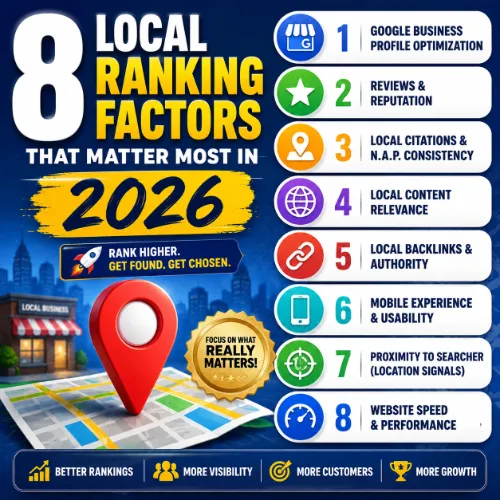
local ranking factors Key Takeaways
Your business’s visibility in local search results depends on a specific set of ranking signals.
- The most critical local ranking factors include Google Business Profile optimization, review signals, and local link relevance.
- On-page signals like NAP consistency and localized content directly impact your local search performance.
- Off-page factors such as structured citations and local backlinks build the authority needed to outrank competitors in your service area.
Why Understanding local ranking factors Is Essential for Your Business
Local search has become the primary way customers discover nearby services and products. When someone searches for a plumber, a bakery, or a law firm near them, Google uses a sophisticated algorithm to surface the most relevant and trustworthy local businesses. If you don’t understand the local ranking factors that power this algorithm, you’re leaving visibility on the table. Mastering these signals helps you capture the attention of high-intent local customers ready to buy.
The Shift from General to Hyperlocal Search
In recent years, Google has prioritized proximity and intent more than ever. Searches with phrases like “near me” or “best coffee shop in Austin” now trigger localized results that prioritize businesses near the searcher. The local SEO ranking factors that drive these results are not just about being close; they involve trust signals, relevance, and prominence both online and offline. Understanding this shift helps you allocate resources effectively: a beautiful website won’t matter if your Google Business Profile is incomplete or your citations are inconsistent.
How to Optimize for Core local SEO ranking factors
To rank higher in the local pack and organic results, you need to work across several interconnected areas. Below are the eight most impactful local ranking factors you should prioritize in 2025, with actionable tips for each.
1. Google Business Profile (GBP) Optimization
Your GBP is the single most influential factor for local pack rankings. Google pulls information like your address, phone number, hours, and customer reviews directly from this profile. Ensure every field is complete: business name, address (exact physical location, not a P.O. box), phone number, website URL, business category, and attributes. Add high-quality photos regularly—businesses with photos receive 42% more requests for directions and 35% more click-throughs to their websites. Keep your profile active by posting updates, offers, and events. Inconsistent or outdated GBP data is one of the biggest local ranking factors mistakes you can make.
2. Consistent NAP (Name, Address, Phone) Across the Web
Google uses NAP consistency as a trust signal. If your business phone number appears as “555-0123” on your website but “555-0124” on Yelp, the algorithm gets confused about which information to trust. Use a local SEO audit tool to scan for inconsistencies across major directories like Yelp, Yellow Pages, Facebook, and industry-specific citation sites. Even small variations like “Suite 100” versus “Ste. 100” can dilute your local authority. This foundational aspect of local ranking factors costs almost nothing to fix but has a massive impact.
3. High-Quality and Relevant Online Reviews
Reviews are a direct ranking signal for local packs and a powerful trust factor for potential customers. Google considers the quantity, recency, and sentiment of your reviews. A steady stream of recent positive reviews signals that you are an active and reliable business. Respond to every review—positive ones to say thank you and negative ones to demonstrate your commitment to customer satisfaction. Politely ask happy customers to leave a review on Google, and make it easy with a direct link. Avoid fake reviews at all costs; Google’s algorithm is sophisticated enough to detect manipulation, and penalties can be severe.
4. Localized Content on Your Website
Your website needs to speak directly to the community you serve. Create pages that reference local landmarks, events, neighborhoods, or regional problems. For example, a roofing contractor in Phoenix might write a blog post about “Choosing Heat-Reflective Roofing for Phoenix Summers.” This type of content signals to Google that your business is locally relevant and authoritative for that geography. On-page local ranking factors also mean including your city and state in title tags, meta descriptions, and heading structures naturally, without keyword stuffing. For a related guide, see 9 Key Factors That Affect Your Website’s SEO Performance (Essential Checklist).
5. Local Link Building and Citations
Backlinks from other local businesses, community organizations, and news outlets carry immense weight. A link from a local chamber of commerce, a sponsor page for a charity run, or a mention in a neighborhood blog tells Google that you are a legitimate part of the community. Focus on earning link opportunities that come from local relevance, not just high domain rating. Similarly, citations (mentions of your business on other websites without necessarily linking) are fundamental local SEO ranking factors. Being listed in reputable local directories like Better Business Bureau, local newspapers, and industry-specific sites builds your digital footprint. For a related guide, see 7 Smart AI Hyperlocal Marketing Strategies to Boost Local Sales.
6. On-Page SEO Signals: Schema Markup and Keyword Usage
Adding LocalBusiness schema markup to your website helps search engines understand your business type, address, hours, and geo-coordinates directly. This structured data can help you qualify for rich results including the local pack and knowledge panel. Additionally, use location-specific keywords throughout your page copy—like “plumbing repair in Denver”—but write for humans first. A page designed solely for the algorithm will lack the natural readability that keeps users engaged. Balancing keyword inclusion with user experience is a cornerstone of effective local ranking factors.
7. Mobile Friendliness and Page Speed
Most local searches happen on mobile devices. If your website takes more than three seconds to load or is hard to navigate on a smartphone, potential customers bounce to a competitor. Google has confirmed that Core Web Vitals (loading speed, interactivity, and visual stability) are local ranking factors for mobile searches. Run your site through Google’s PageSpeed Insights and prioritize fixing issues like large images, unoptimized code, and server response time. A fast, mobile-friendly experience not only improves rankings but also increases conversion rates. For a related guide, see 5 Essential Core Web Vitals Explained: Avoid Costly Ranking Mistakes.
8. Behavioral Signals: Click-Through Rate and Engagement
Google interprets how users interact with your listing and website as a signal of relevance. A high click-through rate (CTR) from the search results indicates that your listing matches what the searcher wants. Similarly, if users visit your site and stay for a while or take an action (like clicking to call), that engagement boosts your local authority. Encourage clicks by having a compelling GBP description and a clear website URL. Make your call-to-action buttons prominent so that once users land on your site, they are guided to convert. These behavioral metrics are increasingly important among local ranking factors because they reveal true user satisfaction.
Optimization Tips Beyond the Basics
Once you’ve addressed the foundational eight local ranking factors, consider advanced tactics to gain a competitive edge. Monitor your Google Business Profile Insights regularly to see how customers are finding your listing and what actions they take. Compile a list of your top local competitors and analyze their backlink profiles using SEO tools to discover link opportunities you might be missing. Keep your local citations updated quarterly—businesses change addresses, phone numbers, or hours surprisingly often. Finally, experiment with local advertisements (Google Local Services Ads) to complement your organic efforts. These ads sit above the local pack and can drive immediate leads while your organic strategies build long-term authority.
SEO Entities and Their Functions
Understanding the specific entities that influence local search can help you make smarter optimization decisions. Here is a breakdown of key entities relevant to local ranking factors:
- Local SERP Packs: The map-and-listings block that appears for local queries. Winning a spot here requires strong GBP optimization and review signals.
- City-Specific Keywords: Search queries that include a city or region name. Tracking these reveals local demand and helps you prioritize content topics.
- Google Business Profile (GBP): The primary entity for local visibility. Includes business name, category, hours, reviews, photos, and posts.
- Referring Domains for Local Links: The number of unique websites linking to your domain. Local referring domains (from .edu, .gov, or local .org sites) carry disproportionate weight.
- Local Keyword Difficulty (KD): A metric that estimates how hard it is to rank for a local keyword. Low-competition local terms often offer quick wins.
- Citation Consistency Signals: Structured data from directories that confirm your NAP details. Inconsistencies create ranking drag across the local algorithm.
- Market Velocity: The combined rate at which your business gets new reviews, citations, and local links. A steady velocity signals freshness and activity to Google.
Useful Resources
For deeper insights into local SEO, explore the comprehensive guides from industry leaders:
- Read Moz’s 2023 Local Search Ranking Factors Survey for peer-reviewed insights on what matters most to local SEO practitioners.
- Check out Google’s official Business Profile help center for step-by-step optimization guidance directly from the source.
Frequently Asked Questions About local ranking factors
What are the most important local ranking factors in 2025?
The most important local ranking factors currently include Google Business Profile completeness and accuracy, online review volume and sentiment, consistency of Name/Address/Phone across the web, localized website content, and local backlink profiles. Mobile-friendliness and page speed also play critical roles for local mobile searches.
How is local SEO different from traditional SEO?
Traditional SEO focuses on ranking for broad keywords globally or nationally, while local SEO targets geographically specific queries. Local SEO ranking factors emphasize proximity, Google Business Profile signals, local citations, and reviews, which are less important for non-local searches.
Does Google use my business address as a ranking factor?
Yes, proximity is one of the core local ranking factors. The closer your business is to the searcher, the more likely you are to appear in the local pack. However, relevance and prominence can sometimes override strict proximity for highly relevant or well-reviewed businesses.
How many reviews do I need to rank locally?
There is no magic number, but businesses with a steady flow of fresh, positive reviews tend to rank better. As part of local ranking factors, Google values both quantity and recency. Aim for at least 25–50 reviews to establish credibility, and keep earning them consistently throughout the year.
Can I rank without a physical address?
Yes, if you operate a service-area business (like a plumber or dog walker), you can hide your address on Google Business Profile while still showing your service area. This is a valid approach within local SEO ranking factors, though you’ll need strong reviews and local content to compensate for the lack of a fixed location.
Does my website domain authority affect local rankings?
Domain authority does play a role in organic local results, but the local pack prioritizes proximity, reviews, and GBP signals. A newer website with excellent GBP optimization and local citations can sometimes outrank a high-authority site with poor local signals. Both matter among local ranking factors.
How often should I update my Google Business Profile?
At minimum, keep your hours accurate and respond to reviews weekly. Post updates (offers, events, photos) at least once a week. Regular activity signals engagement and is considered a positive local ranking factor in most studies.
What is a citation and why does it matter?
A citation is any online mention of your business’s Name, Address, and Phone number. Consistent citations across directories like Yelp, Yellow Pages, and industry-specific sites are foundational local SEO ranking factors that build trust and visibility.
Should I include my city in every page title?
Only where it feels natural and serves the user. Including location in service pages and blog posts is helpful, but avoid keyword stuffing. Google can understand relevance through context and schema markup, not just keyword repetition. Moderation is key for local ranking factors.
How long does it take to improve local rankings?
Improvements can take anywhere from a few weeks to several months. Optimizing your GBP can yield quick wins within 2–4 weeks, while building local backlinks and earning reviews takes 3–6 months. Patience and consistency are essential when working on local ranking factors.
Does link building still matter for local SEO?
Absolutely. Local backlinks from community organizations, chambers of commerce, and local news sites remain powerful local ranking factors. They signal relevance and authority within your geographic area.
Can duplicate listings hurt my rankings?
Yes, duplicate Google Business Profile listings confuse the algorithm and spread your review and citation signals thin. This can negatively impact your local ranking factors. Claim and remove any duplicate profiles through Google’s support tools.
What role does mobile-friendliness play in local search?
Since most local searches happen on smartphones, mobile optimization is a top local ranking factor. Google uses mobile-first indexing, meaning it evaluates your site’s mobile version first. A fast, responsive site is critical.
Are social media signals local ranking factors ?
Social signals (likes, shares, follows) are not direct ranking factors, but an active social presence can drive brand awareness and lead to more citations and reviews. These indirect effects support your overall local SEO ranking factors.
How do I find the right keywords for local SEO?
Use keyword research tools and filter by location. Look for city-specific terms like “coffee shop in Seattle” and long-tail variations like “best cold brew near Capitol Hill.” These local keywords are the foundation of your on-page local ranking factors strategy.
What is the local pack and how do I get in it?
The local pack is the map-and-listing block at the top of SERPs for local queries. To get in, you need a well-optimized Google Business Profile, strong reviews, consistent NAP data, and a website with locally relevant content. These are the core local ranking factors for pack inclusion.
Does negative feedback hurt my local ranking?
One or two negative reviews won’t ruin your rankings, but a pattern of recent negative sentiment can lower your overall review score, which is a local ranking factor. Respond professionally to negative reviews to show you care about feedback.
Can I target multiple cities with one listing?
Yes, if you have a service-area business that covers multiple cities. On your Google Business Profile, list all service areas (within a reasonable range). Create separate landing pages for each city on your website. This is a legitimate approach within local SEO ranking factors.
Is it worth using a local SEO agency?
If you lack the time or expertise to manage GBP, citations, and local content, an agency can add value. Look for one that focuses on organic local ranking factors and provides transparent reporting—avoid those promising guaranteed instant results.
How frequently should I check my local search rankings?
Check your rankings monthly to spot trends, but avoid obsessing over daily fluctuations. Monitor your Google Business Profile Insights weekly for actions (calls, direction requests, website clicks) rather than exact positions. Consistent focus on local ranking factors leads to steady improvement over time.