semantic search trends 2026 Key Takeaways
The shift from exact-match keywords to user intent, entity understanding, and conversational queries is accelerating.
- Google’s AI models now interpret meaning over literal keyword repetition, making semantic search trends 2026 a must-know for ranking stability.
- Entity-based optimization and E-E-A-T signals are becoming as important as backlinks.
- Voice search, helpful content updates, and knowledge graph integration are reshaping how content earns visibility.
Why semantic search trends 2026 Matters for Your SEO Strategy
For years, SEOs focused on keyword density and exact-match phrases. That era is fading. Search engines now parse the meaning behind queries, the relationships between entities, and the context of the searcher’s journey. If you ignore these shifts, your rankings will slide even if your content is technically perfect.
Understanding semantic search trends 2026 helps you create content that aligns with how Google’s AI — like the Helpful Content System and RankBrain — actually evaluates relevance. Instead of guessing which keyword variant to use, you build topic clusters that answer real user questions.
What Semantic Search Actually Means for SEOs
Semantic search refers to the ability of search engines to understand the searcher’s intent and the contextual meaning of terms. For example, searching for “apple” might mean the fruit or the tech company. Google decides based on your recent searches, location, and the words around the query. In 2026, this understanding extends to whole passages, image captions, and even video transcripts.
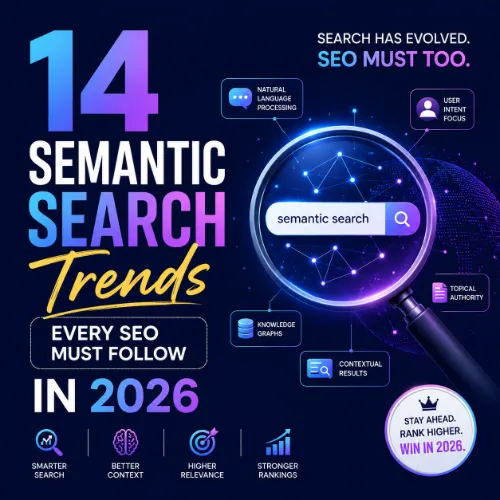
The 14 Semantic Search Trends 2026 That Will Define Success
1. Entity-First Optimization Becomes Standard
Rather than optimizing for keywords alone, you’ll need to define and connect entities — people, places, things, and concepts — within your content. Tools like Ahrefs’ Content Explorer can help you see which entities top-ranking pages mention. For each article, list three to five core entities and weave them naturally into paragraphs, headings, and image alt text.
2. Helpful Content System Rewards Topical Depth
Google’s Helpful Content System now flags thin, repetitive content even if it matches keywords. To satisfy this trend, publish comprehensive guides that cover subtopics, include original research, and link to authoritative sources. A site audit using Ahrefs’ Site Audit tool can reveal pages with low word counts or high bounce rates that may need restructuring. For a related guide, see 10 Hidden Google Ranking Signals You Must Not Ignore in 2026.
3. Knowledge Graph Integration Drives Visibility
When Google understands your content entities, it may display them in the Knowledge Graph — the panel that appears on right side of results. To increase your chances, apply structured data (Schema.org markup) for Organization, Person, Article, and FAQ. Use Ahrefs’ Webmaster Tools to check for schema errors.
4. Conversational and Voice Search Queries Grow
By 2026, more than half of searches will be voice-activated. These queries are longer, more natural, and often question-based. Optimize for phrases like “how to fix a leaky faucet” instead of “leaky faucet fix.” Build FAQ sections with real spoken-language questions.
5. Passage Indexing Changes On-Page Strategy
Google can now index individual passages from your page, not just the whole page. This means even a well-written paragraph buried deep in your article can rank for a specific query. Use descriptive subheadings (H2 and H3) that clearly summarize the passage topic.
6. Topic Clusters Outperform Single Pages
Linking related articles around a central pillar page signals to Google that you have authority on a subject. For example, a pillar page about “content marketing” can link to clusters about “keyword research,” “link building,” and “social media promotion.” This internal linking structure is one of the most effective semantic search trends 2026 tactics. For a related guide, see 7 Best AI Keyword Research Tools to Unlock Smart SEO.
7. E-E-A-T Becomes a Ranking Factor for All Niches
Experience, Expertise, Authoritativeness, and Trustworthiness now affect even non-YMYL sites. Show expertise by adding author bios, citing credible sources, and linking to reputable external references like Google Search Central or academic studies. For a related guide, see 12 Advanced Internal Linking Strategies for Better SEO.
8. Multimodal Search Unifies Text, Image, and Video
Google Lens, video carousels, and image results are all part of semantic understanding. For each piece of content, include relevant images with descriptive alt text and structured captions. Use Ahrefs’ Site Explorer to review which images drive traffic from Google Images.
9. Search Intent Categories
Classifying queries into informational, navigational, commercial, and transactional intent is no longer optional. Match content format to intent: informational queries earn guides; commercial queries need product comparisons. Ahrefs’ Keywords Explorer shows you the typical intent for any keyword.
10. People Also Ask Expands Content Opportunities
The “People Also Ask” box drives significant zero-click traffic. Identify PAA questions for your target keywords, then answer each one concisely in your content. Structure answers as clear paragraphs, not bullet lists, because Google pulls snippets from well-formed prose.
11. AI-Powered Summarization Changes Featured Snippets
Google’s AI now summarizes answers directly in search results. To win these snippets, use direct, factual language and place answers early in the content — ideally within the first 200 words. Use Ahrefs’ Content Gap analysis to find snippet opportunities your competitors already capture.
12. Core Web Vitals Integration with Semantic Relevance
Page experience signals (LCP, FID, CLS) now work in tandem with semantic relevance. Even the most semantically rich content won’t rank well if it loads slowly on mobile. Run a Core Web Vitals report in Ahrefs’ Site Audit to identify problem pages.
13. Local Search and Semantic Understanding Merge
For local businesses, semantic search interprets “near me” as a contextual signal tied to location history and device data. Optimize Google Business Profile, use local structured data, and include city-specific entities in your content. Ahrefs’ Country database helps you target location-specific keywords.
14. Data-Driven Content Strategy Replaces Guesswork
Finally, 2026’s semantic search trends 2026 demand data-backed decisions. Use Ahrefs’ Top Pages report to see which content earns the most traffic, then replicate its structure and entity coverage for new pieces. Track keyword movement for your focus term using Rank Tracker.
How to Audit Your Current Content for semantic search trends 2026
Performing a semantic search trends 2026 audit doesn’t require complicated tools. Follow these steps:
- Identify core entities: For your top 10 pages, list the main people, products, concepts, or locations. Check if those entities appear in headings, first paragraphs, and image alt text.
- Check content depth: Use Ahrefs’ Content Gap to see what questions related to your topic remain unanswered. Add those answers in a dedicated FAQ or expanding section.
- Review internal linking: Ensure each page links to at least two related cluster pages. This signals topic authority to Google.
- Test passage clarity: Ask someone unfamiliar with the topic to read a single H3 section. Can they understand the point without reading the whole article? If not, rewrite that passage.
Useful Resources
For deeper understanding of semantic search principles, refer to these credible sources:
- Google Search: How Search Works — Google Developers
- Ahrefs: What is Semantic Search and Why It Matters for SEO
SEO Entities and Their Functions
When auditing your site for semantic search trends 2026, several Ahrefs entities help you make data-informed decisions:
- Website / Domain entities: Root domain and subdomain analysis in Site Explorer reveal whether authority comes from the whole site or a specific section (e.g., blog.example.com). This guides internal linking strategy.
- Keyword entities: Keyword Difficulty (KD) and search volume from Keywords Explorer help you balance opportunity with effort. Pair high-volume terms with low KD topics to gain quick wins.
- Backlink entities: Referring domains count and new/lost backlinks tracked via Site Explorer show changes in authority. A spike in lost backlinks may signal a broken or removed page.
- Page entities: Top Pages by traffic and top pages by links reveal which URLs Google values most. Replicate their structure for new content.
- Content entities: Authors and published dates matter for E-E-A-T. Use Content Gap to find topics where competing domains rank but you don’t.
- SERP entities: Featured snippets, People Also Ask, and AI Overviews change how users find answers. Monitor SERP features in Rank Tracker for your focus keyword.
- Technical SEO entities: Crawl issues and canonical warnings in Site Audit prevent semantic content from being indexed.
- Competitor entities: Competing domains and shared keywords in Site Explorer show where you can fill content gaps.
- Link building entities: Unlinked mentions and broken link prospects from Ahrefs help build contextual backlinks that reinforce entity authority.
- Metrics entities: Domain Rating (DR) and URL Rating (UR) summarize overall strength. Aim for UR above 30 for pages targeting competitive queries.
- Local SEO entities: Country database and city-specific keywords ensure you target the correct geography for local semantic queries.
- Brand / Topic entities: Parent topics and related terms in Content Explorer clarify semantic relationships. Include them to build topical authority.
Frequently Asked Questions About semantic search trends 2026
What is the most important semantic search trend for 2026?
The Helpful Content System and entity-first optimization are the most impactful trends. Google now evaluates topical depth and entity coverage, not just keywords.
How do I optimize for voice search in 2026?
Use natural, conversational language. Focus on question phrases like “how to” and “what is,” and build FAQ sections with direct answers.
Does Google still use keywords?
Yes, but keywords are now signals for intent, not exact-match requirements. Google interprets synonyms and related terms through its language models.
What tools help with semantic SEO analysis?
Ahrefs Site Explorer, Keywords Explorer, Content Gap, and Rank Tracker are essential for entity mapping, intent analysis, and content optimization.
How long should a semantically optimized article be?
Length varies by topic, but aim for at least 1,500 words for core topics. Cover subtopics thoroughly and include internal links to cluster pages.
What is passage indexing?
Passage indexing lets Google rank individual sections of your page. Use clear H3 subheadings so passages can be extracted independently.
Should I use structured data for semantic search?
Yes. Schema markup for FAQ, Article, BreadcrumbList, and Organization helps Google understand entity relationships and eligibility for rich results.
How does Core Web Vitals affect semantic ranking?
Slow pages reduce user engagement signals. Even with perfect semantics, poor page experience can hurt rankings. Optimize LCP, FID, and CLS.
What is entity-first optimization?
It means identifying the key people, products, concepts, and locations central to your topic and covering them naturally throughout the content.
How do People Also Ask boxes affect semantic content?
They reveal the exact questions users ask. Answer each PAA question in a dedicated paragraph to increase chances of appearing in the box.
Does semantic search impact local businesses differently?
Yes. Local queries rely on location entities and context. Optimize Google Business Profile and include city names, neighborhoods, and local landmarks.
What is a topic cluster?
A pillar page covering a broad topic links to multiple supporting articles. This signals topical depth and entity coverage to search engines.
How often should I update content for semantic freshness?
Review core topic pages every six months. Add new research, update statistics, and refresh internal links to keep entity signals current.
What is the role of AI Overviews in semantic search?
AI Overviews pull answers from authoritative sources. To appear, provide clear, well-structured answers early in your content.
How do I know if my content is semantically relevant?
Use Ahrefs’ Content Gap to compare your content against top-ranking pages. Check if you cover the same entities and answer similar questions.
Should I write for humans or for search engines?
Always write for humans. Semantic search algorithms reward natural, engaging text that satisfies user intent; they penalize keyword-stuffed content.
What is the difference between semantic and traditional SEO?
Traditional SEO focuses on exact-match keywords and backlinks. Semantic SEO emphasizes meaning, entity relationships, content depth, and user intent.
How do images affect semantic search rankings?
Images with descriptive alt text and relevant file names become indexed entities. Google Lens also extracts text and objects from images for semantic signals.
What is search intent optimization?
It means creating content that matches the user’s goal: informational (guide), navigational (product page), commercial (comparison), or transactional (checkout).
How do I measure semantic SEO success?
Track organic traffic growth, keyword position stability, featured snippet ownership, and People Also Ask appearances for your focus terms.