
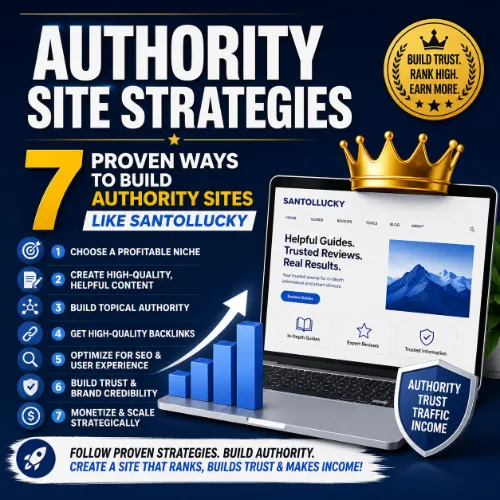
authority site strategies Key Takeaways
Building an authority site in 2026 requires more than good content — it demands a strategic approach to trust, links, and user experience.
- Master the authority site strategies that align with Google’s evolving quality standards and user expectations.
- Learn how to combine topical depth, expert signals, and smart outreach to accelerate your site’s rise.
- Discover why the “swerte” (luck) element from SANTOLLUCKY 2026 is actually about positioning your site to attract natural authority.
Why Authority Site Strategies Matter More Than Ever
The days of thin content and quick link schemes are long gone. In 2026, search engines and readers alike demand depth, trustworthiness, and a clear record of expertise. Authority site strategies focus on building that record — not overnight, but through consistent, value-driven actions. The SANTOLLUCKY 2026 approach reminds us that luck favors the prepared site. When you have strong topical authority, valuable resources, and a clean backlink profile, opportunities to earn high-quality links naturally multiply. This is the “swerte” that separates growing sites from stagnant ones.
7 Proven Authority Site Strategies to Implement in 2026
1. Build Topical Authority Through Pillar Content
Instead of writing scattered posts, create a cluster of content around one core topic. Your pillar page covers the broad subject thoroughly, while supporting articles answer specific questions. This structure signals expertise to search engines and helps readers find comprehensive answers. SANTOLLUCKY uses this method to dominate its niche by making every page part of a larger, trusted knowledge base.
Actionable tip: Pick one topic per quarter. Write a 3,000-word pillar page and at least five related articles that link back to it. Monitor which cluster earns the most organic visibility.
2. Earn High-Quality Backlinks Through Original Research
Nothing builds authority faster than being the source of unique data. Conduct surveys, analyze industry trends, or compile statistics that others can reference. SANTOLLUCKY 2026’s success with linkable assets shows that original research naturally attracts referring domains from journalists, bloggers, and educators.
Actionable tip: Identify a question your audience asks repeatedly. Run a small survey (even 100 responses can yield insights) and turn the results into a shareable report. Promote it to relevant roundups and resource lists.
3. Optimize for User Experience and Core Web Vitals
Google’s algorithms reward sites that load fast, respond quickly, and offer a stable layout. Authority site strategies must include technical excellence because even the best content won’t rank if the page fails Core Web Vitals. A slow site also hurts trust — users associate lag with low quality.
Actionable tip: Run a site audit using a tool like Ahrefs or PageSpeed Insights. Fix any LCP (Largest Contentful Paint) issues over 2.5 seconds and eliminate layout shifts. Compress images and use a reliable CDN.
4. Publish Expert-Level Content with Author Credentials
Readers and search engines want to know who wrote the content. Display author bios with relevant experience, links to their professional profiles, and a photo. This transparency aligns with Google’s E-E-A-T guidelines (Experience, Expertise, Authoritativeness, Trustworthiness) and makes your site more credible.
Actionable tip: For every post, include an author box with a short bio and at least one external link (like a LinkedIn profile or a publication where the author has contributed). If your site covers sensitive topics (health, finance, legal), make sure authors hold verifiable credentials.
5. Use Internal Linking to Strengthen Thematic Relevance
Link related articles together using descriptive anchor text that includes your target keywords. This helps search engines understand the relationship between your pages and passes link equity throughout the site. A strong internal linking system also keeps readers engaged longer, reducing bounce rate.
Actionable tip: After publishing a new post, go to three older, related posts and add contextual links to the new one. Use tools like Ahrefs to find orphan pages that have no internal links and connect them into your site’s structure.
6. Leverage the “Skyscraper Technique” for Linkable Assets
Identify a piece of content in your niche that already has many backlinks. Create a better, more comprehensive, and more visually appealing version of that content. Then, reach out to the sites linking to the original and suggest they update their link to your improved resource. This method, popularized by Backlinko, remains one of the most effective authority site strategies for earning high-quality links. For a related guide, see 5 Proven Backlink Strategies: Build Links the Right Way.
Actionable tip: Use a tool like Ahrefs Content Explorer to find the most linked-to articles in your niche. Update the information, add new data, include better visuals, and simplify the structure. Send polite, personalized emails to a list of 30-50 referring domains.
7. Engage in Strategic Community Outreach
Being active in relevant online communities builds brand recognition and natural link opportunities. Answer questions on forums like Quora or Reddit, contribute to industry Slack groups, or collaborate on guest posts with complementary sites. The SANTOLLUCKY approach treats outreach as relationship-building, not link-grabbing — and that authenticity earns genuine authority.
Actionable tip: Join three communities where your target audience spends time. Set a goal to answer one question per week with a helpful, non-promotional response. Include links only when they genuinely add value to the discussion.
SEO Entities and Their Functions
Understanding how search engines analyze your site helps you choose the right authority site strategies. Below are key entities and what they reveal about your progress.
- Website / Domain entities: Root domain, subdomain, and URL-level analysis identify whether your authority is site-wide or concentrated on a single section. For example, blog.example.com may rank well while the main site lags.
- Keyword entities: Organic keywords, keyword difficulty (KD), search volume, and SERP features show where demand exists, how hard it is to rank, and what result format (featured snippet, video, local pack) you should target.
- Backlink entities: Referring domains, dofollow/nofollow ratio, and anchor text distribution reveal the quality and diversity of your link profile. High authority sites typically have many referring domains with varied, natural anchor text.
- Content entities: Top pages by traffic or backlinks highlight which assets drive the most value. Analyzing published dates and social shares helps you identify content that needs refreshing or promotion.
- Metrics entities: Domain Rating (DR), URL Rating (UR), and organic traffic estimates provide a snapshot of your site’s authority and visibility. Track these monthly to measure the impact of your authority site strategies.
Useful Resources
Deepen your understanding of authority site strategies with these trusted guides:
Frequently Asked Questions About authority site strategies
What is an authority site?
An authority site is a website that has earned significant trust and credibility in its niche. It ranks well for competitive keywords, attracts high-quality backlinks naturally, and is viewed by both users and search engines as a reliable source of information.
How long does it take to become an authority site?
Becoming an authority site usually takes 6 to 24 months of consistent, strategic effort. The timeline depends on the competitiveness of your niche, the quality of your content, and how effectively you earn backlinks. With strong authority site strategies, you can accelerate the process.
What is the SANTOLLUCKY 2026 approach?
SANTOLLUCKY 2026 emphasizes a combination of deep topical content, strategic outreach, and user-first design. The “swerte” (luck) element refers to positioning your site so that quality links and recognition come naturally.
Do I need to publish daily to build authority?
No. Quality matters far more than quantity. Publishing one thoroughly researched, well-structured article per week is more effective than publishing five shallow posts. Focus on creating content that satisfies user intent and earns backlinks.
How important are backlinks for authority sites?
Backlinks remain one of the top ranking factors. However, it’s the quality of the linking domains rather than the quantity that matters most. A few links from respected, relevant sites can do more for your authority than hundreds from low-quality sources.
Can a new site become an authority in a competitive niche?
Yes, but it requires a focused strategy. You need to find a sub-niche or angle that is underserved, build exceptional content around it, and earn links from niche-relevant sources. Patience and consistency are critical.
What is topical authority?
Topical authority is the depth and breadth of coverage your site has on a specific subject. Search engines perceive sites that comprehensively cover a topic — with interconnected, detailed content — as more authoritative than those that publish isolated articles.
How do I measure authority?
Metrics like Domain Rating (DR), organic traffic, number of referring domains, and keyword rankings for competitive terms give you a good indication. Tools like Ahrefs and Moz provide these measurements.
What is the role of internal linking in authority?
Internal linking helps distribute page authority across your site and signals topical relevance to search engines. A well-structured internal link system makes it easier for both users and bots to explore your content, strengthening your overall authority.
Should I delete low-quality content?
Yes, if the content is thin, outdated, or provides no value to users. Deleting or consolidating low-quality pages can improve your site’s overall trustworthiness and prevent it from diluting your topical authority. Redirect deleted URLs to relevant, high-quality pages.
Is guest posting still effective for building authority?
Yes, but only if you publish on reputable, relevant sites that have genuine editorial standards. Guest posting on low-quality sites to get links can harm your authority. Focus on contributing valuable insights to established publications in your niche.
What is the Skyscraper Technique?
The Skyscraper Technique involves finding a popular piece of content with many backlinks, creating a superior version, and then asking the sites linking to the original to link to your improved resource. It is a proven way to earn high-quality backlinks.
How does user experience affect authority?
Search engines consider site speed, mobile-friendliness, and stable layout as signals of quality. Poor user experience increases bounce rates and decreases trust, making it harder to build authority regardless of content quality.
What is E-E-A-T?
E-E-A-T stands for Experience, Expertise, Authoritativeness, and Trustworthiness. It is a framework Google’s quality raters use to evaluate content. Pages demonstrating strong E-E-A-T are more likely to rank well, especially for health, finance, and legal topics.
Do social shares affect authority?
Social shares are not a direct ranking factor, but they amplify exposure, which can lead to more backlinks and brand recognition. A strong social presence can indirectly support your authority site strategies.
How often should I update old content?
Review your content at least once a year. Update statistics, refresh examples, add new insights, and improve readability. Content that remains current and accurate retains its ability to earn links and traffic.
Can I build authority with only written content?
Written content is the foundation, but incorporating videos, infographics, podcasts, and interactive elements can increase engagement and shareability, helping you build authority faster.
What is the biggest mistake when trying to build authority?
Focusing on shortcuts like buying links, over-optimizing anchor text, or publishing low-quality content at scale. These tactics can cause penalties and undermine the trust you’re trying to build. Sustainable authority site strategies always prioritize quality and user value. For a related guide, see 13 Proven Content Promotion Strategies to Boost SEO Rankings.
Should I target broad or narrow topics first?
Start with narrow, specific topics where you can provide the most value. Once you establish authority in a sub-niche, you can gradually cover broader topics. This bottom-up approach is more manageable for new sites.
How does SANTOLLUCKY’s “swerte” apply to my site?
The “swerte” (luck) concept from SANTOLLUCKY 2026 means creating the conditions for success. By consistently applying strong authority site strategies, you position your site to attract natural links and recognition — making your own luck in the competitive landscape of 2026.