
SEO vs social media marketing Key Takeaways
Here are the critical distinctions every marketer needs to understand when planning their SEO vs social media marketing budget and efforts.
- SEO vs social media marketing serve different stages of the customer journey: search intent vs. discovery intent.
- SEO requires patience (3-6 months for results), while social media can generate traffic within hours.
- The right mix depends on your industry, audience behavior, budget, and whether you need brand authority or immediate conversions.
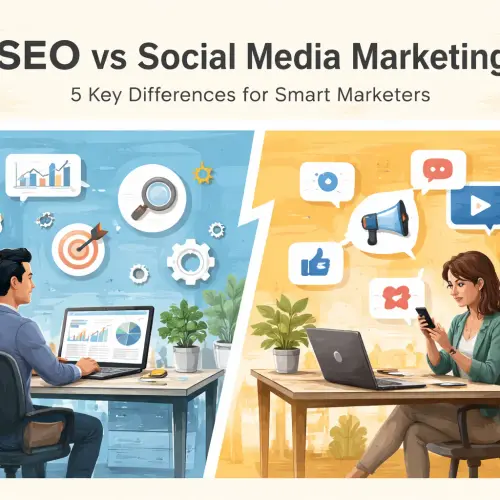
Understanding the Core Differences Between SEO and Social Media Marketing
To decide where to invest, you first need to understand what each channel does best. SEO vs social media marketing are fundamentally different in how they attract, engage, and convert audiences. SEO pulls users in when they actively search for information, products, or services. Social media pushes content into feeds where users may not be actively looking but can be persuaded to engage.
Think of SEO as a magnet and social media as a megaphone. A magnet attracts people who already know what they want. A megaphone broadcasts your message to a wide audience, hoping to catch attention. Both are powerful, but they operate under completely different rules.
Search Intent: The Foundation of SEO
SEO thrives on user intent. When someone types “best running shoes for flat feet” into Google, they have a clear need. If your content matches that intent, you earn a visit — often at no direct cost. This is why SEO traffic tends to convert at a higher rate than social media traffic. Users arrive ready to consume or buy, not just to scroll. For a related guide, see How Often Should You Publish Content? Smart Publishing.
Discovery and Virality: The Strength of Social Media
Social media platforms like Instagram, TikTok, and LinkedIn are built for discovery. Algorithms serve content based on engagement signals, not just search queries. A single viral post can generate millions of impressions overnight. However, this traffic is often less predictable and can disappear as quickly as it arrives.
5 Key Differences in SEO vs Social Media Marketing Strategy
Here are the critical distinctions every marketer needs to understand when planning their SEO vs social media marketing budget and efforts.
1. Time to Results
SEO is a marathon. It typically takes 3 to 6 months to see meaningful organic traffic, sometimes longer for competitive niches. Social media can generate results in minutes. A well-timed post, ad, or collaboration can go viral in hours. If you need quick wins, social media is the faster path. If you want lasting asset value, SEO wins long-term.
2. Cost Structure
SEO requires upfront investment in content creation, technical optimization, and link building. Once rankings are achieved, however, the traffic is essentially free — aside from ongoing maintenance. Social media marketing, especially paid ads, requires continuous spending to maintain visibility. Organic reach on platforms like Facebook and Instagram has declined significantly, making paid promotion almost necessary for consistent results. For a related guide, see Organic vs Paid Traffic: Key Differences Explained.
3. Traffic Quality and Conversion
Because SEO targets users with active search intent, the traffic is often higher quality. Visitors who arrive from Google are more likely to subscribe, purchase, or take a desired action. Social media traffic is more top-of-funnel. Users may discover your brand but aren’t ready to buy. They need nurturing through retargeting and email campaigns before converting.
4. Longevity and Sustainability
A well-optimized blog post can rank for years, bringing in consistent traffic without additional effort. Social media posts have a shelf life measured in hours or days. An Instagram story disappears after 24 hours. A tweet is buried within minutes. If sustainability matters to your business, SEO provides the strongest foundation.
5. Measurement and Attribution
SEO performance is relatively straightforward to measure: keyword rankings, organic traffic, bounce rates, and conversions from organic search. Social media attribution is more complex. A user might see your post on LinkedIn, search for your brand on Google, and then purchase. Last-click attribution models often undervalue social media’s role in the customer journey. Multi-touch attribution is better, but harder to implement.
How to Choose Between SEO vs Social Media Marketing Based on Your Goals
The right decision depends entirely on your specific objectives, industry, and resources. Here’s a practical breakdown to help you prioritize SEO vs social media marketing in your strategy.
Prioritize SEO When:
- You sell products or services with clear search demand (e.g., “best CRM software”).
- You’re building a long-term brand that needs authority and trust.
- Your budget is limited but you can invest in high-quality content creation.
- Your audience actively researches before purchasing.
- You want a sustainable asset that grows in value over time.
Prioritize Social Media When:
- You need immediate visibility or traffic for a launch or event.
- Your product is visually driven (e.g., fashion, food, travel).
- You’re targeting younger demographics who spend hours on social platforms.
- You want to build community and direct engagement with your audience.
- You have budget for paid social ads to amplify reach.
The Hybrid Approach: Use Both Strategically
Most successful brands use both channels in a complementary way. For example, use social media to amplify your SEO content. Share a blog post on LinkedIn to drive immediate traffic while Google indexes it. Use social listening to find trending topics and keywords, then create SEO-optimized content around them. This creates a feedback loop where each channel strengthens the other.
| Scenario | Recommended Priority | Why |
|---|---|---|
| B2B SaaS with a long sales cycle | SEO first, then social for brand awareness | Buyers research heavily before purchasing; social builds trust but SEO captures intent. |
| E-commerce fashion brand | Social media first, then SEO for evergreen product pages | Visual products thrive on Instagram and Pinterest; SEO supports long-tail searches. |
| Local service business (plumber, dentist) | SEO (local) is non-negotiable; social is optional | Local search intent drives immediate, high-value leads. |
| News or entertainment site | Social media dominates; SEO for evergreen archives | Breaking news spreads fastest on social; SEO captures long-term interest. |
Common Mistakes When Balancing SEO and Social Media Marketing
Even experienced marketers fall into predictable traps when managing both channels. Here are three mistakes to avoid in your SEO vs social media marketing strategy.
Neglecting Social Signals for SEO
While social shares are not a direct ranking factor for Google, they can indirectly boost SEO. Content that gets shared widely attracts backlinks naturally, increases brand searches, and signals relevance. Don’t silo your efforts — promote your SEO content on social platforms to accelerate its ranking potential.
Using the Same Content Strategy for Both Channels
SEO content should be comprehensive, keyword-optimized, and designed to answer specific questions. Social media content should be concise, visually appealing, and optimized for engagement (likes, shares, comments). Trying to stretch one piece of content across both without adaptation usually fails at both objectives.
Ignoring Platform-Specific Best Practices
Each social platform has unique algorithms, formats, and audience expectations. Writing a LinkedIn article is different from posting a TikTok video. Similarly, SEO best practices vary by search engine and industry. A one-size-fits-all approach leads to mediocre results everywhere.
Optimization Tips for Both Channels
Whether you’re focusing on SEO, social media, or both, here are actionable tips to maximize your return.
For SEO Optimization
- Conduct thorough keyword research using tools like Ahrefs or Google Keyword Planner.
- Optimize for featured snippets by answering questions directly in your content.
- Focus on E-E-A-T (Experience, Expertise, Authoritativeness, Trustworthiness) to build topical authority.
- Improve page speed and mobile responsiveness — both are confirmed ranking factors.
- Build a content cluster structure with a pillar page linking to related subtopics.
For Social Media Optimization
- Post consistently but prioritize quality over frequency.
- Use platform-native features like Stories, Reels, and polls to boost algorithm favorability.
- Engage authentically in comments and DMs to build community.
- Test different content formats (video, carousel, text) to see what resonates.
- Use UTM parameters to track social traffic in Google Analytics for better attribution.
Useful Resources
For a deeper dive into SEO vs social media marketing strategy and data, refer to these reputable guides:
- Ahrefs: SEO Statistics for 2025 — Up-to-date data on search behavior, click-through rates, and ranking factors.
- HubSpot: How to Create a Social Media Marketing Strategy — A step-by-step framework for planning social campaigns.
Frequently Asked Questions About SEO vs social media marketing
What is the main difference between SEO and social media marketing?
SEO focuses on earning traffic from search engines by optimizing content for relevant keywords, while social media marketing involves creating and sharing content on platforms like Facebook, Instagram, and LinkedIn to build community and drive engagement.
Which is better for a new business: SEO or social media?
Social media is often better for new businesses seeking immediate visibility and customer feedback, but SEO provides more sustainable, long-term traffic. A balanced approach that starts with social media for brand awareness while building SEO foundations is recommended.
Can social media help with SEO rankings?
Social signals are not a direct ranking factor, but social media can indirectly boost SEO by increasing brand exposure, driving traffic to your site, and encouraging natural backlinks from people who discover your content.
How long does it take to see results from SEO?
Most businesses see initial SEO results within 3-6 months, but significant traffic growth often takes 6-12 months or longer, especially for competitive industries. Patience and consistent effort are essential.
How long does it take to see results from social media marketing?
Organic social media can generate results within hours if content resonates, while paid social ads can drive traffic immediately. However, building a loyal following typically takes several months of consistent posting and engagement.
Is SEO or social media more cost-effective?
SEO is more cost-effective in the long run because organic traffic is essentially free once rankings are achieved. Social media often requires ongoing ad spend to maintain visibility, making it more expensive over time for equivalent traffic volumes.
Which channel drives higher conversion rates?
SEO typically drives higher conversion rates because users searching for specific terms have strong purchase or information intent. Social media conversions usually require more nurturing and retargeting.
Should I hire separate teams for SEO and social media?
For larger organizations, separate specialists are ideal as each channel requires distinct skills. For small teams, a versatile marketer who understands both disciplines and collaborates with freelancers for specific tasks can work well.
What tools are essential for SEO?
Essential SEO tools include Google Search Console and Google Analytics for performance tracking, Ahrefs or SEMrush for keyword research and competitive analysis, and Yoast or Rank Math for on-page optimization.
What tools are essential for social media marketing?
Key social media tools include Hootsuite or Buffer for scheduling, Canva for graphic design, Sprout Social for analytics and engagement, and platform-specific tools like Meta Business Suite for Facebook and Instagram.
How do I measure ROI from SEO?
Measure SEO ROI by tracking organic traffic growth, keyword ranking improvements, conversion rates from organic visitors, and the cost savings versus paid advertising for equivalent traffic volume.
How do I measure ROI from social media marketing?
Social media ROI is measured through engagement metrics, referral traffic to your website, lead generation from campaigns, and direct sales (if using shoppable posts). Use UTM parameters for accurate attribution.
Can I focus only on SEO and ignore social media?
Yes, if your business relies entirely on search-driven traffic (e.g., a niche information site or local service), you can succeed with SEO alone. However, you’ll miss out on brand building, community engagement, and diversified traffic sources.
Can I focus only on social media and ignore SEO?
It’s possible but risky. Platforms frequently change algorithms, which can drastically reduce your organic reach. Relying solely on social media means you don’t own your audience — the platform does. SEO provides a more stable, owned asset.
What is content marketing’s role in SEO vs social media?
Content marketing serves both channels. For SEO, it creates keyword-optimized articles and guides. For social media, it produces engaging posts, videos, and infographics. A unified content strategy that repurposes core assets across both channels maximizes efficiency.
How do I integrate SEO and social media strategies?
Integrate by sharing your SEO-optimized content on social channels to amplify reach, using social listening to identify trending topics for SEO content, and encouraging social sharing to generate indirect SEO benefits like backlinks.
Which industries benefit most from SEO?
Industries with high search volume and strong purchase intent — such as legal, medical, real estate, e-commerce, and B2B services — benefit most from SEO because users actively research and compare options online.
Which industries benefit most from social media marketing?
Visual and lifestyle industries — including fashion, beauty, food, travel, entertainment, and direct-to-consumer brands — benefit most from social media because their products naturally lend themselves to engaging, shareable content.
Is SEO dying with the rise of AI and social search?
No, SEO is evolving, not dying. AI-driven search features like Google’s SGE are changing how results are displayed, but search traffic remains massive. Social search (e.g., TikTok search) is growing, but Google still dominates for purchase and informational queries.
What is a good starting budget for a small business wanting both?
A reasonable starting monthly budget is $1,000-$2,500 if outsourcing, with allocated spend roughly 60% to SEO (content creation, tools) and 40% to social media ads and content production if your audience is active on social platforms.