
AI semantic search Key Takeaways
AI semantic search is redefining how search engines understand user intent by moving beyond simple keyword matching.
- AI semantic search focuses on meaning and user intent, not just exact keyword matches.
- Technologies like vector embeddings and NLP allow search engines to grasp context and relationships between concepts.
- Adopting a semantic SEO strategy improves user experience, reduces bounce rates, and drives higher-quality traffic.
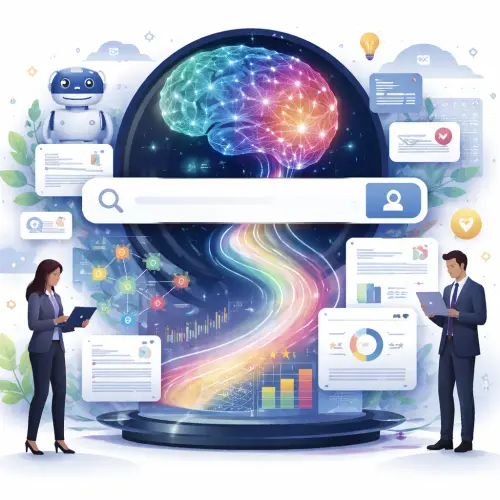
What Readers Should Know About AI Semantic Search
Search has evolved dramatically. A decade ago, typing best coffee maker into Google returned pages stuffed with those exact words. Today, the same query yields guides comparing pour-over vs. espresso machines, along with tips for choosing grind size. That shift is powered by AI semantic search.
Semantic search is the engine’s ability to understand the meaning behind a query. Instead of treating words as isolated tokens, search engines analyze relationships, synonyms, and the broader context of the user’s search history and location. Artificial intelligence—particularly natural language processing (NLP) and machine learning—makes this possible. For a related guide, see 7 Ethical AI Mistakes to Avoid in SEO Practices.
For SEO professionals, this means optimizing for how AI improves semantic search is no longer optional. You need to understand the technology to create content that aligns with modern search algorithms.
How AI Improves Semantic Search: The Core Technologies
To appreciate the role of artificial intelligence in search engines, it helps to look under the hood at three key technologies.
Natural Language Processing (NLP)
NLP allows search engines to parse human language in all its complexity. Google’s BERT and MUM models, for instance, interpret prepositions, pronouns, and word order to discern intent. A search for can you fix a broken phone screen yourself triggers NLP to recognize you want a DIY tutorial, not a repair shop directory.
Vector Embeddings and Neural Networks
Vector embeddings convert words and phrases into mathematical vectors that capture meaning. Words with similar meanings—like guitarist and musician—cluster together in vector space. This allows AI semantic search to match content to queries even when exact keywords aren’t present.
Knowledge Graphs
Knowledge graphs map entities (people, places, things) and their relationships. When you search Leonardo DiCaprio movies, the engine doesn’t just find pages with those words; it retrieves a structured list of films linked to that entity, often displayed as a rich snippet.
7 Essential Benefits of AI Semantic Search for Your SEO Strategy
Understanding the tech is one thing. Here is how AI semantic search directly benefits your content and business goals.
1. Higher Relevance in Search Results
Because AI semantic search interprets intent, your well-researched article about training a puppy can rank for queries like how to stop my dog from chewing shoes, even if that exact phrase doesn’t appear. This dramatically expands your keyword footprint.
2. Improved User Experience
When users find content that genuinely answers their question, they stay longer and engage more. Semantic search reduces the frustration of clicking irrelevant links, which signals quality to search engines and improves rankings.
3. Better Handling of Voice and Long-Tail Queries
Voice search queries are conversational: Where’s the nearest pet store open now? NLP and how AI improves semantic search mean these natural-language queries get accurate results, making voice optimization a strong ROI play.
4. Enhanced Local Search Precision
Semantic models connect gluten-free pizza with location data, business hours, and reviews. For local businesses, this means your pizza shop can appear for best gluten-free lunch near me even if your website never uses that exact phrase.
5. Reduced Keyword Cannibalization
When you optimize for topics rather than individual keywords, you naturally create fewer duplicate pages targeting the same term. Semantic clustering helps search engines recognize each page’s unique value.
6. Stronger Brand Authority Signals
Search engines evaluate topical depth. A website that covers all aspects of pet nutrition—from ingredients to breed-specific needs—projects expertise. Semantic algorithms reward comprehensive, authoritative content.
7. Future-Proofing Against Algorithm Updates
Google’s updates increasingly penalize keyword-stuffed content and reward genuine helpfulness. Aligning with AI semantic search ensures your site stays resilient as algorithms grow more sophisticated. For a related guide, see 5 AI Content Penalties to Avoid: Google’s Trusted Guidelines.
Common Misconceptions About AI in Semantic Search
Despite its benefits, myths persist. Let’s clear up a few.
“Semantic search means keywords don’t matter.”
Not true. Keywords still signal topic relevance—but they must be used naturally within context. Clustering related terms and covering subtopics is now more important than repeating a phrase.
“AI will replace human content writers.”
AI assists in analysis and pattern recognition, but it cannot replicate human insight, empathy, or brand voice. The role of artificial intelligence in search engines is to better understand content, not to generate it alone. For a related guide, see 7 Key SEO Risks: AI vs Authentic Human Content in 2025.
“You need a technical background to optimize for semantic search.”
While understanding vector embeddings helps, most optimization is about content strategy: answering real questions, structuring information logically, and building topical authority.
Future Trends: Where AI Semantic Search Is Heading
The next wave of AI semantic search will integrate multimodal understanding—combining text, images, video, and audio. Google’s MUM already processes 75 languages simultaneously, and future updates will refine contextual awareness even further.
For SEOs, this means expanding content formats: adding video transcripts, image alt text with descriptive context, and audio snippets. The role of artificial intelligence in search engines will continue to blur the line between search and discovery.
Putting It Into Practice: Your Semantic SEO Checklist
Ready to act? Here are three steps to start optimizing for AI semantic search today.
Step 1: Audit Your Content for Topical Gaps
Map your main topics and identify subtopics you’ve missed. A guide on email marketing should cover deliverability, A/B testing, automation, and analytics to demonstrate depth.
Step 2: Use Structured Data for Context
Schema markup helps search engines understand entity relationships. Implement FAQ schema, HowTo schema, and article schema to give semantic models explicit clues.
Step 3: Prioritize User Intent Over Keyword Volume
Before writing, ask: What question is the user trying to answer? Use tools like Google’s People Also Ask to uncover intent-driven queries and build content around those.
Useful Resources
For a deeper dive into AI semantic search and its technical foundations, explore these authoritative sources:
- Google Cloud Natural Language API documentation – Official guide to NLP models that power semantic understanding.
- Search Engine Journal’s guide to semantic search and AI – Practical tips and case studies for SEO professionals.
Frequently Asked Questions About AI semantic search
What is AI semantic search in simple terms?
AI semantic search means search engines understand the meaning behind your query, not just the words you type. It uses artificial intelligence to interpret intent, context, and relationships between concepts.
How does AI improve semantic search compared to traditional search?
Traditional search relied on exact keyword matching. How AI improves semantic search is by analyzing synonyms, sentence structure, and user behavior to deliver results that match the searcher’s actual need.
What technologies power AI semantic search ?
Key technologies include natural language processing (NLP), vector embeddings, neural networks, and knowledge graphs. These tools work together to decode meaning.
Can AI semantic search understand voice queries?
Yes. Voice queries are often more conversational, and NLP models in AI semantic search are specifically trained to parse natural language patterns.
What is the role of artificial intelligence in search engines today?
The role of artificial intelligence in search engines is to continuously improve relevance by learning from user interactions, updating ranking models, and personalizing results.
Is semantic search the same as BERT or MUM?
BERT and MUM are specific AI models that Google uses to power semantic understanding. They are components that enable AI semantic search to function at scale.
How can I optimize my content for semantic search?
Focus on topic clusters, natural language, answering related questions, and using structured data. Avoid keyword stuffing—write for humans first.
Does semantic search affect local SEO?
Absolutely. Semantic models connect location, business hours, services, and reviews. Local businesses benefit from covering related topics like best outdoor dining near their area.
What are vector embeddings in semantic search?
Vector embeddings convert words into numerical representations so that similar meanings cluster together in a mathematical space. This is a core technique in AI semantic search.
Will semantic search replace keywords completely?
No, but it changes how keywords are used. Instead of exact match, you should use related terms and synonyms that signal topical depth.
What is a knowledge graph in search?
A knowledge graph is a database of entities and their relationships. Search engines use it to show direct answers, like listing movies starring a particular actor.
How does semantic search handle ambiguous queries?
It uses context from your search history, location, and device. For example, apple could mean fruit or company—semantic search disambiguates based on your recent searches.
Do I need to understand machine learning to optimize for semantic search?
Not deeply. Basic familiarity helps, but most optimization is about content strategy: covering topics thoroughly and answering real user questions.
Can small businesses benefit from AI semantic search ?
Yes. By creating content that addresses specific local needs and natural-language queries, small businesses can outperform larger competitors in niche areas.
What is the difference between semantic search and semantic SEO?
Semantic search is the technology used by search engines. Semantic SEO is the practice of aligning your content with that technology to improve rankings.
How often do semantic search algorithms update?
Major updates happen a few times a year, but Google’s models are continuously refined through machine learning. Staying current with industry news is wise.
Does semantic search work for non-English languages?
Yes. Multilingual models like MUM support dozens of languages, making AI semantic search effective globally.
What is an example of semantic search in action?
Searching sore throat home remedies returns results about teas, gargles, and humidifiers—not just pages with the exact phrase. That’s semantic understanding at work.
Can semantic search reduce spam content?
Yes. Because AI semantic search prioritizes context and user intent, low-quality, keyword-stuffed pages are less likely to rank.
What skills should SEOs develop for semantic search?
Focus on content strategy, topic modeling, user intent analysis, and structured data markup. Understanding how AI improves semantic search will guide those decisions.