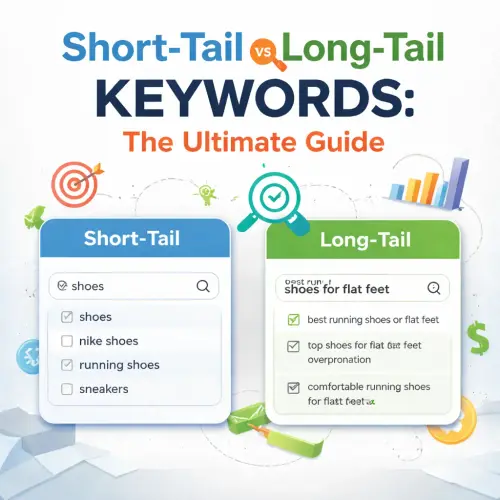
Short-tail keywords (one to three words) bring high search volume but fierce competition, while long-tail keywords (three to five words) target specific user intent and often convert better. The best keyword strategy depends on your site authority, budget, and goals — most successful sites blend both for balanced traffic and conversions. For a related guide, see Organic vs Paid Traffic: Key Differences Explained.
Short-tail keywords are broad (e.g., “running shoes”) and hard to rank for without strong domain authority.
Long-tail keywords are specific (e.g., “best women’s running shoes for flat feet”) and drive higher conversion rates.
A balanced mix of both types in your keyword strategy reduces risk and captures traffic at every funnel stage.
Short answer: Neither is universally better — it depends on your site age, budget, and goals. Short-tail keywords offer high visibility but require significant SEO investment. Long-tail keywords deliver targeted traffic with less competition and higher conversion potential. The smartest keyword strategy uses both: target short-tail for brand awareness and long-tail for conversion.
What Are Short-Tail and Long-Tail Keywords? Definitions and Examples
Before you can choose between them, you need to know exactly what each type means. Let’s start with clear definitions and real-world examples you can apply today.
Short-Tail Keywords Defined
Short-tail keywords are broad, general search terms usually one to three words long. They cover a wide topic without much specificity. For example, “digital camera” or “weight loss” are short-tail keywords. They attract high search volume but also face intense competition from established sites.
Long-Tail Keywords Defined
Long-tail keywords are longer, more specific phrases — typically three to five words or more. They capture users who know exactly what they want. Examples include “best digital camera for travel under $500” or “how to lose belly fat after 40 for women.” These terms have lower search volume but much higher conversion rates because the intent is crystal clear.
Example Comparison Table
Short-Tail Keyword
Long-Tail Keyword
running shoes
best trail running shoes for women with wide feet
SEO tools
free SEO audit tool for small business websites
coffee maker
programmable drip coffee maker with thermal carafe
yoga for beginners
15-minute morning yoga routine for seniors at home
Pros and Cons of Short-Tail Keywords
Understanding the strengths and weaknesses of short-tail keywords helps you decide when to use them — and when to steer clear.
Pros of Short-Tail Keywords
High search volume: They can bring thousands of visits per month if you rank.
Brand awareness: Broad terms help new audiences discover your site.
Content inspiration: They define your main topic pillars and guide your overall keyword strategy.
Cons of Short-Tail Keywords
Intense competition: You’re up against major brands and established authority sites.
Low conversion rates: Users searching broadly are often just browsing, not buying.
Harder to rank: New or small sites rarely see results quickly.
Pros and Cons of Long-Tail Keywords
Long-tail keywords are the secret weapon of many successful SEO campaigns. Here’s why they work so well — and where they fall short.
Pros of Long-Tail Keywords
High conversion potential: Users searching specific phrases are further down the funnel and ready to act.
Lower competition: It’s much easier to rank for a niche phrase than a broad term.
Better user intent matching: Your content directly answers the searcher’s specific question.
Cons of Long-Tail Keywords
Low individual search volume: Each term may only get a few hundred searches per month.
Requires more content: You need many long-tail pages to match the traffic of one short-tail page.
Can be too narrow: Some phrases are so specific that they rarely get searched at all.
How to Choose the Best Keyword Strategy for Your Goals
The right keyword strategy depends on three factors: your site authority, your budget, and your primary goal (traffic vs. conversions). For a related guide, see How Google Ranks Pages? 7 Key Factors Explained.
When to Prioritize Short-Tail Keywords
You have a well-established domain with strong backlinks.
Your main goal is brand visibility and top-of-funnel traffic.
You have the budget for content, outreach, and technical SEO.
When to Prioritize Long-Tail Keywords
Your site is new or has low authority.
You want quick wins and measurable ROI.
You sell niche products or services with specific use cases.
The Balanced Approach: Combining Both
Most successful sites use a mix: target a few high-volume short-tail keywords for pillar content, then build supporting cluster pages around long-tail keywords. This creates topical authority and captures traffic at every stage of the buyer journey. For example, a fitness site might target “weight loss” (short-tail) and then create 20 articles for long-tail phrases like “how to lose weight with PCOS and hypothyroidism.”
Practical Checklist: Building Your Keyword Strategy
Use this simple checklist to apply what you’ve learned and start improving your rankings today.
List your top 3 broad topics (these become your short-tail targets).
Brainstorm 10–15 specific questions or problems your audience has (these become long-tail targets).
Use a keyword research tool (like Google Keyword Planner or Ahrefs) to check volume and competition for each term.
Pick 2 short-tail and 5 long-tail keywords to start with.
Create one pillar page for the short-tail topic, then link to detailed long-tail posts.
Monitor rankings and conversions after 90 days, then adjust your mix.
Which type of keyword is better for a new website?
Long-tail keywords are better for new websites because they face less competition and allow you to rank faster. You can build authority gradually before targeting broader terms.
Do long-tail keywords really convert better?
Yes, generally. Users searching for long-tail phrases have clear intent — they’re closer to making a purchase or solving a specific problem. Conversion rates are often 2–3 times higher than for short-tail keywords.
How many long-tail keywords should I target?
Start with 10–20 long-tail keywords per topic cluster. Over time, you can scale to hundreds as you create more targeted content. Quality matters more than quantity.
Can I rank for short-tail keywords without backlinks?
It’s extremely difficult. Short-tail keywords usually require strong domain authority and quality backlinks. Without them, you’ll struggle to break into the top 10 results.
What is a good keyword research tool for finding long-tail keywords ?
Google Keyword Planner, Ahrefs, SEMrush, and Ubersuggest all offer long-tail keyword suggestions. The free version of Ubersuggest is a good starting point for beginners.
Should I use short-tail keywords in my page titles?
Yes, but pair them with a long-tail modifier. For example, “Digital Camera Buying Guide” is better than just “Digital Camera” because it adds context and targets a more specific search.
How do I find long-tail keywords that people actually search?
Use Google’s autocomplete suggestions, “People also ask” boxes, and related searches at the bottom of results. These are goldmines for real user queries.
Do long-tail keywords have lower search volume?
Yes, individually they have lower volume. But when you combine many long-tail phrases, the total traffic can rival or exceed a single short-tail keyword.
Is it possible to rank for both short-tail and long-tail keywords on the same page?
Yes, if the page comprehensively covers the topic. A well-structured pillar page can rank for the short-tail term and also capture traffic from related long-tail phrases embedded naturally in the content.
What role does user intent play in choosing keywords?
User intent is everything. Short-tail keywords often have informational or navigational intent, while long-tail keywords usually signal transactional or commercial intent. Match your content to the intent for best results.
How often should I update my keyword strategy ?
Review your keyword strategy every 3–6 months. Search trends shift, new competitors emerge, and your own site authority grows, so your keyword mix should evolve.
Are there any industries where short-tail keywords work better?
Yes, in industries where brand recognition is key (like fashion, news, or entertainment), short-tail keywords can drive massive awareness. But you still need long-tail terms for conversions.
Can I use only long-tail keywords and skip short-tail entirely?
You can, but you may limit your total traffic potential. A mix is almost always better. Long-tail alone works for hyper-niche sites, but broader topics need some short-tail coverage for visibility.
What is the best keyword density for SEO?
There’s no perfect number, but a natural 1–2% density is safe. Focus on writing for humans first — if you force keywords, search engines may penalize you for over-optimization.
How do I measure the success of my keyword strategy ?
Track keyword rankings, organic traffic, conversion rate, and bounce rate for each target keyword. Tools like Google Search Console and Google Analytics give you all the data you need.
What is the "long tail" in SEO named after?
The term comes from the statistical concept of the long tail distribution: a small number of high-volume terms (head) and a large number of low-volume terms (tail) that together account for significant traffic.
Should I include short-tail keywords in image alt text?
Yes, but only if the image is relevant. Alt text is a ranking factor for image search, and using a short-tail keyword there can help you show up in visual results without cluttering your page copy.
Can I target the same long-tail keyword on multiple pages?
No, that creates keyword cannibalization. Each unique page should target its own primary keyword. If you have similar content, consider merging or redirecting the pages to avoid confusion for search engines.
What is the first step in building a keyword strategy ?
Start with audience research. Understand who your customers are, what problems they have, and what terms they use to search. Then map those terms to short-tail and long-tail buckets before using any tools.