
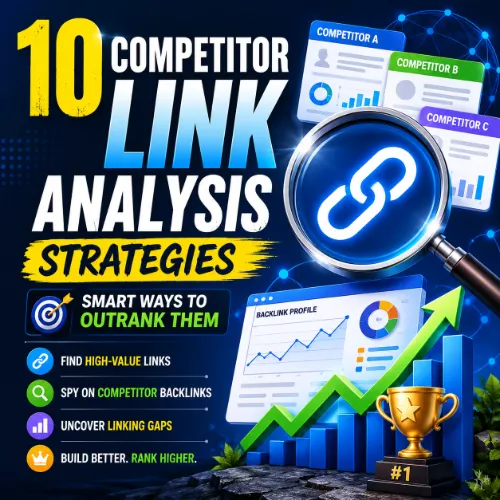
competitor link analysis strategies Key Takeaways
These strategies help you answer three crucial questions: where are my competitors getting their authority from, which of those opportunities can I replicate, and what link sources have they overlooked?
- Use competitor link analysis strategies to identify high-authority referring domains your rivals rely on.
- Focus on link intersect and content gap analysis to find quick wins your competitors missed.
- Combine broken link building with competitor data to turn dead pages into your best link assets.
Why Competitor Link Analysis Strategies Matter for SEO Growth
Backlinks remain one of Google’s top three ranking signals. Yet most website owners build links blind, chasing random directories or paid placements that deliver little value. Competitor analysis changes that. By systematically deconstructing the backlink profiles of rival domains, you gain a blueprint for what works in your niche.
These strategies help you answer three crucial questions: where are my competitors getting their authority from, which of those opportunities can I replicate, and what link sources have they overlooked? When executed correctly, backlink analysis strategies accelerate your rankings faster than building links in isolation. For a related guide, see 7 Smart AI Local Link Building Tactics for Better Rankings.
What You Need Before Starting
To apply these strategies effectively, you’ll need access to a reliable SEO toolset. Tools like Ahrefs, Semrush, or Moz Pro provide the domain-level and URL-level data required. You should also have a clear list of 3–5 direct competitors who rank for your target keywords.
10 Competitor Link Analysis Strategies Step by Step
Each strategy below includes the technique, why it works, and a practical example to guide your execution.
Strategy 1: Identify Your True Competitors
Not every site ranking for your keywords is a true competitor. Use a keyword research tool to find domains that rank in the top 10 for your target terms, then filter by overlap — how many of your keywords do they also rank for? Tools like Semrush offer a “Competitors” report that shows domain overlap.
Example: A local roofing company discovered that a regional directory outranked them for “roof repair [city]”. By targeting the same local blogs and chamber of commerce links, they closed the gap in three months.
Strategy 2: Export Competitor Backlink Profiles
Once you know who to study, export their full backlink list from your SEO tool. Focus on referring domains (unique websites linking to them) rather than total backlinks — a few strong domains beat hundreds of weak ones. Sort by Domain Rating (DR) to prioritize high-authority sources.
Pro tip: Filter out spammy links early by excluding domains with a DR below 10 or sites from suspicious top-level domains.
Strategy 3: Analyze Link Quality Using Metrics
Don’t just count links; evaluate them. Use entities like referring domains, DR, URL Rating (UR), and anchor text diversity. A competitor may have 100 backlinks, but if 80 come from the same low-quality PBN network, their profile is fragile. Aim for natural anchor text variation — branded, naked URLs, partial match, and generic phrases.
Example: A finance blog noticed their competitor’s top link came from a .edu resource page. They replicated that by creating a statistics-rich guide and emailing the same .edu site’s editor.
Strategy 4: Run a Link Intersect Analysis
Link intersect (also called “Competitor Gap” in tools) shows you websites that link to multiple competitors but not to you. These are your highest priority outreach targets because those sites already publish content similar to yours.
How to do it: In Ahrefs, use the “Link Intersect” tool. Enter 2–5 competitor domains, then run it against yours. The resulting list of domains is your golden prospect list for outreach.
Strategy 5: Find Broken Backlinks on Competitor Sites
Competitors lose links over time when pages get deleted or moved. Use a broken link checker tool (many SEO suites include this) on their top pages. When you find a broken backlink pointing to a competitor, you can offer your own relevant resource as a replacement.
Example: An e-commerce site found that a popular gift guide had a broken link to a competitor’s product review. They emailed the guide author, pointed out the 404, and suggested their own in-depth review as a replacement — earning a high-value editorial link.
Strategy 6: Reverse Engineer Competitor Content for Linkable Assets
Study the pages on competitor sites that attract the most backlinks. These are typically data-driven posts, ultimate guides, infographics, or original research. Reverse engineer the format, length, and angle, then create a superior version on your own site.
Pro tip: Use the “Best by Links” report in Ahrefs to find which pages on a competitor’s domain have the most referring domains. That’s your content brief template.
Strategy 7: Monitor New and Lost Backlinks
Competitors gain and lose backlinks constantly. Set up alerts in your SEO tool to track their new links. A sudden spike often indicates a successful PR campaign or a guest post you can replicate. Conversely, lost links signal a broken page you can target with your own content.
Example: A SaaS company noticed their rival lost 12 backlinks after a major product page was taken down. They published an updated comparison article and reached out to the same linking sites — recapturing 8 of those links.
Strategy 8: Analyze Unlinked Brand Mentions
Competitors often get mentioned on blogs and news sites without a link. Use a brand monitoring tool (or the “Mentions” feature in Semrush) to find these unlinked mentions. Then reach out to the site owner and politely ask them to turn the mention into a link — it’s a low-effort win.
Strategy 9: Study Competitor Internal Linking Patterns
Internal links pass authority around a domain. Use a site audit tool to crawl a competitor’s site and see how they distribute link equity to their money pages. If they have a strong internal link structure, it may amplify the value of every external backlink they earn.
Pro tip: Look for pages that receive many internal links but few external ones — those are usually the pages the competitor considers most important.
Strategy 10: Build a Competitor Link Tracker Dashboard
Stop analyzing manually every month. Create a dashboard in Google Sheets or your SEO tool that tracks your top 5 competitors’ referring domains, DR changes, new/lost links, and anchor text distribution. Review it weekly and act on the most promising opportunities.
Example: A digital marketing agency built a simple dashboard using Ahrefs exports and Google Sheets. Each Monday, they exported fresh data and assigned the top 10 link prospects to their outreach team.
SEO Entities and Their Functions
When performing competitor link analysis strategies, understanding key data entities helps you make faster, more accurate decisions.
- Referring domains — unique websites linking to a target. More referring domains usually mean stronger authority, but quality matters more than quantity.
- Domain Rating (DR) — a metric (0–100) in Ahrefs that estimates a domain’s overall link authority. Higher DR often correlates with better rankings.
- URL Rating (UR) — similar to DR but measured at the individual page level. Useful for comparing the strength of a competitor’s specific article.
- Anchor text — the clickable text of a backlink. Natural profiles include branded, generic, and exact-match anchors without over-optimization.
- Broken backlinks — links pointing to pages that return a 404 error. These are opportunities for replacement link building.
- New/lost links — a temporal entity showing link growth or decay. Sudden losses can signal a competitor’s vulnerability; sudden gains reveal new outreach campaigns.
- Link intersect — websites linking to multiple competitors but not to you. This entity defines your highest-probability outreach targets.
Final Tips for Effective Competitor Link Building Techniques
Analysis alone won’t move the needle. To turn insights into results, follow these optimization tips:
- Prioritize link intersect prospects — they already publish content related to your niche.
- Combine competitor analysis with broken link building for rapid wins.
- Track your progress weekly using a dashboard so you never miss a new competitor backlink.
- Always create content that is genuinely better than the competitor’s page before outreach.
By consistently applying these 10 competitor link analysis strategies, you’ll build a backlink profile that rivals — and eventually surpasses — your top competitors. The key is to treat analysis as an ongoing process, not a one-time audit.
Useful Resources
For deeper exploration of competitor link analysis, check these authoritative sources:
- Ahrefs Guide to Competitor Backlink Analysis — a comprehensive walkthrough of the tools and methods discussed in this article.
- Moz Competitor Link Analysis Guide — a beginner-friendly introduction to link intelligence with practical examples.
Frequently Asked Questions About competitor link analysis strategies
What is competitor link analysis ?
Competitor link analysis is the process of studying the backlink profiles of rival websites to understand their link-building strategies and uncover opportunities for your own site. For a related guide, see 13 SEO Opportunities AI Search Reveals (Smart Strategies).
Why is competitor link analysis important for SEO?
It helps you identify high-authority link sources, discover content gaps, and build a more efficient backlink strategy by learning from what already works in your niche.
How often should I perform competitor link analysis ?
Weekly or bi-weekly is ideal for active campaigns. At minimum, run a full analysis monthly to track changes in competitor backlink profiles.
Can I do competitor link analysis without paid tools?
Free versions of tools like Ahrefs Webmaster Tools and Moz’s Link Explorer offer limited data. For serious analysis, a paid subscription to Ahrefs, Semrush, or Moz Pro is recommended.
What metrics matter most in competitor link analysis ?
Key metrics include referring domains count, Domain Rating (DR), URL Rating (UR), anchor text diversity, and new/lost backlinks over time.
What is a link intersect analysis?
Link intersect identifies websites that link to two or more of your competitors but not to you. Those sites are high-priority outreach targets.
How do I find broken backlinks on competitor sites?
Use the “Broken Links” report in Ahrefs or Semrush after entering a competitor’s domain. Export pages with 404 errors that still have external backlinks.
What is a linkable asset?
A linkable asset is any piece of content — guide, infographic, original research, tool — that naturally attracts backlinks because it provides unique value.
How do I use competitor analysis for content ideas?
Identify your competitor’s most-linked pages and create a superior version: longer, more up-to-date, better designed, or with original data.
Should I target every competitor backlink?
No. Focus on high-DR domains that are relevant to your niche. Spammy links from low-quality directories are not worth your time.
How do I monitor competitor new backlinks automatically?
Set up daily or weekly alerts in Ahrefs or Semrush for your competitor domains. Both tools send email notifications when new links are detected.
What is a lost backlink and why does it matter?
A lost backlink occurs when a previously linking page removes the link or goes offline. It matters because it signals a content gap you can fill.
Can I use these strategies for local SEO?
Absolutely. For local SEO, analyze local competitors’ backlinks from city-specific sites, local news, and business directories.
What is the fastest competitor link analysis strategy?
Link intersect combined with broken link building typically delivers the fastest results for most niches.
How many competitors should I analyze?
Analyze 3–5 direct competitors who rank for your target keywords. Too many dilutes focus; too few may miss valuable patterns.
Does anchor text matter in competitor analysis?
Yes. Analyzing competitor anchor text profiles helps you understand natural link diversity and avoid over-optimization in your own outreach.
Can I analyze competitors’ internal links too?
Yes. Use a site crawler to see how competitors distribute link equity internally. This reveals which pages they value most.
What is unlinked brand mention analysis?
It’s the process of finding mentions of your competitor’s brand online that are not hyperlinked, then using those sites as outreach prospects for your own brand.
How do I prioritize outreach targets from competitor analysis?
Sort prospects by Domain Rating (highest first), then by topical relevance. Focus on sites that have linked to at least two competitors in your niche.
What’s the biggest mistake in competitor link analysis ?
Copying every competitor link without considering quality or relevance, and failing to create content that is genuinely better than what the competitor offers.