
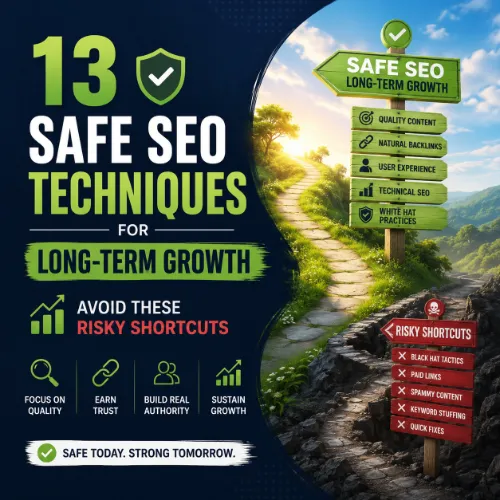
safe SEO techniques Key Takeaways
Each technique below is actionable, ethical, and supported by evidence from real-world SEO campaigns.
- Prioritize user intent and content quality over keyword density for sustainable safe SEO techniques .
- Technical fundamentals like site speed, secure connections, and clean internal linking support every other effort.
- Regular content audits and ethical link building prevent stagnation and reduce risk of algorithmic penalties.
Why Safe SEO Techniques Matter for Long-Term Growth
Search engines update their algorithms hundreds of times each year. Many of those updates target manipulative practices — keyword stuffing, unnatural link schemes, thin affiliate pages, and cloaking. Businesses that rely on shortcuts often see traffic spikes followed by sudden collapses when Google rolls out a core update. Safe SEO techniques avoid this cycle by aligning with what search engines genuinely reward: relevance, authority, and positive user experience. For a related guide, see 9 Backlink Mistakes That Hurt Rankings—Avoid These Costly Errors.
Beyond avoiding penalties, long-term SEO growth builds cumulative advantages. A well-researched piece of content earns backlinks over months and years. A technically sound site maintains its indexability across redesigns. Ethical link building creates relationships that produce referrals beyond search traffic. These compounding effects are impossible to replicate with risky tactics. For a related guide, see 15 White Hat Link Building Methods: Proven Strategies for Ethical SEO.
13 Safe SEO Techniques for Sustainable Results
Each technique below is actionable, ethical, and supported by evidence from real-world SEO campaigns. Use them as a checklist for your ongoing strategy.
1. Target Search Intent Before Keywords
Keyword research remains essential, but intent mapping is more important. A keyword like “best running shoes” can indicate commercial investigation or purchase intent depending on the modifier. Group your target queries by intent — informational, navigational, commercial, transactional — and match content format, length, and tone to user expectations. Tools like Ahrefs Keywords Explorer show SERP features and top-ranking page types that reveal intent signals.
Implementation: for each focus keyword, analyze the top 10 results. Are they blog posts, product pages, category pages, or videos? If most results are listicles, write a listicle. If Google shows a featured snippet with a definition, include a clear definition early in your content.
Benefit: aligning with intent improves click-through rates, reduces bounce rates, and increases the likelihood of earning a featured snippet — all without any manipulative tactics.
2. Build Topical Authority Through Content Clusters
Instead of writing isolated articles on loosely related topics, build content clusters around pillar pages. A pillar page covers a broad topic comprehensively, and supporting cluster posts explore specific subtopics in depth. Internal links connect each cluster post back to the pillar and to each other, creating a semantic web that signals expertise to search engines.
Implementation: choose a core topic like “content marketing.” Write a pillar page (2000+ words) covering strategy, tools, measurement, and channels. Then create cluster posts for each subtopic: “How to Create a Content Calendar,” “Top Content Marketing KPIs,” “Content Distribution Channels That Work.” Link each cluster post to the pillar with relevant anchor text.
Benefit: this structure helps Google understand your site’s expertise on a topic, which can improve rankings for multiple related queries over time.
3. Optimize Core Web Vitals and Page Experience
Page experience signals — Largest Contentful Paint, First Input Delay, Cumulative Layout Shift — are ranking factors. They directly affect how users perceive your site. Slow-loading pages with layout shifts increase bounce rates and reduce conversions, regardless of keyword targeting.
Implementation: run a site audit with Ahrefs Webmaster Tools or Google PageSpeed Insights. Identify pages with poor LCP (over 2.5 seconds), high CLS (over 0.1), or long FID. Common fixes include compressing images, removing render-blocking resources, using a CDN, and optimizing server response times. For WordPress sites, caching plugins and a lightweight theme help significantly.
Benefit: better Core Web Vitals improve user retention and can give a ranking boost, especially on mobile searches where speed matters most.
4. Earn Editorially Given Backlinks
Not all links are equal. Editorial backlinks — given voluntarily because your content is genuinely valuable — carry the most trust and authority. Buying links, participating in link schemes, or using private blog networks violates Google’s guidelines and can lead to manual action.
Implementation: create linkable assets: original research, comprehensive guides, data visualizations, free tools, or expert roundups. Then promote them through genuine outreach to journalists, bloggers, and industry sites. Tools like Ahrefs Content Explorer help find pages that have linked to similar resources, giving you an outreach list.
Benefit: editorial links increase your Domain Rating, drive referral traffic, and are much more resilient to algorithm updates compared to paid or spammy links.
5. Conduct Regular Content Audits and Prune Thin Pages
Old, low-quality content drags down your site’s overall authority. Google may view it as evidence of a neglected site. A content audit identifies pages with low traffic, high bounce rates, or outdated information that no longer serves users.
Implementation: export your top URLs from Google Search Console and Ahrefs. Score each page on relevance, accuracy, traffic, and link equity. Options include updating the content, merging it with a stronger page (301 redirect), or removing it. For pages with no traffic, no backlinks, and no internal references, deletion or noindexing is usually the best choice.
Benefit: cleaning up thin content improves the average quality of your site, which can positively affect rankings for your best pages.
6. Use Descriptive, Unique Title Tags and Meta Descriptions
Title tags and meta descriptions remain critical for click-through rates. They are the first impression users see in search results. Generic titles like “Home” or “Services” waste this valuable real estate.
Implementation: for each page, write a title tag that includes the primary keyword near the beginning, stays under 60 characters, and is unique across the site. Meta descriptions should be between 150 and 160 characters, include a call to action, and accurately reflect the page content. Avoid keyword stuffing — write for humans first.
Benefit: higher click-through rates from search results mean more traffic even if your ranking doesn’t change. This also signals to Google that users find your result relevant, which can support ranking improvements.
7. Structure Content with Clear Headings and Semantic HTML
Search engines use heading hierarchy to understand content structure and topic progression. A well-organized page helps Google extract key points for featured snippets and People Also Ask boxes. It also improves readability for users scanning the page.
Implementation: use one H1 per page (the main title), H2s for major sections, H3s for subsections, and H4s rarely for deeper details. Include relevant keywords naturally in headings, but prioritize clarity over optimization. Maintain a logical flow — don’t skip heading levels.
Benefit: better content structure leads to higher relevance signals for target queries and can increase the chance of earning rich snippets.
8. Optimize for Voice Search and Natural Language Queries
Voice searches tend to be longer and more conversational: “what are the best safe SEO techniques for small businesses?” Unlike typed queries, voice results often come from featured snippets or pages that directly answer the question in a concise, natural way.
Implementation: identify question-based keywords in your data — phrases starting with “how,” “what,” “why,” “can,” “does.” Create dedicated FAQ sections, use structured data (FAQ schema), and write answer paragraphs that directly respond to those questions in a conversational tone.
Benefit: capturing voice search queries increases traffic from mobile and smart speaker users, and often overlaps with featured snippet opportunities.
9. Improve Internal Linking Structure
Internal links distribute link equity throughout your site, help search engines discover new content, and guide users to relevant pages. Many SEOs focus heavily on external links but neglect internal linking, which is fully under your control.
Implementation: conduct a site audit to identify orphan pages — pages with no internal links pointing to them. Add contextual links from high-authority pages (like your blog or pillar content) to these pages. Ensure anchor text describes the target page content. Use breadcrumb navigation for larger sites.
Benefit: improved internal linking increases crawl efficiency, helps newer pages gain visibility faster, and can boost rankings for pages that lack external link equity.
10. Leverage Schema Markup for Rich Results
Structured data helps search engines understand your content’s context and format. It can unlock rich results like star ratings, recipe cards, event listings, product prices, and FAQ accordions — all of which increase visibility and click-through rates.
Implementation: choose the most relevant schema type for your content — Article, Product, FAQPage, HowTo, LocalBusiness, or Review. Use Google’s Structured Data Markup Helper to generate JSON-LD, then test it with the Rich Results Test. For WordPress sites, plugins like Schema Pro or Rank Math simplify the process.
Benefit: rich results stand out in SERPs, taking up more space and often achieving higher click-through rates than standard listings.
11. Perform Technical SEO Audits Quarterly
Technical issues — broken links, redirect chains, duplicate content, crawl errors — accumulate over time and silently erode rankings. Regular audits catch these problems before they cause significant damage.
Implementation: use Ahrefs Site Audit or Screaming Frog to scan your site for common issues. Pay attention to: pages returning 4xx or 5xx status codes, missing meta tags, duplicate title tags, slow-loading URLs, and pages blocked by robots.txt. Prioritize fixes that affect the most traffic or the highest-authority pages.
Benefit: a technically healthy site ensures search engines can crawl, index, and render your content efficiently, giving every other SEO effort a solid foundation.
12. Create Content for Real Users, Not Just Search Engines
The most durable safe SEO techniques center on user value. Content that genuinely helps people — answers their questions, solves problems, entertains, or educates — earns shares, mentions, and backlinks naturally. It also satisfies Google’s Helpful Content system, which rewards people-first content.
Implementation: before writing, ask: “What does the reader need to know after reading this?” Structure your content to deliver that value clearly. Use real examples, case studies, or original data. Avoid fluff, generic advice, or keyword-stuffed paragraphs. Write for one person, not an algorithm.
Benefit: people-first content builds brand trust, encourages repeat visits, and has a much longer shelf life than thin, optimized-for-robots content.
13. Monitor and Adapt to Algorithm Updates
Google’s algorithms evolve constantly. What works today may be less effective tomorrow. Staying informed about major updates (core updates, reviews system updates, spam updates) helps you adjust strategy proactively rather than reacting to traffic drops.
Implementation: follow official Google Search Central blogs, reputable SEO news sites, and community forums. When an update rolls out, compare your site’s traffic and rankings before and after. Look for patterns — did pages with certain characteristics lose or gain? Adjust your content strategy accordingly. Never panic and make drastic changes; small, measured adjustments are safer.
Benefit: staying adaptable keeps your site resilient to algorithm changes and helps you capitalize on new ranking opportunities as they emerge.
SEO Entities and Their Functions
Understanding the entities that influence search performance helps you make informed decisions during audits and optimization. Here are the most relevant ones for safe SEO techniques:
- Root domain, subdomain, and URL-level analysis: identifies whether performance belongs to the whole site, a section like blog.example.com, or a single page such as example.com/page. Essential for isolating issues to specific areas.
- Keyword entities: organic keywords, keyword difficulty (KD), search volume, traffic potential, SERP features: show demand, competition, ranking opportunity, and result-type requirements. Use these to prioritize target queries.
- Backlink entities: referring domains, dofollow/nofollow links, broken backlinks, new/lost backlinks: explain authority, link quality, link risk, and outreach priorities. Monitor new and lost backlinks regularly.
- Page entities: top pages, best by links, best by traffic, broken pages, internal pages: reveal which URLs earn visibility, links, traffic, or need repair. Focus optimization efforts on pages with high traffic potential but poor performance.
- Content entities: articles, authors, topics, published dates, social shares, referring domains to content: help evaluate editorial quality, freshness, authorship, and link attraction. Older content with high backlink counts is worth refreshing.
- SERP entities: featured snippets, People Also Ask, sitelinks, AI Overviews, video results, local packs: show what content format and answer structure the search result rewards. Target featured snippets with concise, direct answers.
- Technical SEO entities: crawl issues, redirect chains, canonicals, duplicate content, Core Web Vitals, indexability status: expose obstacles that prevent crawling, ranking, or a good page experience. Fix these before focusing on content expansion.
- Competitor entities: competing domains, content gap opportunities, link intersect domains, shared keywords: show where rivals win traffic and where your site can catch up. Use tools like Content Gap to find keywords competitors rank for but you don’t.
- Metrics entities: Domain Rating (DR), URL Rating (UR), traffic value, organic traffic, referring domains count: summarize authority, URL strength, market value, and search visibility. Track these monthly to measure progress.
Useful Resources
For deeper dives into specific techniques, these resources are regularly updated and credible:
- Google’s Helpful Content System Guide — official guidance on creating people-first content that aligns with search quality standards.
- Ahrefs Blog: Safe SEO Techniques That Work — a practical article covering 11 effective techniques with real-world examples and data.
Start Building With Safe SEO Techniques Today
Focusing on safe SEO techniques isn’t just about avoiding penalties — it’s about creating a foundation for sustainable growth. Each technique described here works in harmony with the others: content quality supports link earning, technical health supports content visibility, and user intent supports engagement. The result is a site that earns trust from both users and search engines, and that trust compounds over time. Begin with one technique from this list — perhaps a content audit or an internal linking improvement — and build from there.
Frequently Asked Questions About safe SEO techniques
What are safe SEO techniques ?
Safe SEO techniques are strategies that align with search engine guidelines, focus on providing value to users, and avoid manipulative shortcuts that risk penalties. They include content quality, technical optimization, ethical link building, and user experience improvements. For a related guide, see 8 Advanced Technical SEO Techniques to Avoid Risky Mistakes.
How do safe SEO techniques differ from black hat SEO?
Black hat SEO uses tactics that violate search engine guidelines, such as keyword stuffing, cloaking, link farms, and hidden text. Safe SEO techniques follow the rules and aim for long-term, sustainable growth without risk of manual action or algorithmic penalties.
Can safe SEO techniques still get results quickly?
Results from safe SEO techniques typically take longer — often 3 to 6 months to see meaningful movement — but they compound over time. Shortcuts may produce faster initial results, but they come with high risk of reversal.
How do I know if my SEO tactics are safe?
If a tactic would mislead a user or a search engine, it’s not safe. Read Google’s Webmaster Guidelines and use tools like Ahrefs Site Audit to check for red flags such as unnatural links, hidden content, or keyword stuffing.
What is the most important safe SEO technique for beginners?
Focus on content quality. Write pages that genuinely answer the questions your target audience is asking. That foundation supports every other SEO effort — links, social shares, and user engagement.
Do safe SEO techniques work for local businesses?
Absolutely. Local businesses benefit from safe techniques like optimizing Google Business Profile, earning local citations, gathering authentic reviews, and creating locally relevant content. These methods build trust with both users and search engines.
How often should I conduct a content audit?
At least once per quarter. Regular audits help you identify outdated information, thin pages, and content that no longer aligns with user intent or business goals. This keeps your site fresh and authoritative.
Is guest posting a safe SEO technique?
Guest posting is safe when done correctly: writing high-quality articles for relevant, reputable sites with genuine editorial value. Avoid mass guest posting solely for links, and always disclose any sponsored relationships.
What is the role of internal linking in safe SEO?
Internal links distribute link equity across your site, help users navigate, and allow search engines to discover all your pages. It’s a fully controlled, low-risk technique that supports both user experience and SEO.
Can social media activity help safe SEO?
Social signals are not a direct ranking factor, but social media can amplify your content, leading to more visibility, shares, and potentially backlinks. It’s a complementary strategy when used ethically.
How do I recover from a Google penalty using safe methods?
Identify the cause first — a manual action or algorithmic penalty. For manual penalties, remove or disavow unnatural links, fix problematic content, and submit a reconsideration request. For algorithmic drops, improve content quality and user experience steadily over time.
Are schema markup and structured data safe?
Yes, as long as you use it accurately. Mark up content that actually exists on the page. Using misleading or irrelevant schema (like marking a simple blog post as a recipe) can lead to manual action.
What is the difference between white hat and safe SEO?
White hat SEO is a subset of safe SEO that strictly follows search engine guidelines. Safe SEO is a broader concept that includes risk-aware strategies, not all of which are explicitly defined in guidelines (e.g., competitive analysis). Both avoid manipulative tactics.
Should I use exact match anchor text for internal links?
Using exact match anchor text sparingly for internal links is fine, but vary anchor text with partial matches, brand terms, and generic phrases to avoid over-optimization signals.
Can A/B testing help with safe SEO?
Yes, but use caution. Avoid hiding different versions from search engines or showing different content to users vs. crawlers. Test elements like headlines, CTAs, and images while keeping the core page content consistent.
How do I choose safe keywords to target?
Look for keywords with clear search intent, reasonable keyword difficulty (below 40–50 for most sites), and enough search volume to make optimization worthwhile. Avoid keywords that suggest inappropriate or spam-adjacent content.
Is buying backlinks ever safe?
No. Buying links violates Google’s Webmaster Guidelines. Even if undetected initially, these links often become devalued or trigger penalties during algorithmic updates. Safe SEO relies on earning links editorially.
How long should my content be for safe SEO?
Content length should match the topic and intent. Informational articles often perform well at 1500–2500 words, while product pages can be shorter. The key is thoroughness, not word count. Cover the topic completely without fluff.
Do safe SEO techniques require technical skills?
Some techniques — like fixing redirects or implementing schema — require technical knowledge. However, many safe practices (content writing, keyword research, internal linking) are accessible to non-technical marketers. Start with what you can handle and learn gradually.
Can I rank without backlinks using safe SEO?
For very low-competition keywords, yes — high-quality content and solid technical SEO can be enough. For competitive terms, backlinks are usually necessary. Focus on earning links by creating genuinely link-worthy content.