
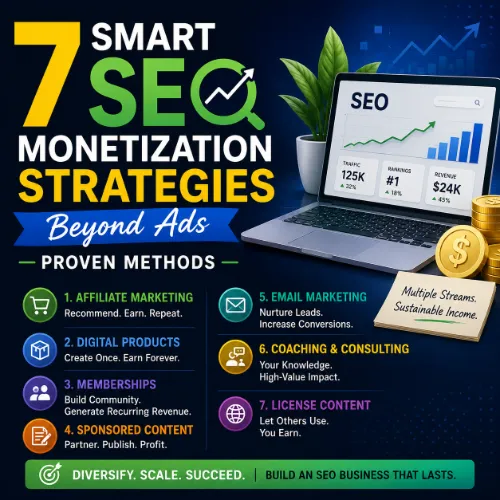
SEO monetization strategies beyond ads Key Takeaways
Affiliate marketing is the most common and scalable SEO monetization strategy beyond ads .
- The most effective SEO monetization strategies beyond ads start with audience intent and content depth, not just pageviews.
- Affiliate marketing, digital products, and paid communities consistently outperform ad-only models for niche publishers.
- Diversifying revenue protects your site from algorithm updates and fluctuating CPM rates.
Why Relying on Ads Limits Your Revenue Potential
Display ads have long been a default way to earn from website traffic. But ad revenue often demands massive traffic volumes, depresses user experience, and offers little control over earnings. When you explore SEO monetization strategies beyond ads, you shift from a volume-based model to a value-based one. Instead of selling attention, you sell solutions, expertise, and access. For a related guide, see 10 Proven Internal Linking Strategies That Boost SEO.
Ad blockers, shrinking CPMs, and ad fatigue further reduce the reliability of ad income. Diversifying into multiple revenue streams not only increases total earnings but also builds a more resilient business. Readers who trust your content are far more likely to buy a product, join a membership, or click an affiliate link than they are to click a banner ad.
1. Affiliate Marketing: Match Products to Search Intent
Affiliate marketing is the most common and scalable SEO monetization strategy beyond ads. The key is to promote products your target audience actively searches for. When a visitor lands on a comparison article or a best-of list, an honest recommendation backed by personal experience converts far better than any sidebar ad.
How to Implement Affiliate Marketing for SEO Traffic
Start by identifying commercial intent keywords within your niche—terms like “best running shoes for flat feet” or “affordable CRM for freelancers.” Write detailed, helpful content that compares features, shares pros and cons, and includes your affiliate link naturally. Disclose your relationship clearly to maintain trust. Use analytics to track which pages and products generate the most clicks and revenue, then double down on those topics.
Tools like Ahrefs Keywords Explorer can help you find low-competition, high-intent terms that have strong affiliate potential.
2. Digital Products: Create What Your Audience Needs
Selling your own digital products gives you full control over pricing, margins, and customer relationships. Ebooks, templates, online courses, and printable checklists are all formats you can market directly to your organic audience. Because these products solve specific problems, they align perfectly with SEO traffic that arrives with a problem to solve.
Choosing the Right Digital Product Format
Survey your existing readers or analyze the questions they ask in comments and emails. A common request like “Can you show me how to create a budget template?” is a clear signal to design a premium spreadsheet or short video course. Price your product based on the value it delivers, not the time it took to make. A $47 ebook that saves a business owner 10 hours a week is a bargain.
Promote your product on your highest-traffic informational pages—the ones where readers are learning the basics. Add a soft call-to-action at the end of a guide, linking to a product that goes deeper into the topic.
3. Membership and Subscription Models
Recurring revenue through memberships provides predictable income and deepens audience loyalty. This SEO monetization strategy beyond ads works especially well for sites that consistently publish high-value, niche content. Exclusive articles, video tutorials, data reports, or community access become the draw.
Setting Up a Paid Membership That Converts
Offer a tiered model: free content for SEO-driven discovery, then a low-cost tier for bonus material, and a premium tier for one-on-one access or detailed case studies. Use the free content to demonstrate quality and build trust. Platforms like MemberPress or Patreon handle the technical side. The key is to make the paid experience noticeably richer than the free experience.
4. Sponsored Content and Brand Partnerships
Once your site establishes authority in a niche, brands will pay to be featured. Unlike display ads, sponsored content is integrated into your editorial flow—a product review, a tutorial, or a roundup post that highlights a sponsor. This approach preserves user experience while generating higher CPMs. For a related guide, see 10 Proven Humanization Techniques for AI Content That Feel Natural.
Pitching and Pricing Sponsored Opportunities
Create a media kit that shows your traffic, audience demographics, and engagement rates. Reach out to companies that already advertise in your space. Propose a specific content angle, such as “How [Brand] Solves [Pain Point] for [Audience].” Price based on the value of a dedicated post, not per thousand impressions. A well-written sponsored article can earn 5–10x the revenue of display ads on the same page.
5. Selling Services and Consulting
Your SEO traffic likely includes business owners or professionals who need help implementing what they read. If you’re an expert in your field, offering consulting, coaching, or done-for-you services is a natural extension. This SEO monetization strategy beyond ads lets you leverage your content as a lead generation machine.
Creating a Service Funnel from Organic Traffic
Add a “Work With Me” or “Book a Consultation” page to your site. At the end of relevant articles, include a call-to-action like “Need help implementing this for your business? I offer 1:1 consulting.” Use a booking tool like Calendly to streamline scheduling. Charge a premium rate because your content has already pre-qualified the lead—they know you understand the topic deeply.
6. Premium Newsletters and Email Courses
Email marketing remains one of the highest-ROI channels. By offering a paid newsletter or a structured email course, you convert casual readers into paying subscribers. The content is delivered directly to their inbox, making it convenient and actionable.
Building a Paid Newsletter That People Want
Start with a free newsletter to build your list and prove value. Then introduce a paid tier that includes weekly deep dives, exclusive interviews, or early access to content. Use your best SEO articles as lead magnets—when someone lands on a top-performing post, offer a free email course related to that topic. Once they trust your voice, they’ll upgrade to the paid version.
7. License Your Content or Data
For publishers with unique data sets, proprietary research, or highly specialized content, licensing is an overlooked SEO monetization strategy beyond ads. Other websites, media outlets, or businesses will pay to republish your original research, infographics, or white papers.
How to License Content Ethically
Conduct original surveys, compile industry statistics, or create in-depth guides that no one else has. Add a licensing page that explains how others can use your content. Reach out to editors at larger publications who might purchase a license to republish. Include a backlink to your original post in the license terms to preserve SEO value.
Useful Resources
To deepen your understanding of SEO monetization strategies beyond ads, explore these resources:
- Ahrefs Guide to Affiliate Marketing and SEO — Practical advice for combining content and affiliate promotions.
- Neil Patel: How to Monetize a Website Without Ads — A comprehensive overview of non-ad revenue models.
Frequently Asked Questions About SEO monetization strategies beyond ads
What is the fastest way to monetize SEO traffic without ads?
Affiliate marketing typically generates revenue the fastest because you can add affiliate links to existing high-traffic posts. Focus on products with strong relevance to your audience and use comparison or best-of formats.
Can I earn from SEO traffic with a small audience?
Yes. Digital products and consulting services work well even with modest traffic, as long as the audience trusts your expertise. A 1,000 loyal readers can generate more revenue than 50,000 casual visitors.
How do I choose between selling a product or a membership?
If your content offers a one-time solution (e.g., a budget template), sell a product. If you produce ongoing information (e.g., industry trends), a membership model provides recurring income.
Do sponsored posts hurt SEO?
No, as long as the content adds value and you use the proper rel="sponsored" attribute on links. Google rewards high-quality sponsored content that satisfies user intent.
How do I transition from ad revenue to other monetization methods?
Start by adding one affiliate link to your most popular post. Then create a free email course. As revenue grows, reduce ad density gradually to avoid shocking your user experience or earnings.
Should I remove all ads once I start other monetization?
Not necessarily. A hybrid model that combines a few non-intrusive ads with affiliate links or digital products often maximizes total revenue. Test different ratios to find the best balance.
Can I sell both informational and commercial products?
Absolutely. For example, a fitness blog can sell a meal plan (digital product) while also promoting supplement brands through affiliate links. Just ensure each offer matches the intent of the traffic.
What type of content works best for membership sites?
Membership sites thrive on in-depth tutorials, exclusive data, community interaction, and expert Q and As. The content should be something users can’t easily find for free elsewhere.
How much should I charge for a digital product?
Price based on the value delivered. A $297 online course that saves someone hundreds of dollars is reasonable. For lower-ticket items like templates, $9–$47 works well.
Is email marketing necessary for monetization?
Not strictly, but it dramatically improves conversion rates. An email list allows you to nurture leads over time, announce new products, and drive repeat traffic to monetized content.
What are the risks of relying only on affiliate marketing?
Affiliate income can drop if commission rates change or if the merchant discontinues the program. Diversify across multiple affiliate networks and supplement with your own products.
How do I find the right affiliate partners?
Look for products you personally use or that have strong reviews in your niche. Join networks like ShareASale, Impact, or CJ Affiliate. Check the merchant’s conversion rates and cookie duration.
Can I license my content if I have a small blog?
Yes, if you have original data, a unique perspective, or a very niche topic. Small blogs can license a single infographic or a detailed guide to a larger website in the same industry.
How do I price consulting services?
Base your rate on industry standards for your niche, your years of experience, and the value you provide. Beginners might charge $75–150/hour, while experts can command $300+/hour.
Should I offer a free trial for my membership?
Yes. A 7- or 14-day free trial reduces the perceived risk and lets potential members see the value before committing. Just ensure the free trial leads to premium content quickly.
How do I measure success for non-ad monetization?
Track revenue per visitor, conversion rate, average order value, and recurring revenue. Compare these metrics against your previous ad-only performance to gauge improvement.
Can I use multiple monetization methods on the same page?
Yes, but be strategic. For example, include an affiliate link in a product review and a call-to-action for your email course at the bottom. Avoid overwhelming the reader with too many offers.
How long until I see results from non-ad monetization?
Affiliate and sponsored revenue can start within days if you have existing traffic. Digital products and memberships may take 1–3 months to build traction. Consistent promotion shortens this timeline.
What is the most sustainable SEO monetization strategy beyond ads ?
A combination of affiliate marketing and a digital product or membership creates a balanced, sustainable model. This mix diversifies risk and builds multiple income streams from the same traffic.
Do I need a large email list to launch a paid newsletter?
No, but you need a highly engaged list. A list of 500 loyal subscribers converts better than 5,000 inactive ones. Focus on building trust and delivering value before asking for payment.