
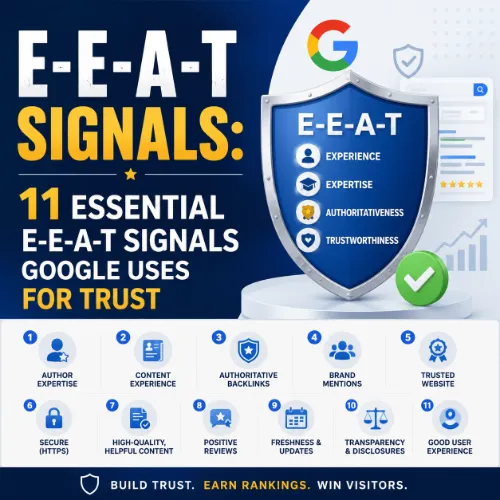
E E A T signals Key Takeaways
Google’s quality rater guidelines center on Experience, Expertise, Authoritativeness, and Trustworthiness (E-E-A-T).
- Key E-E-A-T signals include author bios, cited sources, positive reviews, and secure site infrastructure.
- Building topical authority through consistent, high-quality publishing is one of the strongest trust indicators.
- User engagement metrics like low bounce rates and high dwell time indirectly signal trust to Google.
Why E-E-A-T signals Matter More Than Ever
Google’s search quality team evaluates content against four pillars: Experience, Expertise, Authoritativeness, and Trustworthiness. Together, these form E-E-A-T, a framework that rewards creators who demonstrate firsthand knowledge, credible credentials, and reliable information. In 2024 and beyond, sites that prioritize E-E-A-T ranking factors consistently outperform competitors in organic search. For a related guide, see E-E-A-T Explained: 5 Essential Credibility Boosters for Your Site.
For YMYL pages—health, finance, legal—Google applies stricter scrutiny. Without clear E-E-A-T signals, even well-written articles may struggle to rank. The following checklist covers 11 actionable signals that help search engines trust your content.
11 Essential E-E-A-T signals Google Looks For
1. Verified Author Expertise
Google’s guidelines ask raters to check whether content is created by someone with recognized expertise. Display author names, credentials, and links to professional profiles (e.g., LinkedIn, academic institutions). For medical pages, a doctor’s byline and medical review badge are strong E-E-A-T signals.
2. Firsthand Experience
Experience means the creator has real-world involvement with the topic. A recipe blog written by a professional chef carries more weight than a generic summary. Showcase product testing, travel photos, or case studies to prove direct experience.
3. Cited Reputable Sources
Linking to authoritative sources like government databases, peer-reviewed journals, or industry standards (e.g., NIH for health topics) improves credibility. Each citation acts as a trust anchor, reinforcing your content’s accuracy.
4. Positive Online Reputation
Reviews on platforms like Google Business Profile, Trustpilot, or Better Business Bureau contribute to authoritativeness. A brand with consistently positive feedback sends a strong trust signal. Actively manage and respond to reviews to maintain a healthy reputation. For a related guide, see Social Signals SEO: 5 Powerful Facts to Boost Rankings.
5. Clear Content Attribution
Every article should clearly state who wrote it, when it was published, and when it was last updated. A visible “Last Updated” date and author credit show transparency and freshness—both important E-E-A-T ranking factors.
6. Accurate and Fact-Checked Information
Google values correctness. Factual errors, broken statistics, or outdated claims harm trust. Use tools like fact-checking plugins (e.g., Google Fact Check Explorer) and cite primary data to ensure accuracy.
7. Professional Website Design
A clean, fast, mobile-friendly design signals professionalism. Broken layouts, slow load times, or intrusive ads reduce perceived trustworthiness. Ensure your site passes Core Web Vitals and offers intuitive navigation.
8. Secure HTTPS Connection
HTTPS is a baseline requirement. Google flags non-secure sites as untrustworthy, especially on pages handling personal data. Install a valid SSL certificate and enforce HTTPS across all pages.
9. Consistent Topical Coverage
Publishing multiple articles on a specific topic—each adding depth—builds topical authority. A law firm writing 30 articles on employment law signals deep expertise, one of the strongest E-E-A-T signals in competitive niches.
10. User Engagement Metrics
High dwell time, low bounce rate, and social shares indicate that readers find your content useful. Google interprets engagement as a trust proxy. Improve readability with short paragraphs, visuals, and clear subheadings.
11. Third-Party Endorsements
Earned backlinks from reputable websites act as votes of confidence. A link from a university, government site, or industry leader boosts authoritativeness. Quality links remain a core Google E-E-A-T signals checklist item.
SEO Entities and Their Functions
Understanding how search engines evaluate E-E-A-T ranking factors becomes easier when you know the underlying data points. Below are key entities that support E-E-A-T analysis.
- Keyword entities: Organic keywords, keyword difficulty (KD), and search volume help identify which topics you can authoritatively cover.
- Backlink entities: Referring domains, dofollow/nofollow links, and anchor text reveal the quality of third-party endorsements.
- Content entities: Authors, published dates, and social shares help evaluate editorial quality and freshness.
- Technical SEO entities: Crawl issues, canonicals, and Core Web Vitals expose trust barriers like broken pages or slow load times.
- Metrics entities: Domain Rating (DR), URL Rating (UR), and organic traffic summarize your site’s authority and visibility at a glance.
Useful Resources
Deepen your understanding of E-E-A-T signals with these trusted guides:
- Google Search Central: E-E-A-T Overview – Official documentation on how Google defines and evaluates E-E-A-T.
- Search Engine Land: What Is E-E-A-T? – Practical breakdown of E-E-A-T with real-world examples.
Frequently Asked Questions About E E A T signals
What are the 11 E-E-A-T signals ?
The 11 key E-E-A-T signals include verified author expertise, firsthand experience, cited reputable sources, positive online reputation, clear attribution, accurate information, professional design, HTTPS, consistent topical coverage, user engagement metrics, and third-party endorsements.
Does Google use E-E-A-T as a direct ranking factor?
Google has stated that E-E-A-T is not a direct ranking factor, but the signals that support it—like backlinks, reviews, and expertise—directly influence rankings. Improving E-E-A-T signals indirectly boosts organic performance.
How do I check my site’s E-E-A-T?
Review your content for author bios, source citations, HTTPS, load speed, and online reputation. Tools like the Google Search Quality Rater Guidelines provide a self-assessment framework.
What is a YMYL page?
YMYL stands for “Your Money or Your Life.” These are pages that could impact a person’s health, financial stability, safety, or well-being. Google applies stricter E-E-A-T ranking factors to YMYL content.
Can a new website have strong E-E-A-T?
Yes, by featuring expert authors, citing credible sources, securing HTTPS, and building positive reviews. New sites can earn trust quickly if they follow the Google E-E-A-T signals checklist from day one.
Do backlinks affect E-E-A-T?
Yes. Backlinks from authoritative domains act as third-party endorsements, strengthening authoritativeness—one of the core E-E-A-T signals.
How can I prove firsthand experience in my content?
Include original photos, personal testimonials, case studies, or product testing results. Show that you have directly interacted with the topic.
What role does website design play in E-E-A-T?
Professional design, fast load times, and mobile responsiveness signal trust. A poorly designed site undermines perceived authority.
Is HTTPS mandatory for E-E-A-T?
Not officially, but Google flags non-HTTPS sites as less secure, hurting trust. For YMYL pages, HTTPS is essential.
How often should I update my content for E-E-A-T?
Regularly review and refresh statistics, dates, and references. Content that is clearly outdated signals low trustworthiness.
Do user reviews count as E-E-A-T signals ?
Yes, especially on third-party platforms. Positive reviews on Google, Trustpilot, or industry directories enhance reputation.
What is the difference between expertise and experience in E-E-A-T?
Expertise refers to formal credentials or deep knowledge. Experience means hands-on involvement. Both are distinct E-E-A-T ranking factors that Google evaluates separately.
Can duplicate content hurt my E-E-A-T?
Yes. Duplicate content can confuse search engines and reduce perceived originality, weakening trust signals.
Do social signals impact E-E-A-T?
Indirectly. High social shares indicate content value, which can lead to backlinks and engagement—both trust indicators.
How do I find broken backlinks for trust repair?
Use tools like Ahrefs or Screaming Frog to identify broken backlinks. Fixing 404 links improves user experience and trust.
What is a content gap analysis for E-E-A-T?
It identifies topics your competitors cover that you don’t. Filling those gaps demonstrates topical breadth, strengthening authority.
Does page speed affect E-E-A-T?
Yes. Slow loading frustrates users and signals poor technical quality, damaging trust. Core Web Vitals are part of the user experience evaluation.
How can I build topical authority?
Publish a series of in-depth articles on a specific subject, linking them together. Become the go-to resource for that niche.
What is the easiest E-E-A-T signal to implement?
Adding clear author names and credentials to every page. It’s quick, transparent, and immediately boosts perceived trust.
Will AI-generated content fail E-E-A-T?
Not automatically, but AI content often lacks firsthand experience. Adding original research, expert review, and personal anecdotes improves its E-E-A-T signals.