
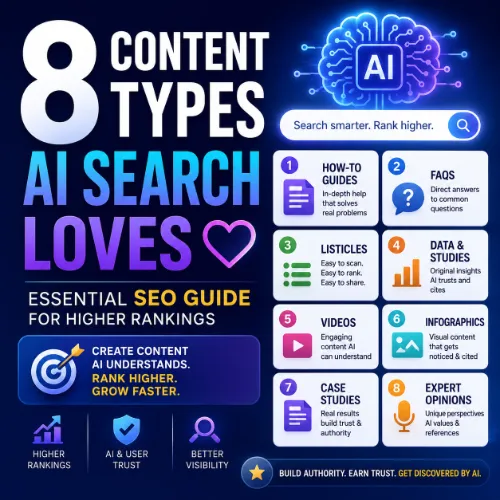
AI content types Key Takeaways
AI-powered search engines now favor structured, authoritative content over simple keyword matching.
- AI content types like comprehensive guides and data-driven lists answer user intent directly, which AI models prioritize.
- Semantic depth, clear structure, and trustworthy sources make content more likely to be cited by AI search engines.
- Practical implementation of these content types leads to higher engagement, lower bounce rates, and improved organic traffic.
Understanding AI content types and Search Engine Priorities
Search engines powered by artificial intelligence—like Google’s Search Generative Experience (SGE) and Bing’s AI-powered chat—analyze content beyond keywords. They evaluate entity relationships, topical authority, and how well a page satisfies a user’s real need. To succeed, you need to create content that answers questions clearly and provides unique value. For a related guide, see 9 Proven Ways Google Understands Entities (2026 Swerte Warning).
The eight AI content types outlined below have proven effective in this new landscape. Each type aligns with how AI models parse information: they look for clear hierarchies, factual depth, and structured data. By adopting these formats, you signal to AI search engines that your page is a reliable source. For a related guide, see 13 Signs Your Website Lacks Topic Depth: Avoid These Content Gaps for 2026.
Below we break down each content type, explain why AI search loves it, and give you actionable tips to create your own.
1. Comprehensive How-To Guides
How-to guides answer specific user queries step by step. AI search engines love them because they directly resolve a search intent with a logical, scannable process. When you break down a task into numbered steps, you make it easy for AI to extract key points and cite your page in featured snippets or AI Overviews.
Why AI Search Ranks How-To Guides Highly
- Step-by-step clarity matches the format AI uses to generate summaries.
- Actionable headings (e.g., “Step 1: Gather Your Tools”) help AI identify each phase.
- Screenshots and diagrams add context, but ensure you use alt text with keywords.
Practical Implementation Tips
Start with a clear goal statement. For example, if you’re writing a guide on “how to optimize for AI content types,” include a list of materials or prerequisites. Use
for each step, keep paragraphs short, and link to reputable sources for additional context.
2. Listicles with Data-Driven Insights
Listicles remain popular because they break complex topics into digestible items. AI search engines appreciate the structured format—each list item acts as a mini-section that can be quoted independently. Adding statistics and research turns a simple list into an authoritative resource.
Why AI Prefers Data-Backed Lists
- Named entities (tools, metrics, authors) improve semantic relevance.
- Numbered lists create natural anchor points for AI to reference.
- Original data (e.g., your own survey results) makes the content difficult to replicate.
Example Tip
For a post titled “8 Content Types AI Search Loves,” each point (like this one) includes a clear heading and supporting facts. You can apply the same pattern to any industry—just ensure every list item stands alone as a useful insight.
3. Pillar Pages and Topic Clusters
A pillar page covers a broad topic in depth, while cluster posts explore subtopics and link back to the pillar. AI search engines see this as a sign of topical authority. The internal linking structure helps AI understand which page is the most comprehensive source.
Why This AI content type Works
- Central hub for a key topic (e.g., “SEO fundamentals”) consolidates authority.
- Related clusters address specific queries (e.g., “keyword research for AI search”) and link to the pillar.
- AI models can traverse these links to confirm topic mastery.
How to Build a Pillar Page
Choose a broad keyword like “AI search optimization.” Write a 2000+ word guide that covers definitions, strategies, and examples. Then create 5–10 cluster posts on sub-topics like “structured data for AI” or “entity-based content.” Link every cluster post back to the pillar.
4. Structured Data-Rich Content
When you implement schema markup (FAQ, HowTo, Article, etc.), you provide explicit instructions to AI about your content’s meaning. This increases your chance of appearing in rich results and being used in AI-generated answers.
Why Schema Signals Trust
- FAQ schema directly feeds AI-powered answer boxes.
- HowTo schema adds step-by-step instructions with multimedia.
- Breadcrumb and Article schema clarify context and authorship.
Implementation Check
Use a tool like Google’s Rich Results Test to validate your markup. For example, adding FAQ schema to your post can help AI display your Q and A right in the search result, improving click-through rates.
5. Expert Roundups and Original Research
Original research—surveys, experiments, or interviews—creates fresh data that AI models can’t find elsewhere. Expert roundups gather multiple perspectives, increasing the page’s authority and backlink potential.
What AI Search Values Most
- Unique statistics become quotable facts for AI summaries.
- Named contributors add credibility and entity signals.
- Publication date matters: AI favors recent data for timely queries.
Quick Start Guide
Identify a trending question in your niche. Survey your audience or reach out to 5–10 experts for their opinions. Compile their answers with proper attribution, and add your own analysis. Promote the final piece to earn backlinks.
6. Comparison Pages and Versus Tables
When users want to choose between options (tools, services, methods), comparison pages directly answer that intent. AI search engines love these because they organize pros, cons, and specs in a clear table format that is easy to parse.
Why Comparisons Rank
- Table markup lets AI extract side-by-side attributes.
- Decision-focused headings (e.g., “Tool A vs. Tool B: Pricing”) match user queries.
- Honest evaluation builds trust and reduces bounce rates.
Example Table Structure
| Feature | Tool A | Tool B |
|---|---|---|
| Price | Free / $10 mo | $15 mo |
| Ease of Use | Very easy | Moderate |
| AI Integration | Built-in | Via API |
Always add a short paragraph after the table summarizing the best pick for different user needs.
Frequently Asked Questions About AI content types
What are AI content types ?
AI content types refer to specific content formats that AI-powered search engines prefer, such as how-to guides, listicles, pillar pages, comparison tables, FAQ sections, and original research.
Why do AI search engines favor certain content formats?
AI search engines parse content based on structure, clarity, and entity richness. Formats with clear headings, tables, and bullet points are easier to extract and cite in AI-generated answers.
How can I make my content more AI-friendly?
Use descriptive H2/H3 headings, incorporate structured data (FAQ, HowTo schema), include original data, and build internal links between related pages.
Does AI search care about word count?
Not directly. AI cares about comprehensive coverage of the topic. A well-structured 800-word guide can outperform a 3000-word article if it directly answers the user intent.
Will AI search replace traditional SEO?
No, traditional SEO foundations—backlinks, site speed, mobile-friendliness—still matter. AI search adds new layers like entity understanding and content structure, but does not eliminate existing ranking factors.
What is the best AI content type for beginners?
Start with listicles and FAQ sections because they are easy to structure and naturally align with AI extraction patterns. You can later expand into pillar pages or original research.
How do I measure if my content works for AI search?
Monitor clicks on featured snippets, appearance in AI Overviews, and organic traffic from long-tail queries. Also check your page’s position in People Also Ask boxes.
Do images help AI understand my content?
Yes, but only with descriptive alt text that includes relevant keywords. AI cannot “see” images; it reads the alt text and surrounding context to associate the image with the topic.
Should I use bullet points or paragraphs for AI search?
Both have their place. Use bullet points for key features or steps, and paragraphs for explanations. AI appreciates the clear segmentation that bullets provide.
Can I reuse the same content type for every topic?
You can, but you will miss opportunities. Different topics suit different formats. A comparison page works for product choices, while a case study is better for proving a method’s effectiveness.
How often should I update my pillar pages?
Review pillar pages every six months. Add new data, update examples, and refresh internal links to cluster posts. Freshness signals relevance to AI search engines.
Does internal linking affect AI search?
Yes. AI models use internal links to discover related content and understand site structure. Linking from a pillar page to cluster posts and vice versa strengthens topical authority.
What role do backlinks play for AI content types ?
Backlinks remain a key trust signal. Pages with quality backlinks are more likely to be cited by AI as authoritative sources. Focus on earning links to your most structured content types. For a related guide, see 14 Proven Ways to Earn Editorial Links (Expert Guide).
Is there any content type that AI search dislikes?
Thin content—pages with little substance, duplicate content, or keyword-stuffed articles—perform poorly. AI ignores or buries such pages because they do not provide real value.
Can I combine multiple content types in one post?
Absolutely. For example, a pillar page can include a comparison table, a FAQ section, and a how-to guide. Just ensure the main focus remains clear and the structure does not become chaotic.
How do I find which AI content types my audience needs?
Analyze search queries in Google Search Console, look at People Also Ask suggestions, and check competitor content. Survey your audience directly for pain points.
Does mobile-friendliness affect AI search?
Yes. AI search engines prioritize pages that load quickly and display well on mobile devices. Use responsive design and test your content on various screen sizes.
What is the ideal structure for a case study?
Use a clear H2 for the case study title, then sub-sections: Challenge, Solution, Results (with data), and Key Takeaways. Use quotes and bullet points for impact.
How can I optimize an existing post for AI search?
Add FAQ schema, break long paragraphs into bullet points, include a table for comparisons, and insert a clear summary at the top. Also check internal links and update statistics.
Will AI search ever replace reading articles?
AI search provides summaries, but users still click through for detailed, authoritative content. High-quality pages that answer follow-up questions will continue to attract traffic.