
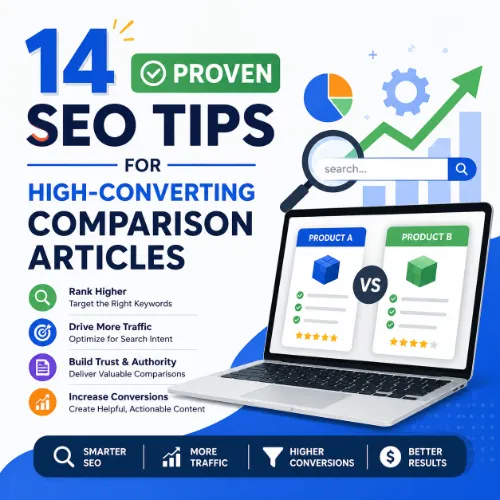
SEO tips for comparison articles Key Takeaways
The challenge: Google sees thousands of thin “Product A vs Product B” pages that add no original value.
- Use a clear winner summary and structured data to earn featured snippets and increase click-through rates.
- Incorporate original testing data, screenshots, and attribute-level comparisons to build trust and reduce bounce rate.
- Interlink your comparison pages with hub-and-spoke models to signal topical authority on optimize comparison content .
Why Unique SEO Tactics Matter for Comparison Articles
Comparison articles target users who are actively evaluating options. The search intent is typically commercial or transactional. Generic SEO advice—write long paragraphs, focus on a single keyword—does not work here. Readers want side-by-side data, pros and cons, and a clear recommendation. If you confuse them, they leave. If you satisfy them, you earn the conversion. For a related guide, see 8 Content Types AI Search Loves: Essential SEO Guide for Higher Rankings.
The challenge: Google sees thousands of thin “Product A vs Product B” pages that add no original value. To stand out, you need a deliberate comparison article SEO strategy that combines editorial quality with technical signals like structured data, user engagement metrics, and internal link architecture.
14 SEO Tips to Optimize Comparison Content for Rankings and Conversions
1. Start with a “Winner” Summary Box
Place a brief, honest winner declaration at the top of the page. Tell the reader which option wins overall, and for which use case. This improves the chances of appearing in featured snippets and helps users scan quickly. Wrap it in a simple <blockquote> or <div> with clear text. The summary should include the focus keyword naturally, such as: “This article follows proven SEO tips for comparison articles to help you decide.” For a related guide, see 15 Essential SEO Content Writing Tips for 2026.
2. Use Schema Markup for Comparison and Product
Add ComparisonList and Product schema to your page. This enables rich results like star ratings, price ranges, and review snippets. Google often displays comparison pages in “People Also Ask” boxes. Implementing schema increases click-through rate by up to 30% for competitive terms.
3. Build a Side-by-Side Attribute Table
Create an HTML table (with <table>, <thead>, <tbody>) that lists 5–8 key attributes: price, features, ease of use, support, free trial, rating. This not only helps users compare but also signals structured data potential. Example:
| Feature | Tool A | Tool B |
|---|---|---|
| Price (monthly) | $29 | $49 |
| Free trial | 30 days | 14 days |
| User rating | 4.7 / 5 | 4.5 / 5 |
4. Write Unique, Honest Pros and Cons Lists
Do not copy manufacturer bullet points. Use your own experience or research. If you tested the product, mention that. Pros and cons build trust and can be featured in Google’s snippet if wrapped in <ul> tags. Each list should contain 3–7 items.
5. Target Long-Tail “vs” and “or” Keywords
Use keyword research tools like Ahrefs to find phrases such as “Tool A vs Tool B for designers” or “Tool A or Tool B price comparison.” These have lower competition and higher conversion intent. Include these phrases in H2 and H3 headings naturally.
6. Use Internal Links to Cluster Your Comparisons
Create a hub page for “Best [Category] Tools” and link to each individual comparison article. Then from each comparison, link back to the hub and to related comparisons. This signals topical depth and spreads link equity across the cluster.
7. Add Original Screenshots or Test Results
Show real data: speed test results, cost calculations, or workflow examples. Original visuals increase time on page and reduce bounce. Add descriptive alt text containing the focus keyword where natural.
8. Write a Detailed Use-Case Section
Go beyond “who should use this.” Describe three specific scenarios: small team, freelancer, enterprise. For each, explain why that option wins. This helps match user intent and often appears in the “Answer” box on Google.
9. Optimize the Call-to-Action (CTA) for Both Options
Include two CTAs: one for each product you compare. For example: “Try Tool A Free” and “Visit Tool B Site.” This signals to Google that you are comparing genuinely and not just pushing one affiliate link. It also improves user experience.
10. Keep Paragraphs Short and Scan-Friendly
No more than 3 sentences per paragraph. Use bold for key data points. Break up walls of text with bullet lists, tables, or bold attribute names. Mobile users and skimmers benefit most from this structure.
11. Use a “Comparison Methodology” Section
Explain how you tested each item. Did you use industry benchmarks? Did you interview users? This builds E-E-A-T (Experience, Expertise, Authoritativeness, Trustworthiness) and can separate your article from thin competitors.
12. Interlink with Product Review Pages
If you have separate review pages for each product, link to them from your comparison. For example: “Read our full [Product A] review for deeper testing results.” This distributes authority and gives users a path for more detail.
13. Monitor and Refresh Comparison Content
Product features and pricing change often. Set a reminder to update your comparison every 6 months. When you refresh, update the publish date and add a note at the top: “Last updated [date] — we test each product regularly.”
14. Analyze Competitor Comparison Pages
Use a tool like Ahrefs’ Content Gap to see which keywords your competitors rank for that you do not. Also check their on-page structure: do they use schema? How long are their articles? Learn from their strengths and fill gaps they miss.
SEO Entities and Their Functions
When you optimize comparison content, several SEO entities play a role in analysis and strategy:
- Keyword entities: Organic keywords, keyword difficulty, search volume, and SERP features show you which comparison terms have high commercial intent and low competition.
- SERP entities: Featured snippets, “People Also Ask” boxes, and video results tell you which format Google prefers for “vs.” queries. Target those with your winner summary or pros/cons list.
- Backlink entities: Referring domains, anchor text, and new/lost backlinks help you gauge which comparison pages earn trust from other sites and where you can build relationships.
- Competitor entities: Competing domains, content gap opportunities, and shared keywords show where rival comparison articles win traffic and what topics you can cover more thoroughly.
- Technical SEO entities: Core Web Vitals, indexability, and duplicate content checks ensure your comparison page loads fast, is crawlable, and does not compete with itself.
Useful Resources
For deeper guidance on implementing SEO tips for comparison articles, review these two resources:
- Ahrefs: How to Find and Rank Comparison Keywords — detailed walkthrough on keyword research for “vs.” queries.
- Google Developers: Comparison List Structured Data — official documentation for implementing schema markup on comparison pages.
SEO tips for comparison articles are not a set-and-forget tactic. They require deliberate structuring, honest evaluation, and regular maintenance. Apply these 14 tips to your next comparison piece to earn both rankings and conversions.
Frequently Asked Questions About SEO tips for comparison articles
What are SEO tips for comparison articles ?
They are search-engine-optimized practices specifically for articles that compare two or more products, services, or solutions. These tips include structured data, side-by-side tables, honest pros and cons, and targeted keyword research.
Why do comparison articles need unique SEO?
Because the search intent is commercial and the content must satisfy immediate comparison needs. Generic SEO tactics often fail due to thin content or lack of original data.
Should I use schema markup on comparison pages?
Yes. ComparisonList and Product schema help your page display rich results like star ratings and price info, improving click-through rate and visibility.
How long should a comparison article be?
Aim for 1,200 to 2,000 words that include tables, pros/cons, methodology, and use-case sections. Quality matters more than length, but thin pages rarely rank.
Can I compare more than two products?
Yes. Multi-product comparisons can rank well if you use clear tables and a summary. Just be careful not to overwhelm the reader with too many options.
How do I choose the winner fairly?
Base your winner on objective criteria like price, features, performance, and user feedback. State your methodology and call out ties honestly.
Should I update comparison articles regularly?
Yes. Product pricing and features change frequently. Update every 6 months to maintain accuracy and search freshness.
What is the best heading structure for a comparison article?
Use H2 for main sections (Overview, Pros and Cons, Use Cases, Winner Summary) and H3 for sub-points like attributes or scenarios.
How can I avoid duplicate content on comparison pages?
Write unique descriptions for each product attribute. Do not copy-paste from manufacturer sites or other comparison pages.
Do comparison articles need external links?
Yes. Link to credible reviews, official product pages, or industry benchmarks. This builds trust and supports E-E-A-T.
Should I include a CTA for each product?
Yes. Giving options shows you are unbiased and helps users take action regardless of their choice.
What is a content gap in comparison SEO?
A content gap is a “vs.” or “or” keyword that competitors rank for but you do not. Finding these gaps helps you create new targeted comparison articles.
How do I find comparison keywords?
Use keyword tools like Ahrefs or Google Keyword Planner, filter for “vs” and “or” queries, and look for moderate volume with low keyword difficulty.
Can comparison articles rank without backlinks?
Occasionally, for low-competition keywords. But most competitive comparisons require a few quality backlinks to build domain authority.
What is the best way to add pros and cons?
Use unordered lists with clear headers. Keep each list between 3 and 7 items. Be honest and include drawbacks for each option.
Should I include a comparison video?
Yes. Video can improve engagement and can appear in video results on SERPs, especially for “vs.” queries.
How do I measure the success of a comparison article?
Track organic traffic, CTR, bounce rate, time on page, and conversion events like affiliate clicks or sign-ups.
What technical SEO issues affect comparison pages?
Crawl errors, slow page speed, duplicate content, and missing structured data can all prevent comparison pages from ranking well.
Is it okay to use brand names in the title?
Yes. Brand names in the title improve relevance and click-through for branded search queries.
How often should I refresh my comparison articles?
Every 6 to 12 months, and whenever a product’s pricing or feature set changes significantly.