
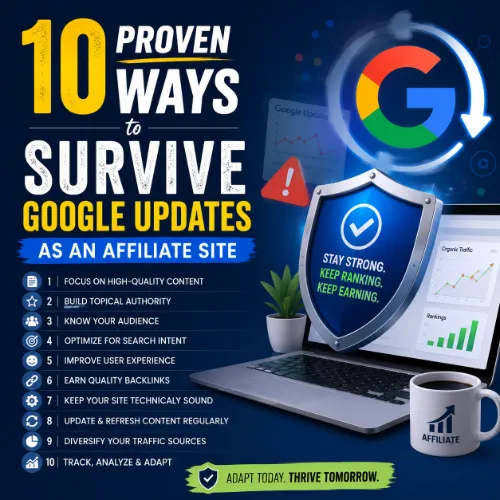
survive Google updates as an affiliate site Key Takeaways
Google updates can feel like an earthquake for affiliate sites, but with the right foundation, you can absorb the shocks and even emerge stronger.
- Focus on EEAT signals — experience, expertise, authoritativeness, and trust — to survive Google updates as an affiliate site and thrive in competitive niches.
- Shift from thin affiliate content to in-depth, original research that earns natural backlinks and reader loyalty.
- Diversify beyond pure affiliate SEO with email lists, YouTube, and direct site traffic to reduce reliance on any single algorithm change.
Why Adapting Now Helps You survive Google updates as an affiliate site
Google rolls out hundreds of algorithm updates every year, from broad core updates to specific product review algorithm tweaks. For affiliate sites, these changes can cause dramatic ranking swings. The sites that weather these storms consistently are the ones that have built a strong, user-first foundation — not those chasing shortcuts. To truly survive Google updates as an affiliate site, you need a multifaceted approach that covers content quality, technical SEO, and business model resilience.
1. Prioritize EEAT and Genuine Expertise
Google’s Search Quality Evaluator Guidelines place heavy weight on EEAT: Experience, Expertise, Authoritativeness, and Trustworthiness. For affiliate sites, this means your content must demonstrate firsthand knowledge of the products or services you promote. Instead of rewriting manufacturer descriptions, test the products yourself, share personal experiences, and include unique insights only a real user would know. This shift from generic to expert-driven content is one of the most effective ways to survive Google updates as an affiliate site. For a related guide, see E-e-a-t Signals: 11 Essential E-E-A-T Signals Google Uses for Trust.
Actionable Tips
- Add an author bio that shows real credentials or experience with the niche.
- Include original photos or videos from your own product tests.
- Cite expert opinions and industry studies to back up your recommendations.
Summary Takeaway
Authentic expertise creates trust with readers and signals quality to Google — a powerful hedge against algorithm volatility.
2. Build a Diversified Traffic Portfolio
Relying solely on organic search traffic is a high-risk strategy. When Google updates hit, SEO traffic can drop by 50% or more overnight. To survive Google updates as an affiliate site, build multiple traffic channels: email newsletters, YouTube reviews, Pinterest pins, social media, and even paid ads for high-intent keywords. This diversification insulates your revenue from any single update.
Actionable Tips
- Start collecting emails from day one with a lead magnet relevant to your niche.
- Repurpose your top blog posts into short YouTube review videos.
- Engage in niche-specific communities (Reddit, Quora, Facebook groups) to drive referral traffic.
Summary Takeaway
Multiple traffic streams mean one algorithm update can’t cripple your business — diversification is survival insurance.
3. Create Deep, Original Content That Stands Alone
Thin affiliate content — pages that simply list products with little added value — is a prime target for Google updates. To survive Google updates as an affiliate site, your content must be valuable even without a single affiliate link. Write comprehensive guides, original research pieces, and comparison articles that answer every possible user question. When your page is the best resource on the web, Google’s algorithm will reward it regardless of updates.
Actionable Tips
- Aim for 2,000+ word ,well-structured articles with clear subheadings.
- Add unique data, charts, or expert interviews that can’t be found elsewhere.
- Update old content regularly to keep it fresh and accurate.
Summary Takeaway
Original depth beats recycled breadth every time — invest in content that earns its place in search results.
4. Strengthen Your Technical SEO Foundation
Technical issues like slow page speed, broken links, and poor mobile usability can amplify the impact of algorithm updates. To survive Google updates as an affiliate site, ensure your technical SEO is bulletproof. Fast-loading pages, clean internal linking, and a logical site structure help Google understand and rank your content correctly. For a related guide, see 10 Internal Linking Strategies That Boost SEO (Proven).
Actionable Tips
- Use a tool like Ahrefs to run a site audit and fix crawl errors and redirect chains.
- Optimize Core Web Vitals: reduce Largest Contentful Paint (LCP), minimize Cumulative Layout Shift (CLS), and improve First Input Delay (FID).
- Ensure your site is fully mobile-responsive.
Summary Takeaway
A technically sound site provides a solid foundation that helps content perform better even during volatile algorithm periods.
5. Earn High-Quality Backlinks Naturally
Google’s algorithm updates consistently reward sites with authoritative backlinks. For affiliate sites, building a backlink profile through guest posting, digital PR, and creating linkable assets is essential to survive Google updates as an affiliate site. Focus on quality over quantity — a single link from a well-respected industry site can outweigh dozens of low-quality directory links.
Actionable Tips
- Create original research or a free tool that journalists and bloggers want to cite.
- Reach out to sites that mention your competitors’ products and offer your own expert insight.
- Monitor lost backlinks and reclaim them with outreach.
Summary Takeaway
Natural, earned backlinks are a trust signal that protects your rankings through algorithm shifts.
6. Use a Balanced Ad-to-Content Ratio
Affiliate sites that are heavily monetized with ads or multiple affiliate links often trigger Google’s spam guidelines. To survive Google updates as an affiliate site, maintain a user-friendly balance. For every affiliate link, provide enough non-commercial content to genuinely help the reader. A good rule of thumb: the page should be useful even if you removed all the affiliate links.
Actionable Tips
- Limit affiliate links to 2-3 per 1,000 words of text.
- Use
rel="sponsored"orrel="nofollow"on all affiliate links. - Avoid pop-up ads that obscure content.
Summary Takeaway
Monetization is fine, but it should never overpower the user’s reading experience — that’s a signal Google watches closely.
7. Focus on User Intent, Not Just Keywords
Modern Google algorithms prioritize search intent over exact-match keywords. To survive Google updates as an affiliate site, analyze the intent behind each query you target. If the user wants a comparison, write a comparison. If they want a tutorial, write a tutorial. Matching intent signals to Google that your page belongs in the top results.
Actionable Tips
- Use Ahrefs or SEMrush to see the top-ranking pages for your target phrase and note the content format.
- Look at the “People Also Ask” box and FAQ sections to cover related questions.
- Avoid forcing affiliate keywords into informational content.
Summary Takeaway
When your content perfectly matches what the searcher needs, Google’s algorithm will keep it visible through updates.
8. Monitor Your Site Health Constantly
Reacting early to a Google update can make the difference between a temporary dip and a permanent traffic loss. To survive Google updates as an affiliate site, set up monitoring for ranking changes, traffic drops, and site errors. Use Google Search Console to spot issues like manual actions or indexing problems as soon as they happen.
Actionable Tips
- Create a weekly dashboard in Google Looker Studio tracking organic traffic, top pages, and keyword rankings.
- Set up automated alerts for sudden drops in impressions or clicks.
- Review Google Search Console’s “Core Web Vitals” report weekly.
Summary Takeaway
Early detection of problems allows you to adjust your strategy before a small issue becomes a big crisis.
9. Avoid Over-Optimization and Aggressive Linking
Over-optimized anchor text, keyword stuffing, and unnatural internal linking patterns are red flags during Google updates. To survive Google updates as an affiliate site, use a natural mix of exact-match, branded, and generic anchor text. Your linking should feel organic, not forced.
Actionable Tips
- Vary anchor text: use phrases like “click here,” “learn more,” and branded terms instead of the same keyword every time.
- Limit the number of internal links per page to under 100.
- Avoid linking to affiliate offers from every paragraph — space them out naturally.
Summary Takeaway
Natural, varied linking signals to Google that you’re writing for humans, not just to manipulate rankings.
10. Stay Agile and Keep Learning
The affiliate landscape changes quickly. What works today may not work tomorrow. To survive Google updates as an affiliate site, commit to continuous learning. Follow industry experts, join affiliate marketing communities, and test new strategies regularly. Flexibility and a willingness to pivot are your greatest allies.
Actionable Tips
- Follow trusted SEO blogs like Search Engine Journal and Google’s official blog for update announcements.
- Participate in affiliate marketing forums like AffiliateFix or STM Forum.
- Set aside time each quarter to review and update your content and strategies.
Summary Takeaway
The sites that survive long-term are those that treat algorithm updates as learning opportunities, not disasters.
Useful Resources
For deeper insights into building a resilient affiliate site, check out these resources:
- Google Search Status Dashboard — Official page tracking all confirmed algorithm updates and ranking system changes.
- Ahrefs Guide to Google Algorithm Updates — Practical advice on how to analyze and respond to each major update.
Frequently Asked Questions About survive Google updates as an affiliate site
What is the most important factor to survive Google updates as an affiliate site?
Building genuine expertise and trust (EEAT) is the single most important factor. Content that demonstrates firsthand experience with products consistently ranks better and recovers faster after updates.
How long does it take to recover from a Google update?
Recovery can take anywhere from a few weeks to several months, depending on the severity of the drop and the quality of your site’s foundation. Focus on improvements, not quick fixes.
Should I remove all affiliate links after a Google update?
No. Instead of removing links, improve the surrounding content and reduce the ratio of affiliate-to-informational content. Ensure each page offers genuine value beyond the links.
Do Google updates target affiliate sites specifically?
Some updates, like the Product Reviews Update, directly target low-quality affiliate content. But many updates are broad and impact all sites. The best defense is quality.
Can a new affiliate site survive a Google update?
Yes, if it is built on a solid foundation of EEAT, original content, and technical SEO from day one. New sites with thin content are most vulnerable.
Is it okay to use AI-generated content for my affiliate site?
Google’s guidance says AI content is acceptable as long as it is helpful and demonstrates expertise. However, heavily automated, low-effort AI content often lacks the depth needed to survive updates.
How many backlinks do I need to survive a Google update?
There is no magic number. A handful of high-quality, relevant backlinks from authoritative sites are far more valuable than hundreds of low-quality links.
Do social signals help with Google rankings?
Social shares are not a direct ranking factor, but they can drive traffic and generate backlinks indirectly. A strong social presence also diversifies your traffic.
What should I do immediately after a Google update drops my traffic?
Wait a week to stabilize, then audit your top lost pages. Improve content quality, fix technical issues, and remove or update thin affiliate sections.
Is keyword research still important for affiliate sites?
Keyword research remains critical, but focus on search intent and long-tail queries rather than high-volume generic terms. Intent-matched content survives updates better.
How do I check if my site was hit by a Google update?
Use Google Search Console and compare organic traffic before and after the update date. Cross-reference with Google’s official update announcements.
Should I use nofollow on all affiliate links?
Yes, Google recommends using rel="sponsored" or rel="nofollow" for all affiliate links. This helps avoid being flagged as a paid link scheme.
Can internal linking help me survive a Google update?
Absolutely — a strong internal linking structure spreads link equity and helps Google understand the hierarchy and relevance of your pages, which can stabilize rankings.
What is the role of Core Web Vitals in Google updates?
Core Web Vitals are a ranking factor. Poor page experience can amplify the negative impact of an update. Optimizing them is a must for affiliate sites.
Should I remove old content after an update?
Do not delete old content blindly. Instead, update it — add fresh information, improve structure, and enhance user experience. Outdated info can hurt you, but well-maintained old content can gain authority over time. For a related guide, see 10 Proven Humanization Techniques for AI Content That Feel Natural.
Do Google updates affect all niches equally?
No. YMYL (Your Money or Your Life) niches like health, finance, and law are more heavily scrutinized. Affiliate sites in these niches need extra attention to EEAT.
Is it worth using a content delivery network (CDN) for speed?
Yes, a CDN can significantly improve page load times globally, which helps with both Core Web Vitals and user experience — both protective factors against update impacts.
How can I monitor competitor sites after an update?
Use tools like Ahrefs or SEMrush to see how your competitors’ traffic and keyword rankings changed. This can reveal what strategies work and what to avoid.
Should I focus on one niche or diversify?
Diversifying into related sub-niches or adding a second site can spread risk. However, building deep authority in one core niche remains the best foundation.
What is the one thing I should stop doing today to survive future updates?
Stop publishing thin, low-value content solely for the purpose of ranking. Every page should offer unique value that a user cannot find elsewhere easily.