
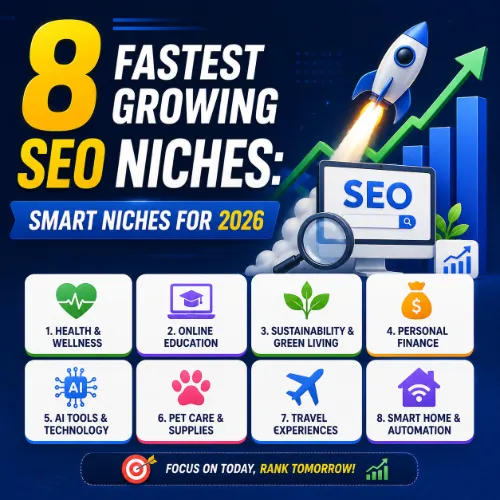
SEO niches growing fast Key Takeaways
Choosing the right niche is one of the most important decisions you can make as an SEO professional.
- SEO niches growing fast include AI content strategy, local SEO for service businesses, and e-commerce technical SEO.
- Each niche offers unique opportunities for specialization and higher earning potential.
- Focusing on a specific niche allows you to build authority faster and charge premium rates.
Why SEO niches growing fast Demand Your Attention
The SEO landscape shifts constantly. What worked two years ago may deliver mediocre results today. Google updates, changes in user behavior, and emerging technologies create new gaps that savvy SEOs can fill. By targeting SEO niches growing fast, you position yourself ahead of the curve, working with clients who need specialized skills rather than generic tactics.
Specialization also commands higher fees. A general SEO consultant might charge $1,000 per month, while a niche expert in, say, programmatic SEO for real estate portals can easily earn $5,000 or more. The depth of expertise you build in a focused area becomes a defensible advantage.
1. AI-Driven Content Strategy
Artificial intelligence tools like ChatGPT, Claude, and Jasper are changing how content is created and optimized. But using AI effectively for SEO is a skill that most businesses still lack. This niche covers everything from prompt engineering for search intent to using AI for topic clustering and content gap analysis.
Growth Factors
Businesses want to produce more content faster, but they struggle with quality and originality. An SEO who understands how to blend AI efficiency with editorial oversight can deliver scalable content that ranks. Google’s stance on helpful content also rewards human-guided AI output.
Actionable Insight
Start by offering AI content audits. Analyze a client’s existing AI-generated posts, identify where they miss search intent or over-optimize, and create a revised framework. Pair this with keyword research using Ahrefs Keywords Explorer to target lower-difficulty topics.
2. Local SEO for Home Service Businesses
Plumbers, electricians, roofers, and HVAC companies rely on local search to get leads. Yet many small businesses still have messy Google Business Profiles, inconsistent NAP citations, and zero local content strategy. This niche is hands-on but highly rewarding.
Growth Factors
With “near me” searches growing every year, visibility in the local pack directly translates to phone calls and booked jobs. Competition in most local markets is weak because business owners are too busy working to optimize their online presence.
Actionable Insight
Offer a local SEO starter package that includes GBP optimization, citation cleanup on sites like Yelp and Angi, and a monthly content plan targeting city-based keywords like “emergency plumber Austin.” Track results with calls and form submissions.
3. E-commerce Technical SEO
Online stores have unique technical challenges: faceted navigation causing duplicate content, slow page speeds from large images and scripts, and complex product feed management. E-commerce technical SEO solves these issues to boost organic revenue.
Growth Factors
E-commerce continues to grow as a percentage of retail sales. Platforms like Shopify, WooCommerce, and BigCommerce all have quirks that affect crawling and indexing. Brands are willing to invest in technical fixes because they see a direct ROI from increased organic traffic.
Actionable Insight
Perform a site audit using Ahrefs Site Audit to uncover crawl errors, thin pages, and index bloat. Prioritize fixes that impact the most important product and category pages. Present findings in a clear prioritized list, and offer an ongoing monitoring retainer.
4. SEO for SaaS and B2B Software
SaaS companies depend on organic search for lead generation. Content marketing, landing page optimization, and programmatic SEO for knowledge bases are all in demand. This niche requires understanding of buyer intent and longer sales cycles.
Growth Factors
The SaaS market is expanding rapidly, and many young companies lack internal SEO expertise. They need help ranking for high-intent keywords like “best project management tool for agencies” or “enterprise CRM comparison.”
Actionable Insight
Specialize in one type of SaaS — for example, HR tech or marketing software. Develop case studies showing how you increased organic leads by optimizing free tool pages or comparison posts. Use Ahrefs Content Gap to find topics competitors rank for that your client does not.
5. Podcast and Video SEO
Podcasts and video content are booming, but they are often invisible to search engines. Transcribing audio, optimizing video titles and descriptions, and structuring podcast show notes for featured snippets are underserved skills. For a related guide, see 8 Content Types AI Search Loves: Essential SEO Guide for Higher Rankings.
Growth Factors
Google indexes audio and video content more aggressively than ever. Apple Podcasts and YouTube are also search engines in their own right. Creators want to be discovered, but few know how to optimize for discovery.
Actionable Insight
Offer podcast SEO audits. Check transcript quality, chapter markers, and timestamps. Ensure each episode targets a specific keyword phrase. For YouTube, focus on thumbnail design, metadata, and closed caption accuracy.
6. SEO for Health and Wellness Brands
Health and wellness content is high-traffic but also heavily regulated. Google’s YMYL (Your Money or Your Life) guidelines mean only authoritative sources rank. SEOs who understand medical content accuracy, E-E-A-T signals, and compliance can serve this lucrative vertical.
Growth Factors
The global wellness market is worth trillions. Supplement companies, telehealth platforms, and fitness apps all need SEO that respects medical guidelines while driving traffic.
Actionable Insight
Focus on building topical authority. Create clusters of content around specific health conditions or ingredients. Cite peer-reviewed studies and ensure every health claim is backed by reputable sources (e.g., PubMed, FDA). Avoid affiliate content that appears purely commercial. For a related guide, see 9 Proven Ways to Build Topical Authority Faster.
7. International SEO and Multilingual Optimization
Businesses expanding into new markets need their websites to rank in different countries and languages. Hreflang tags, regional keyword research, and localization are specialized skills that generalists rarely master.
Growth Factors
Global e-commerce and remote work make international SEO essential. Companies want to enter markets like Latin America, Europe, and Asia but struggle with technical implementation and cultural context.
Actionable Insight
Start with one language pair, such as English to Spanish. Master hreflang implementation, ccTLD vs. subdomain strategy, and local search volume tools. Offer a multilingual site audit as a first engagement.
8. Programmatic SEO
Programmatic SEO involves generating hundreds or thousands of landing pages from structured data — think city-based service pages, product comparison pages, or property listings. It combines technical skills, data management, and content automation.
Growth Factors
Large-scale sites need to scale content without sacrificing quality. Programmatic SEO delivers that scale. Real estate portals, job boards, and review sites are prime candidates.
Actionable Insight
Identify a data source your client already has, such as a database of products or locations. Build a page template that dynamically inserts unique, useful content. Use Ahrefs to check that each generated page targets a distinct keyword with reasonable search volume.
How to Choose Your Fast-Growing Niche
Not every niche will fit your skills or interests. Start by evaluating your existing experience. If you have worked with local businesses before, local SEO is an easy entry. If you are technical and enjoy data, programmatic SEO might be a better fit.
Consider market demand. Use keyword research to check the number of monthly searches for terms like “e-commerce SEO consultant” or “AI content strategy service.” Also assess competition: how many specialized agencies exist in that space? Low competition with rising demand signals a sweet spot.
Finally, think about earnings potential. Some niches, like SaaS SEO, have higher average project values because the clients operate with larger budgets. Others, like local SEO, require more volume but lower per-client fees. Pick a balance that works for your business model.
SEO Entities and Their Functions
Understanding key SEO entities helps you analyze and improve performance in any niche. Below are the core entities and what they reveal:
- Website / Domain entities: root domain, subdomain, and URL-level analysis show whether performance belongs to the whole site, a section like blog.example.com, or a single page such as example.com/page.
- Keyword entities: organic keywords, paid keywords, keyword difficulty (KD), search volume, CPC, traffic potential, and SERP features indicate demand, competition, paid value, ranking opportunity, and result-type requirements.
- Backlink entities: referring domains, referring pages, anchor text, dofollow/nofollow links, broken backlinks, and new/lost links explain authority, link quality, risk, and outreach priorities.
- Page entities: top pages, best by links, best by traffic, broken pages, and internal pages reveal which URLs earn visibility, links, traffic, or need repair.
- Content entities: articles, authors, topics, published dates, social shares, and referring domains to content help evaluate editorial quality, freshness, authorship, engagement, and link attraction.
- SERP entities: featured snippets, People Also Ask, sitelinks, AI Overviews, video results, and local packs show what content format and answer structure the search result rewards.
- Technical SEO entities: crawl issues, redirect chains, canonicals, duplicate content, Core Web Vitals, and indexability status expose obstacles that prevent crawling, ranking, or a good page experience.
- Competitor entities: competing domains, content gap opportunities, link intersect domains, shared keywords, and competing pages reveal where rivals win traffic and where you can catch up.
- Metrics entities: DR (Domain Rating), UR (URL Rating), AR (Ahrefs Rank), traffic value, organic traffic, and referring domains count summarize authority, URL strength, market value, and search visibility.
Useful Resources
Continue learning about niche selection and SEO specialization:
- Ahrefs Blog: How to Choose an SEO Niche — A detailed guide on picking profitable SEO niches with real data.
- Moz: The Case for SEO Specialization — Why generalists lose and specialists win in a competitive market.
Frequently Asked Questions About SEO niches growing fast
What are SEO niches growing fast in 2026?
SEO niches growing fast include AI content strategy, local SEO for service businesses, e-commerce technical SEO, SaaS SEO, podcast and video SEO, health and wellness SEO, international SEO, and programmatic SEO.
How do I pick the right SEO niche?
Assess your current skills, interests, and experience. Then research market demand using keyword tools, evaluate competition level, and consider average client budgets in that vertical. Choose a niche where you can build authority quickly.
Why should I specialize instead of being a generalist?
Specialists command higher rates, face less competition, and build deeper expertise that generates better results. Clients prefer experts who understand their specific industry challenges.
Is AI content strategy a sustainable SEO niche?
Yes. While AI tools evolve, the need for human oversight, quality control, and strategic alignment with search intent remains. Businesses will continue paying for content that ranks.
How much can I earn in a specialized SEO niche?
Earnings vary widely, but specialists often charge $3,000 to $10,000+ per month for advanced services like programmatic SEO or SaaS content strategy, compared to $1,000–$2,500 for general SEO. For a related guide, see 13 SEO Content Mistakes Beginners Should Avoid (Expert Guide).
What is the easiest SEO niche to break into?
Local SEO for home services is relatively easy to start because the skills are straightforward and local business owners are often underserved. You can build a portfolio quickly with small wins.
Do I need coding skills for programmatic SEO?
Basic HTML and knowledge of templating languages helps, but you can also use no-code tools like Webflow or WordPress with custom post types and ACF. Understanding structured data is more important.
How do I find clients in a specific SEO niche?
Create content that demonstrates your expertise — case studies, tool comparisons, and industry-specific guides. Network in communities where your target clients gather, like trade forums or LinkedIn groups.
What tools do I need for specialized SEO work?
A comprehensive SEO toolset like Ahrefs is essential for keyword research, site audits, competitor analysis, and backlink tracking. Depending on the niche, you may also need Google Search Console, Screaming Frog, and Surfer SEO.
Can I combine two niches?
Yes. Many successful SEOs combine two related niches, such as local SEO + e-commerce, or SaaS SEO + content strategy. Just be careful not to spread yourself too thin early on.
How long does it take to become an expert in a niche?
With focused effort, you can achieve strong proficiency within 6 to 12 months. Deep specialization with proven results may take 2 to 3 years of continuous work in one vertical.
What is the most profitable SEO niche?
E-commerce technical SEO and SaaS SEO often yield the highest per-client revenues due to the complexity and direct revenue impact. Programmatic SEO also commands premium pricing.
Do SEO agencies hire niche specialists?
Yes. Many agencies hire freelancers or in-house specialists for projects that require specific expertise, such as international SEO or technical e-commerce audits. Being a specialist makes you more hireable.
Is health and wellness SEO risky?
It can be if you make unsubstantiated health claims. Stick to evidence-based content, cite authoritative sources, and follow Google’s E-E-A-T guidelines. The reward is high traffic and loyal audiences.
How do I get started with international SEO?
Learn hreflang implementation, ccTLD vs. gTLD strategy, and how to do keyword research for different languages. Practice on a small multilingual site or offer a free audit to a company already expanding abroad.
What are the common mistakes in local SEO?
Inconsistent NAP across directories, neglecting Google Business Profile reviews, using non-local keywords, and failing to track phone calls and directions. A solid local SEO strategy addresses each.
Can I do SEO for multiple niches at once?
As a freelancer or agency owner, you can serve multiple niches, but try to keep it to 2 or 3 closely related ones. Serving too many dilutes your expertise and marketing message.
How do I prove my expertise in a new niche?
Build a portfolio with case studies from real projects, even if you work at a reduced rate initially. Publish detailed guides and contribute to industry publications. Certifications can help but results matter more.
What is the future of SEO niches ?
Niche specialization will become even more important as Google gets better at understanding context and intent. AI, voice search, and video will create new opportunities for specialists who adapt early.
Should I niche down if I am just starting in SEO?
Yes. Beginners benefit from focusing on one niche because they can learn deeper skills faster, build a targeted portfolio, and market themselves more effectively than a generalist with limited experience.