
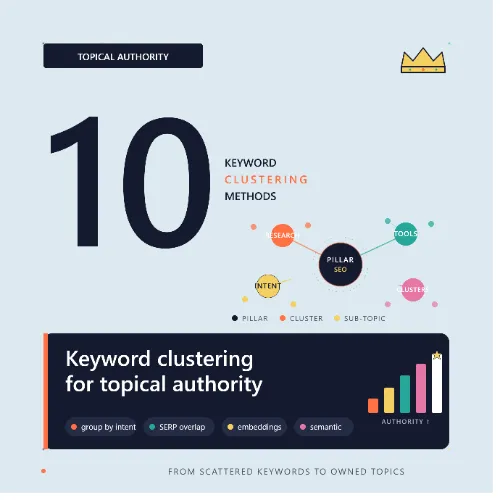
keyword clustering methods Key Takeaways
Understanding keyword clustering methods is the foundation of building topical authority in modern SEO.
- Keyword clustering methods help you create interlinked content that search engines recognize as authoritative on a topic.
- Each method suits different stages of your SEO maturity, from beginner to advanced.
- Consistent clustering improves keyword rankings, reduces keyword cannibalization, and increases organic traffic.
Why Keyword Clustering Methods Matter for Topical Authority
Topical authority SEO rewards websites that cover a subject comprehensively. Randomly writing articles around single keywords rarely builds the depth search engines now expect. Keyword clustering for topical authority changes that by grouping related search queries into clusters, then creating content that addresses the entire theme. For example, instead of separate articles on “coffee brewing methods” and “pour-over coffee tools,” a cluster might include a pillar page on coffee brewing and supporting posts on pour-over, French press, and cold brew methods. Each post links contextually, signaling to Google that your site is a go-to resource. For a related guide, see 7 Proven Methods for How AI Finds High-Value SEO Keywords.
Method 1: Manual SERP-Based Clustering
This is the most accessible keyword clustering method. Start by collecting your target keywords in a spreadsheet. For each keyword, search Google and note which pages rank prominently. If the same page ranks for multiple keywords, those keywords likely belong in the same cluster.
Steps to Follow
Open a clean spreadsheet. List your seed keywords in column A. Perform a manual search for each and note the top 3 ranking URLs in column B. Where URLs overlap, group the corresponding keywords. This method works best for small keyword sets (under 100).
Method 2: Word Frequency and TF-IDF Clustering
Term Frequency-Inverse Document Frequency (TF-IDF) identifies words that appear frequently within a set of top-ranking pages for a given topic. By extracting common and unique terms, you can build a vocabulary for each cluster. Tools like Screaming Frog or custom Python scripts can compute TF-IDF scores. Words with high TF-IDF within a topic but low frequency across the web indicate cluster-specific concepts.
Practical Example
If your topic is “organic gardening,” TF-IDF might reveal cluster terms like “compost tea,” “soil pH,” and “cover crops.” These become the backbone of your cluster content.
Method 3: Co-Occurrence Analysis in Search Results
Co-occurrence analysis examines which keywords appear together on the same SERP. When two or more keywords consistently appear in the same search results, they are likely related. Use Ahrefs or SEMrush to extract ranking keywords for competitor pages. Then, in a matrix, count how often each pair of keywords appears together. Pairs with high co-occurrence form a cluster.
Why It Works
Google uses co-occurrence to understand semantic relationships. This method mimics that logic.
Method 4: Google Search Console Query Grouping
Your own site data offers a goldmine for clustering. In Google Search Console, export your queries and their click-through rates. Sort by impressions and identify queries that share core terms or user intent. For example, queries containing “how to” and “best” often indicate different intents (informational vs. commercial) and belong to different clusters.
Pro Tip
Create a filter for queries from the same URL. If multiple queries drive traffic to the same page, they are a natural cluster.
Method 5: Machine Learning Topic Modeling
For large keyword datasets (thousands of terms), machine learning models like Latent Dirichlet Allocation (LDA) can automatically discover clusters. Tools like Orange Data Mining or Python libraries (gensim, scikit-learn) let you input keyword lists and output topic groupings. The model identifies which keywords most strongly define each cluster.
When to Use
If you manage an e-commerce site with 10,000+ product-related keywords, manual grouping is impractical. LDA can group them into 50-100 logical clusters in minutes.
Method 6: Hierarchical Clustering with Search Volume
Hierarchical clustering builds a tree structure where keywords are grouped based on similarity. First, create a similarity matrix (using co-occurrence or TF-IDF distances). Then apply an algorithm (Ward, single linkage) to form clusters. Finally, overlay search volume data from keyword research tools. Clusters with high total volume get priority for pillar content.
Balance Topics
This method ensures you don’t over-invest in low-volume clusters and miss high-volume opportunities.
Method 7: Competitor Gap and Topic Clustering
Analyze your top 3-5 competitors using Ahrefs or Similarweb. Extract the topics they cover (by looking at their top pages and linking structure). Map those topics to your own keyword list. Clusters where competitors have deep content but you have none are high-value gaps. Build content for those clusters first.
Actionable Step
Create a matrix: rows = your target keywords, columns = competitor domains. Mark where each competitor ranks. Clusters where multiple competitors rank strongly are likely well-defined topical clusters.
Method 8: Search Intent Classification
This method groups keywords by user intent: informational, navigational, commercial, or transactional. Even if keywords are semantically similar, different intents require separate clusters. For “keyword clustering methods,” intent could be “learn clustering” (informational) vs. “buy clustering software” (transactional). Build separate clusters for each.
How to Classify
Look at the dominant SERP features. If the SERP shows featured snippets or People Also Ask, intent is informational. If product listings or buy buttons appear, intent is transactional.
Method 9: Anchor Text Analysis of Backlinks
Your existing backlinks reveal how other sites perceive your content. Export your backlinks from Ahrefs or Majestic. Group anchor texts that share common terms. For example, anchors like “best SEO tools,” “SEO software reviews,” and “top SEO platforms” suggest a cluster around “SEO tools.” This method is particularly useful for content pruning and internal linking.
Method 10: Combining Clusters into a Topical Map
The final method integrates all previous techniques into a visual or spreadsheet-based topical map. Start with one core cluster (e.g., “keyword clustering methods“). Connect related clusters (e.g., “TF-IDF analysis,” “LDA topic modeling,” “Search intent classification”). Define relationships: parent-child (pillar-to-supporting), sibling (complementary topics), or sequential (prerequisite steps). This map becomes your editorial blueprint for months of content creation.
Ongoing Optimization
Revisit your topical map quarterly. As search trends shift, some clusters may split or merge. Adjust your content plan accordingly.
Common Mistakes in Keyword Clustering
Even experienced SEOs fall into traps. Here are three common ones and how to avoid them.
Mistake 1: Over-Clustering
Grouping too many loosely related keywords into one cluster dilutes topical focus. A cluster should have a clear core topic. If keywords don’t share a similar user intent or content opportunity, split them.
Mistake 2: Ignoring Search Volume
Clustering without volume data can lead to wasted effort. Prioritize clusters with adequate total search volume to justify the investment.
Mistake 3: No Internal Linking Strategy
Clusters only work if you link the pages together. Build a linking plan that connects pillar pages to support posts and vice versa.
SEO Entities and Their Functions
Understanding SEO entities strengthens your clustering accuracy. Here are the key ones relevant to keyword clustering and topical authority SEO:
Website / Domain entities: Root domain, subdomain, and URL-level analysis help you decide whether to create cluster content on a main domain or a subdomain. For instance, a subdomain like blog.example.com may host the cluster separately from your product pages.
Keyword entities: Organic keywords, keyword difficulty, search volume, and SERP features indicate demand, competition, and the type of content a cluster’s keywords need (e.g., a featured snippet requires a concise answer format).
Backlink entities: Referring domains, anchor text, and dofollow/nofollow links show which clusters already earn external authority and where you need link-building support.
Content entities: Articles, authors, topics, published dates, and social shares help evaluate editorial quality within a cluster. Fresh, well-shared content strengthens topical authority.
Useful Resources
To deepen your understanding of keyword clustering, explore these resources:
- Ahrefs: Keyword Clustering Guide – A detailed walkthrough of clustering techniques using Ahrefs tools.
- Google Search Central: Topical Authority – Official documentation on how Google assesses topical authority.
Frequently Asked Questions About keyword clustering methods
What is keyword clustering?
Keyword clustering is the process of grouping related search queries into thematic sets to build comprehensive content around a topic, rather than targeting isolated keywords.
Why is keyword clustering important for SEO?
It helps search engines understand your topical expertise, reduces keyword cannibalization, and improves organic rankings by creating a structured content ecosystem.
How many keywords should be in a cluster?
Ideal cluster size ranges from 10 to 50 keywords, depending on topic breadth. Smaller clusters work better for narrow niches, while larger clusters suit broad categories.
What tools can I use for keyword clustering?
Popular tools include Ahrefs (Content Gap, Keyword Explorer), SEMrush (Topic Research), Screaming Frog (TF-IDF), Google Search Console, and Python libraries like scikit-learn for advanced users. For a related guide, see Ai Saves Time In Seo: 5 Costly Mistakes to Avoid in 2026.
Can I do keyword clustering manually?
Yes. Manual SERP-based clustering works well for small sets (under 100 keywords). Use a spreadsheet to compare ranking URLs and group keywords that share top pages.
What is the difference between keyword clustering and keyword grouping?
Keyword grouping is broader, often based on simple similarities (e.g., same head term). Clustering is more sophisticated, using statistical or intent-based methods to form semantically tight groups.
How does machine learning improve clustering?
Machine learning models like LDA can process thousands of keywords automatically, discovering hidden topical patterns that manual analysis might miss.
What is TF-IDF in keyword clustering?
TF-IDF stands for Term Frequency-Inverse Document Frequency. It measures how important a word is to a document relative to a collection of documents, helping identify cluster-specific terms.
How do I use search intent in clustering?
Classify keywords by intent (informational, navigational, commercial, transactional) and group keywords with the same intent together, even if they are semantically similar.
Should I include long-tail keywords in clusters?
Yes. Long-tail keywords often have higher conversion rates and fit naturally into specific support posts within a cluster.
How often should I update my keyword clusters?
Review your clusters quarterly or whenever you detect major shifts in search volume, competitor strategies, or your own site performance.
What is a topical map?
A topical map is a visual or spreadsheet-based representation of your keyword clusters and their relationships (pillar, supporting, sibling, sequential). It serves as your content blueprint.
Can clustering help with voice search optimization?
Yes. Voice search queries are often long-tail and question-based. Clustering them by intent helps create FAQ-style content that answers voice queries naturally.
What is keyword cannibalization?
Keyword cannibalization occurs when multiple pages on your site target the same keyword, causing them to compete against each other in search results. Clustering prevents this by assigning each keyword to a unique page.
How does internal linking relate to clustering?
Internal links between cluster pages pass authority and help search engines discover the full scope of your topical content. Link from pillar pages to support posts and vice versa.
Is keyword clustering the same as topic clustering?
They are closely related. Topic clustering often refers to the broader content strategy of creating pillar pages and cluster posts, while keyword clustering is the research phase that identifies which keywords to include.
Can I use clustering for local SEO?
Absolutely. For local SEO, cluster keywords by city or region (e.g., “plumber in Austin,” “Austin emergency plumber,” “water heater repair Austin”) to build local topical authority.
What is the role of SERP features in clustering?
SERP features like featured snippets, People Also Ask, and video results indicate what content format a cluster’s keywords require. This shapes your content creation for each cluster.
How do I measure the success of a keyword cluster?
Track aggregate organic traffic, average position, and click-through rate for all keywords in the cluster. Also monitor overall topical visibility in search results.
What is the best method for beginners?
Start with manual SERP-based clustering using Google Search Console data. It’s free, easy to understand, and teaches you the core principles of grouping keywords.