
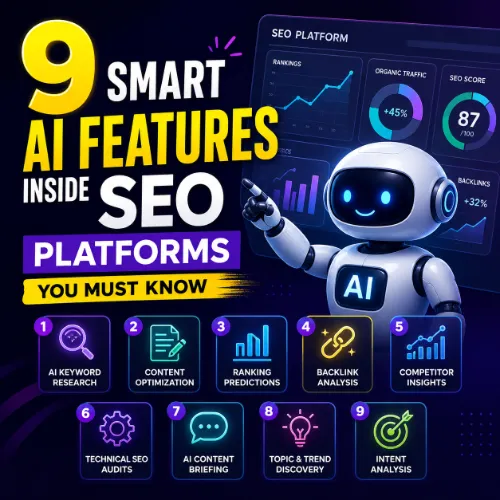
AI features inside SEO platforms Key Takeaways
Modern AI features inside SEO platforms now handle heavy lifting like content optimization, predictive keyword analysis, and competitor benchmarking — tasks that once required entire teams.
- Leading AI features inside SEO platforms automate keyword clustering, content gap analysis, and SERP intent classification.
- AI-driven content optimization tools provide real-time readability, NLP, and entity scoring to improve ranking potential.
- Automated anomaly detection and predictive traffic modeling help you react to ranking shifts before they hurt performance.
How AI Features Inside SEO Platforms Are Changing Search Optimization
SEO has always required a mix of data analysis, creativity, and technical know-how. But the volume of signals — from Core Web Vitals to AI Overviews — has exploded. That is where AI features inside SEO platforms come in. They digest vast datasets, surface patterns humans miss, and automate repetitive tasks. Whether you manage a single blog or a thousand-page enterprise site, these tools let you focus on strategy instead of spreadsheets. For a related guide, see 13 Hidden SEO Signals in Analytics: Smart Data Insights.
Below are nine capabilities that define the current generation of AI-powered SEO platforms. Each one solves a real problem, from discovering untapped keyword opportunities to preventing traffic drops.
1. Intelligent Keyword Discovery and Clustering
Traditional keyword research tools return long lists of terms with search volume and difficulty. But AI features inside SEO platforms go further. They group related keywords into topic clusters, identify search intent (informational, commercial, transactional), and even predict which terms will gain traction. This saves hours of manual sorting and helps you build topical authority faster.
For example, a platform might surface 200 keywords around “organic coffee beans” and automatically group them into clusters like “buying guides,” “brewing methods,” and “roast comparisons.” You then create pillar content for each cluster, linking related articles naturally.
2. Content Optimization with NLP and Entity Scoring
AI can analyze top-ranking pages and tell you exactly which entities, terms, and semantic relationships they include. Tools like Surfer SEO and MarketMuse use natural language processing to score your draft against competitors. The result: a clear list of terms, questions, and related concepts to add — without keyword stuffing.
This is one of the most practical AI features inside SEO platforms for content creators. You paste a draft, the tool highlights missing topics, and you enrich the piece accordingly. The output is more comprehensive and better aligned with what Google considers authoritative.
3. Predictive Traffic and Ranking Modeling
Instead of guessing whether a new article will perform, some platforms use machine learning to estimate traffic potential based on search volume, click-through rates, and SERP feature distribution. They can also model how ranking changes for a specific query will affect overall organic traffic.
This predictive layer turns SEO from a reactive discipline into a proactive one. You can prioritize topics with the highest expected return and set realistic goals for growth.
4. Automated Content Briefs and Outlines
Writing a content brief used to mean manually reviewing the top 10 search results, extracting headings, and noting common questions. Now, AI features inside SEO platforms generate structured briefs in seconds. They pull competitor headings, People Also Ask entries, suggested entities, and even optimal word count ranges.
This is especially helpful for teams that produce content at scale. A brief generated by the platform becomes the single source of truth for writers, editors, and designers, reducing back-and-forth and ensuring consistency.
5. Real-Time SERP Intent Classification
Search intent changes constantly. A query like “best running shoes” might show product listings today and a comparison guide tomorrow. Platforms now use AI to classify SERP intent in real time, helping you decide whether to create a product page, a listicle, or a video. This prevents you from writing a review when the SERP actually rewards commercial listings.
Why This Matters for Strategy
When you align your content format with the dominant SERP pattern, you increase the chance of ranking in featured snippets and AI Overviews. The AI features inside SEO platforms that handle intent classification give you immediate feedback on format fit.
6. Automated Anomaly Detection and Alerts
Traffic drops can happen for dozens of reasons: algorithm updates, competitor changes, technical errors, or seasonality. AI-driven anomaly detection compares current performance against historical baselines and flags unusual patterns. It also tries to identify the likely cause — for example, noting that a specific page lost rankings after a competitor published new content.
This feature moves you from checking analytics daily to receiving actionable alerts only when something requires attention. It is one of the most time-saving AI features inside SEO platforms for busy marketers.
7. Competitor Content Gap Analysis
Traditional gap analysis involves exporting keyword lists and comparing them in spreadsheets. AI automates this by scanning competitor domains and surfacing the exact topics they rank for that you do not. The output includes search volume, difficulty, and suggested content formats. Some platforms even estimate the effort required to close each gap.
How to Apply This Insight
Prioritize gaps with high relevance and moderate difficulty. For example, if a competitor ranks for “how to roast coffee at home” and your coffee blog does not cover that topic, you have a clear content opportunity. The AI suggests related entities to include, helping you produce a thorough guide the first time. For a related guide, see Grok Multimodal Features: Image, Voice and Video 2026.
8. AI-Powered Internal Linking Suggestions
Internal linking distributes authority across your site and helps search engines understand page relationships. Yet it is tedious to do manually at scale. Platforms now analyze your content graph and recommend relevant internal links based on topic similarity, anchor text relevance, and link depth. This improves crawl efficiency and passes authority to deeper pages.
For enterprise sites with thousands of pages, this is a game-changer. The AI might suggest linking a new article on “cold brew recipes” to an existing guide on “best coffee grinders” because both share related entities and user intent.
9. Automated Reporting and Natural Language Summaries
Reporting takes time away from actual optimization. AI tools now generate executive summaries in plain English, highlighting wins, losses, and recommended next steps. They can produce monthly reports that explain why traffic changed, which keywords improved, and where the biggest opportunities lie. This makes it easy to communicate SEO value to stakeholders without manual chart building.
Many of these reports are customizable, so you can include only the metrics that matter to your team or client.
SEO Entities and Their Functions
Understanding the entities that AI features inside SEO platforms analyze helps you interpret data correctly. Here is what each category means for your workflow:
- Website / Domain entities: Root domain, subdomain, and URL-level analysis help you determine whether a performance issue affects the whole site or a single section.
- Keyword entities: Organic keywords, keyword difficulty, search volume, CPC, and SERP features show demand, competition, and paid value.
- Backlink entities: Referring domains, dofollow/nofollow links, and broken backlinks reveal link quality and outreach priorities.
- Page entities: Top pages by traffic, best by links, and broken pages show which URLs earn visibility or need repair.
- Content entities: Articles, authors, topics, and social shares help evaluate editorial quality and link attraction.
- SERP entities: Featured snippets, People Also Ask, and AI Overviews indicate what content format Google rewards.
- Technical SEO entities: Crawl issues, redirect chains, and Core Web Vitals expose obstacles that prevent ranking.
- Competitor entities: Competing domains, content gaps, and link intersect domains show where rivals win traffic.
- Metrics entities: Domain Rating, URL Rating, traffic value, and organic traffic summarize authority and visibility.
- Local SEO entities: Country database, city-specific keywords, and local packs connect campaigns to local intent.
Useful Resources
To deepen your understanding of how AI is reshaping search optimization, explore these resources:
- Ahrefs Blog: AI SEO Tools — An overview of how leading platforms integrate AI into keyword research, content optimization, and backlink analysis.
- Google AI Overviews Documentation — Official guidance on how Google generates AI overviews and how content can appear in them.
Frequently Asked Questions About AI features inside SEO platforms
What are AI features inside SEO platforms?
They are built-in capabilities that use machine learning and natural language processing to automate keyword research, content optimization, competitor analysis, technical audits, and reporting.
Do I need a large team to benefit from AI in SEO?
No. Many AI features are designed for solo practitioners and small teams. They automate repetitive tasks so you can focus on strategy and content creation.
Can AI replace manual SEO analysis?
AI handles data processing and pattern recognition efficiently, but human judgment is still needed for strategy, creative campaigns, and interpreting nuanced results.
Which AI features are most useful for content teams?
Automated content briefs, entity-based optimization scoring, and internal linking suggestions tend to save the most time for content teams.
How do AI platforms detect search intent?
They analyze SERP patterns, page formats, and user behavior signals to classify intent as informational, commercial, transactional, or navigational.
Are AI-generated content briefs reliable?
Yes, when built from real-time SERP and competitor data. They reduce research time significantly, though human review ensures the brief aligns with brand voice and audience needs.
What is entity scoring in content optimization?
Entity scoring measures how well your content covers relevant people, places, things, and concepts compared to top-ranking pages. Higher scores correlate with stronger topical authority.
Do AI tools work for local SEO?
Yes. They can analyze city-specific keywords, local SERP packs, and competitor strategies in specific geographic areas.
How accurate is AI-based traffic prediction?
Predictions are directional, not guarantees. They are most accurate when based on stable keyword sets with consistent search volume and click-through rates.
Can AI help with link building?
Yes. AI tools identify broken link prospects, unlinked brand mentions, and outreach targets by analyzing backlink profiles and competitor link patterns.
What is anomaly detection in SEO platforms?
It is an AI function that monitors traffic and ranking data for unusual changes, then alerts you so you can investigate potential issues like algorithm updates or technical errors.
Do AI features work with ecommerce SEO?
Absolutely. They help with product page optimization, category clustering, and identifying search trends for specific product types.
How do AI platforms handle duplicate content detection?
They crawl your site and compare page content using similarity algorithms, flagging near-duplicates and suggesting canonicalization or merging.
Are AI-powered reports customizable?
Most platforms let you select which metrics, timeframes, and segments appear in automated reports, so you only see what matters to your team.
What is the cost range for platforms with advanced AI features?
Monthly subscriptions typically range from $50 for basic AI features to $500+ for enterprise-grade capabilities like predictive modeling and anomaly detection.
Do AI SEO tools integrate with Google Search Console?
Yes, most connect directly to GSC, Google Analytics, and other data sources to enrich their AI models with your actual performance data.
Can AI help optimize for voice search?
Yes. AI tools analyze question-based queries and conversational language patterns, helping you create content that matches voice search formats.
How fast do AI platforms update their data?
Keyword and SERP data typically refreshes daily or weekly. Anomaly detection and real-time alerts update within hours of significant changes.
What is the learning curve for using AI in SEO?
Most platforms include guided onboarding and preset workflows. Basic features like keyword clustering and content scoring are intuitive; advanced predictive models may require some experimentation.
Will AI make SEO specialists obsolete?
No. AI automates data tasks but cannot replace strategic thinking, creative storytelling, or relationship-based link building. Specialists who adopt AI tools become more efficient and valuable.