
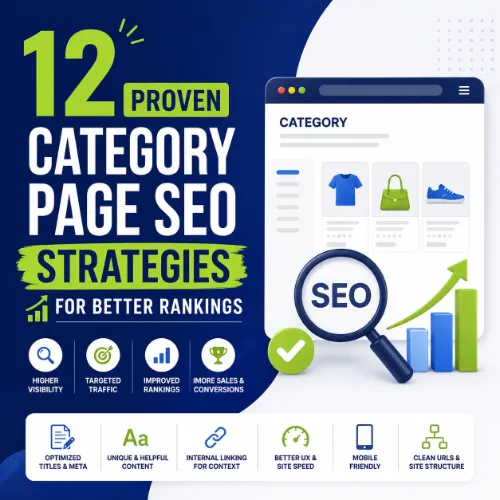
category page SEO strategies Key Takeaways
When you implement proven category page SEO strategies , you don’t just improve rankings for a handful of product pages.
- Use unique, descriptive product descriptions and category-level content to satisfy search intent and avoid duplication.
- Leverage a clear, flat site structure with optimized breadcrumbs and internal links to pass authority efficiently.
- Add schema markup, ensure mobile-first usability, and continuously monitor performance with a site audit. These 12 SEO tips for category pages will help you outrank competitors.
Why Category Page SEO Strategies Matter for Ecommerce
Category pages are often the most visited sections on an ecommerce site. They help users navigate product groups and signal to search engines which content is most important. Yet many ecommerce sites treat them as thin, duplicate-laden afterthoughts—missing a major opportunity.
When you implement proven category page SEO strategies, you don’t just improve rankings for a handful of product pages. You strengthen your site’s entire topical authority, increase crawl efficiency, and create a better user experience that boosts conversion rates. Below are 12 detailed tactics to get you there. For a related guide, see 12 Free SEO Tools Worth Using for Better Search Rankings.
1. Craft Unique, Descriptive Category Descriptions
Avoid the common mistake of copying manufacturer text or using the same paragraph across multiple categories. Write a short, original description (100–200 words) that explains what makes this category special, who it’s for, and what shoppers will find. Include your category page SEO focus keyword naturally once or twice, but prioritize readability.
2. Structure URLs for Clarity and Hierarchy
Keep URLs simple, readable, and consistent. For example, example.com/women/dresses/summer-dresses is much better than example.com/products?id=234 and cat=12. A flat hierarchy—ideally no more than three levels deep—makes it easier for both users and search engines to understand your site’s organization. This is a foundational element of ecommerce SEO strategies.
3. Optimize Title Tags and Meta Descriptions
Each category page needs a unique title tag (50–60 characters) and meta description (150–160 characters). Include your focus keyword early in the title, and craft a meta description that compels clicks—for example, showing the range of products or a benefit like free shipping. Use action verbs and a natural call to action.
4. Use Breadcrumb Navigation for Internal Links
Breadcrumbs improve user experience and give search engines clear contextual signals. Implement schema.org BreadcrumbList markup so Google can display breadcrumbs in SERPs. This internal linking structure helps distribute PageRank and shows the relationship between subcategories and parent categories—a subtle but powerful category page SEO win. For a related guide, see 11 AI SEO Experiments: Smart Ways to Boost Your Rankings.
5. Add High-Quality, Scannable Content Above the Fold
Place your category description and a selection of best-selling or featured products near the top of the page. Filtering options, size guides, and customer ratings also help users find what they need quickly. This reduces bounce rate and signals relevance—both benefits of smart category page SEO strategies.
6. Implement Product Schema Markup
Add structured data (Product schema) to each product card on your category page. This can generate rich snippets that display price, availability, and star ratings in search results. More SERP real estate often translates to higher click-through rates, making schema one of the most technical yet rewarding ecommerce SEO strategies.
7. Manage Pagination Properly
If your category spans multiple pages, use rel=\”next\” and rel=\”prev\” tags (or a simpler \”view-all\” approach if the load time is acceptable). Avoid indexing every paginated page—instead, use a self-referencing canonical tag on the first page or let Google combine paginated pages via the parameter handling tool. This prevents index bloat and preserves ranking signals.
8. Leverage Faceted Navigation with Care
Faceted filters can create thousands of thin, scraped-looking URLs. Use nofollow tags, robots.txt rules, or parameter handling in Google Search Console to keep low-value filter pages out of the index. Alternatively, use AJAX to filter products without changing the URL. This protects your crawl budget—an often-overlooked aspect of category page SEO strategies.
9. Build Internal Links from Your Homepage and Top-Level Pages
Don’t let your category pages sit deep in the site structure. Link to your most important categories from the homepage, the main navigation menu, and relevant blog posts. Use descriptive anchor text (e.g., \”browse our organic coffee beans\”) to reinforce topical relevance. This is one of the simplest yet most effective 12 SEO tips for category pages.
10. Optimize for Mobile Usability and Page Speed
Google’s mobile-first indexing means your category pages must load quickly and look great on smartphones. Compress images, use a responsive design, and minimize JavaScript that blocks rendering. Core Web Vitals (LCP, FID, CLS) are now ranking factors, so speed optimization directly supports your overall ecommerce SEO strategies.
11. Monitor and Adjust with a Site Audit
Run regular site audits using tools like Ahrefs, Screaming Frog, or Semrush. Look for missing meta tags, broken internal links, duplicate content, and slow-loading category pages. A site audit reveals exactly which category page SEO strategies need fixing, and it helps you track progress over time.
12. Analyze Competitor Category Pages
Identify your top 3–5 competitors and study their category pages. What keywords do they rank for? How long are their descriptions? What schema are they using? Use a keyword gap analysis to find opportunities they’ve missed. Competitive insights are a critical component of modern category page SEO.
Checklist Summary: 12 Category Page SEO Strategies
| # | Strategy | Status |
|---|---|---|
| 1 | Unique category descriptions | ☐ |
| 2 | Clear, hierarchical URLs | ☐ |
| 3 | Optimized title tags and meta descriptions | ☐ |
| 4 | Breadcrumb navigation with schema | ☐ |
| 5 | Scannable content above the fold | ☐ |
| 6 | Product schema markup | ☐ |
| 7 | Correct pagination handling | ☐ |
| 8 | Controlled faceted navigation | ☐ |
| 9 | Strategic internal links | ☐ |
| 10 | Mobile speed and usability | ☐ |
| 11 | Regular site audits | ☐ |
| 12 | Competitor analysis | ☐ |
SEO Entities and Their Functions
When applying the category page SEO strategies above, several SEO entities help you measure and refine your efforts. Here’s what they do:
- Website / Domain entities (root domain, subdomain, URL-level analysis) — help you determine whether a ranking issue belongs to your entire domain, a subfolder, or a single category page.
- Keyword entities (organic keywords, keyword difficulty, search volume) — show you which search queries drive traffic and how hard they are to rank for.
- Backlink entities (referring domains, anchor text, dofollow/nofollow) — reveal the quality of links pointing to your category pages and your competitors.
- Page entities (top pages, best by links, broken pages) — identify which category pages earn the most traffic or need technical repairs.
- Content entities (articles, authors, social shares) — help you evaluate whether your category descriptions are engaging and share-worthy.
- SERP entities (featured snippets, People Also Ask, video results) — show you what format Google rewards, guiding how you structure product information.
- Technical SEO entities (crawl issues, Core Web Vitals, canonicals) — expose obstacles like duplicate content or slow load times that block rankings.
- Competitor entities (competing domains, content gap opportunities) — let you spot keywords your rivals rank for but you don’t.
Useful Resources
For further reading on category page SEO strategies, check out these authoritative guides:
- Yoast’s Guide to Category Page SEO — practical tips on structuring category content.
- Ahrefs Ecommerce SEO Guide — in-depth strategies for optimizing product and category pages.
Conclusion: Put These Category Page SEO Strategies to Work
Category pages are one of the highest-leverage assets in any ecommerce website. By applying the 12 category page SEO strategies in this guide—from unique descriptions and clean URLs to proper schema and competitor analysis—you can turn these pages into powerful entry points for organic search traffic.
Start with a quick audit of your existing categories. Pick two or three strategies that will have the most immediate impact, implement them, and track the results. Over time, these ecommerce SEO strategies will compound, helping you rank higher, attract more qualified visitors, and ultimately grow your sales.
Frequently Asked Questions About category page SEO strategies
What is category page SEO ?
Category page SEO refers to the practice of optimizing a website’s category or taxonomy pages—such as a product category on an ecommerce site—to rank higher in search results, attract targeted traffic, and improve user experience. It involves unique content, clean URLs, internal linking, and technical adjustments.
Why are category pages important for SEO?
Category pages consolidate content around a specific topic, helping search engines understand your site’s structure and topical authority. Well-optimized category pages can rank for broad keywords, pass link equity to product pages, and reduce bounce rates by guiding users to relevant items faster.
How long should a category page description be?
Aim for 100–200 words. Keep it concise but informative—enough to naturally include a primary keyword and explain what makes the category unique, without overwhelming users or diluting the main purpose (helping shoppers browse products).
Should I use a \ and quot;view all\ and quot; page for large categories?
Only if load time remains under 3 seconds and you keep a self-referencing canonical tag. For very large categories (hundreds of products), paginated pages are usually safer. Use rel=\”next\” and rel=\”prev\” tags or the canonical approach to avoid thin content issues.
Do category pages need unique meta descriptions?
Yes. Every category page deserves a unique meta description that includes a call to action and a summary of what shoppers will find. Duplicate meta descriptions waste a valuable ranking signal and reduce click-through potential.
How do I handle faceted navigation without hurting SEO?
Use nofollow tags on filter parameters, block low-value filter URLs via robots.txt, or implement AJAX-based filtering that keeps the URL clean. The goal is to avoid creating thousands of thin, identical-looking pages that dilute your crawl budget.
What is the best URL structure for category pages?
A flat, descriptive structure such as domain.com/category/subcategory/ is ideal. Avoid parameter-heavy URLs like domain.com/products?id=123. Keep it shorter than 100 characters and use hyphens between words.
How many products should a category page show?
There’s no single perfect number, but 20–60 products per page is common. The key is to keep load time fast and provide useful sorting/filtering tools. If you have more than 100 products, consider subcategorizing or using pagination.
Can I use the same content on multiple category pages?
No. Duplicate content across category pages confuses search engines and weakens ranking signals. Each category should have a unique description, unique product set, and unique editorial angle to stand out.
Should category pages have breadcrumbs?
Yes, breadcrumbs improve navigation and provide a clear hierarchy to users and search engines. Use schema.org BreadcrumbList markup so Google can display them in SERPs, which can increase click-through rates.
What schema markup should I use on category pages?
Use Product schema on individual product cards within the category, and optionally ItemList schema to describe the list of products. BreadcrumbList schema is also highly recommended. Avoid using Organization or WebSite schema on category pages.
How do I optimize category pages for mobile?
Use a responsive design, compress images, minimize JavaScript, and ensure buttons and filters are easily tappable. Test page load times with Google’s PageSpeed Insights and fix any Core Web Vitals issues like CLS or LCP.
What is a site audit, and how does it help category page SEO ?
A site audit is a systematic check of your website’s technical health—crawl errors, broken links, duplicate tags, slow pages. For category pages, it reveals missing meta descriptions, canonical issues, or thin content that needs improvement. Regular audits ensure your category page SEO strategies stay effective.
How can I find keyword opportunities for category pages?
Use keyword research tools like Ahrefs or Semrush to identify relevant terms with decent search volume and low-to-medium keyword difficulty. Analyze your competitors’ top-ranking pages and look for content gaps where you can provide better information or product selection.
Should I include images on category pages?
Yes. Add a representative category image (e.g., a hero banner) and product thumbnails. Use descriptive alt text for accessibility and SEO. Large images should be compressed to avoid slowing down the page.
How do I prevent index bloat on category pages?
Block low-value filter/sort URLs via robots.txt or use the parameter handling tool in Google Search Console. Use canonical tags to consolidate paginated pages, and noindex thin affiliate or auto-generated category pages that add no unique value.
Can category pages rank for featured snippets?
Yes, if they contain a clear, well-structured answer to a specific query. For example, a \”best running shoes\” category page with a table of features or a list of top picks can win a featured snippet. Format content with headers, bullets, and concise paragraphs.
How often should I update category page content?
Review your category pages at least twice a year. Update product selections, descriptions, and internal links. Refresh old data to reflect new inventory or seasonal changes. Fresh content signals relevance to search engines and keeps users returning.
What is the difference between a category page and a tag page?
A category page organizes products or posts into a hierarchical taxonomy (e.g., \”Electronics > Headphones\”), while a tag page uses non-hierarchical keywords. In ecommerce, category pages are typically more important for SEO because they group related products under a clear, authoritative topic.
Do category pages need to be included in the XML sitemap?
Yes, include your most important category pages in the sitemap. This ensures search engines can discover them quickly. Exclude low-value filtered or paginated pages to avoid filling your sitemap with near-duplicate URLs.