AI is changing search marketing Key Takeaways
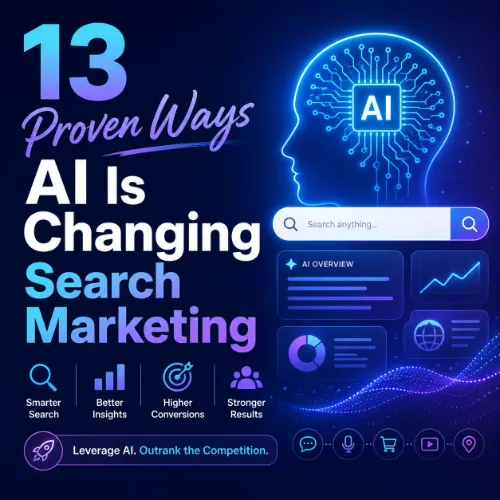
AI is changing search marketing at every level, from how Google understands queries to how brands automate bids and personalize content.
- AI is changing search marketing by introducing generative AI Overviews and conversational results that alter traditional SERP layouts.
- Automated bidding and audience prediction now rely on machine learning models that analyze millions of signals in real time.
- Content teams use AI tools to generate topic clusters, optimize for featured snippets, and scale personalization without sacrificing quality.
Understanding How AI Is Changing Search Marketing in 2025
The relationship between search engines and artificial intelligence has deepened dramatically. Google’s integration of generative AI through Search Generative Experience (SGE) and Microsoft’s Copilot for Bing have reshaped how results appear and how users interact with them. For marketers, this means rethinking keyword research, content structure, and performance measurement. AI search marketing trends now center on predictive analytics, natural language processing, and automated decision-making. For a related guide, see 11 Proven Ways to Optimize for AI Search Engines in 2026.
1. AI-Powered Keyword Research and Topic Clustering
Traditional keyword research relied heavily on manual grouping and guesswork. Today, AI tools analyze search intent, co-occurring terms, and semantic relationships to build comprehensive topic clusters. Platforms like Ahrefs use machine learning to surface related queries with high traffic potential, cutting research time by hours.
Practical takeaway: Use AI-driven keyword tools to identify long-tail variations and question-based queries that align with how users actually search. Focus on clusters rather than isolated keywords.
2. Generative AI Overviews in Search Results
Google’s AI Overviews (formerly SGE) now appear at the top of many queries, summarizing answers from multiple sources. This shift means organic click-through rates for traditional results can drop significantly. However, pages that get cited within those overviews can see massive traffic gains.
Practical takeaway: Optimize for AI Overviews by structuring content with clear headers, concise definitions, and authoritative citations. Use FAQ schema to increase the chance of being pulled into generative summaries.
3. Automated Bid Management and Smart Bidding
Google Ads now defaults to Smart Bidding strategies like Target CPA and Target ROAS. These use real-time signals — device, location, time of day, browser, and even weather — to adjust bids automatically. AI is changing search marketing by removing the need for manual bid adjustments while improving conversion efficiency.
Practical takeaway: Transition away from manual CPC bidding. Provide conversion data consistently and allow Smart Bidding to learn over at least 30 conversions per campaign for reliable performance.
4. Content Personalization at Scale
AI tools analyze user behavior patterns to deliver personalized search experiences. Dynamic content blocks, personalized product recommendations, and adaptive landing pages are now feasible for mid-sized businesses, not just enterprise brands.
Practical takeaway: Implement AI-driven personalization engines like Dynamic Yield or Adobe Target to adjust page copy and offers based on past user behavior and search context.
5. Enhanced Natural Language Processing for Better Query Understanding
Google’s BERT and MUM models have improved the search engine’s ability to understand conversational and complex queries. This means exact-match keywords are less important than answering the user’s actual intent. AI search marketing trends emphasize comprehensive content that addresses multiple angles of a topic.
Practical takeaway: Write content that naturally answers follow-up questions users might ask. Include definitions, comparisons, and step-by-step instructions within your primary article.
6. AI-Generated Content and Human Oversight
Tools like ChatGPT and Claude can draft blog outlines, product descriptions, and meta tags in seconds. However, Google’s quality guidelines still penalize thin or unhelpful content. The best approach combines AI drafting with human editing for accuracy, originality, and brand voice.
Practical takeaway: Use AI for research, headers, and first drafts. Always fact-check and add unique insights, examples, or data that an AI model couldn’t generate on its own.
7. Predictive Analytics for Search Trends
AI models can forecast which search terms will rise in popularity based on social signals, news cycles, and historical patterns. This allows marketers to create content weeks before a trend peaks.
Practical takeaway: Use tools like Exploding Topics or Google Trends paired with AI analysis to identify emerging queries. Publish ahead of the curve to capture early traffic.
8. Automated Link Building and Outreach
AI assists in identifying link-building prospects by analyzing competitor backlinks, domain authority, and relevance. Platforms now automate personalized outreach emails and follow-ups, increasing success rates.
Practical takeaway: Use AI-powered link building tools like Pitchbox or BuzzStream to find and contact prospects. Customize templates with personal details to avoid sounding robotic.
9. Voice Search Optimization via AI
Voice search relies heavily on conversational language and question-based queries. AI helps analyze voice search data to optimize for featured snippets and direct answers, which voice assistants typically pull from.
Practical takeaway: Optimize for voice by including a dedicated FAQ section with natural language questions. Aim for concise answers (40-50 words) that can be read aloud by assistants.
10. Real-Time Performance Monitoring and Anomaly Detection
AI-powered analytics tools track keyword rankings, traffic fluctuations, and conversion rates in real time. They automatically flag anomalies — such as a sudden drop in organic traffic — and suggest probable causes.
Practical takeaway: Set up alerts in Google Search Console and AI analytics platforms like Rank Ranger. Investigate flagged anomalies immediately to prevent long-term traffic loss.
11. Semantic Search and Entity Recognition
Google now understands entities — people, places, things, and concepts — and their relationships. AI is changing search marketing by rewarding content that demonstrates topical authority through entity connections rather than just keywords.
Practical takeaway: Build entity-rich content by linking to authoritative sources, using structured data markup like Schema.org, and covering subtopics comprehensively within your domain.
12. AI-Powered A/B Testing for Landing Pages
Machine learning can run A/B tests on landing page elements — headlines, CTAs, images — and determine winning variations faster than traditional methods. This speeds up optimization cycles and improves conversion rates.
Practical takeaway: Use AI testing tools like Google Optimize or VWO to run multivariate tests. Let the algorithm allocate traffic to the best-performing variant automatically.
13. Enhanced Local SEO Through AI
AI now optimizes local business listings by analyzing review sentiment, photo quality, and proximity signals. Google’s local algorithm updates prioritize businesses with consistent, positive online presences.
Practical takeaway: Use AI reputation management tools to monitor reviews and automatically respond. Ensure NAP (name, address, phone) data is consistent across all directories.
SEO Entities and Their Functions
Understanding how search engines interpret entities helps align your AI search marketing trends strategy with ranking factors. Below are key entities and their roles in modern SEO.
- Root domain: Determines overall site authority through DR (Domain Rating) metrics.
- Organic keywords: Identify topical relevance and search demand via KD (Keyword Difficulty) and search volume.
- Referring domains: Measure backlink profile health and link risk through dofollow/nofollow ratios.
- Top pages: Reveal which URLs earn the most traffic, links, or need technical repair.
- SERP features: Indicate opportunities for featured snippets, People Also Ask, and AI Overviews inclusion.
- Core Web Vitals: Signal page experience quality, directly impacting ranking eligibility.
Useful Resources
Explore these trusted sources to deepen your understanding of AI is changing search marketing:
- Google AI Overviews Official Documentation — Learn how Google’s generative AI features impact search results.
- Ahrefs Guide to AI in Search Marketing — Practical tips for integrating AI into your SEO workflow.
Frequently Asked Questions About AI is changing search marketing
How is AI changing search marketing in 2025?
AI is changing search marketing by automating bidding, generating AI Overviews in SERPs, personalizing content, and improving natural language understanding for better query matching. For a related guide, see 7 Essential Ways AI Overviews Are Changing SEO Forever.
Will AI replace SEO professionals?
AI will not replace SEO professionals but will automate repetitive tasks. Strategic thinking, content quality, and technical analysis still require human expertise.
What is an AI Overview in search results?
An AI Overview is a generative answer box that summarizes information from multiple sources. It appears at the top of some queries, reducing clicks to traditional organic links.
How do I optimize for AI Overviews?
Optimize by using clear H2/H3 headers, providing concise answers to common questions, citing authoritative sources, and implementing FAQ structured data.
Can AI write SEO content better than humans?
AI can generate drafts quickly, but human oversight ensures originality, accurate facts, brand voice, and the nuance needed for high-quality content.
What AI tools are best for keyword research?
Tools like Ahrefs, Semrush, and MarketMuse use AI to cluster keywords by intent, predict traffic potential, and identify content gaps.
Does AI affect local SEO?
Yes, AI improves local SEO by analyzing review sentiment, optimizing Google Business Profiles, and prioritizing businesses with strong local relevance signals.
How does AI help with link building?
AI automates prospect identification, personalizes outreach templates, and tracks responses, making link building more efficient and scalable.
What is Smart Bidding in Google Ads?
Smart Bidding uses machine learning to adjust bids in real time based on signals like device, location, and user behavior to meet conversion targets.
How many conversions does Smart Bidding need?
Google recommends at least 30 conversions in a campaign within 30 days for Smart Bidding to learn effectively and deliver stable performance.
Can AI predict search trends?
AI can analyze historical data, news cycles, and social signals to forecast which search queries will grow in popularity before they peak.
What is entity-based SEO?
Entity-based SEO focuses on optimizing for named entities (people, places, concepts) and their relationships rather than just keywords, improving topical authority.
How does voice search relate to AI?
Voice search relies on AI-powered natural language processing to interpret spoken queries. Optimizing for featured snippets helps voice assistants pull your content.
Is AI content penalized by Google?
Google penalizes low-quality or spammy content regardless of source. AI content that is helpful, original, and factually accurate is not penalized.
What are AI search marketing trends for 2025?
Key trends include generative AI SERP features, predictive analytics, automated personalization, and AI-driven competitor analysis tools.
How do I implement AI personalization?
Use platforms like Dynamic Yield or Adobe Target to segment users by behavior and adjust on-site content, offers, and CTAs dynamically.
Does AI improve PPC campaign performance?
Yes, AI optimizes bidding, ad copy, audience targeting, and creative rotation to maximize ROI while reducing manual management time.
What is the role of AI in semantic search?
AI models like BERT and MUM help search engines understand context, synonyms, and user intent beyond simple keyword matching, improving result relevance.
Can AI help with technical SEO?
AI can crawl sites, detect issues like redirect chains, duplicate content, and indexability problems, and prioritize fixes based on impact.
How do I start using AI in my search marketing?
Start with one area — such as AI keyword research or Smart Bidding — and expand as you see results. Invest in training and choose tools that integrate with your existing stack.