AI SEO hacks Key Takeaways
Search engine optimization is evolving faster than ever, and the smartest marketers are using AI SEO hacks to stay ahead without burning out.
- AI SEO hacks let you analyze search intent at scale, producing content that matches what users actually want.
- Automated keyword clustering and competitor gap analysis reveal opportunities you would otherwise miss.
- Leveraging AI for content optimization and link building saves hours per post while boosting organic traffic.
Why AI SEO Hacks Are Essential for Modern Marketers
Traditional SEO workflows often involve manual keyword research, backlink audits, and content rewriting. These tasks are repetitive and time-intensive. By adopting AI SEO hacks, you can automate the tedious parts and focus on strategy and creativity. Tools powered by natural language processing and machine learning now handle everything from topic clustering to entity optimization. For a related guide, see 10 Essential SEO Terms Every Beginner Should Know.
The key is to use AI as a collaborator, not a replacement. When you combine human judgment with AI-driven insights, you get content that ranks higher, answers real questions, and earns trust from both readers and search engines.
What Makes an AI SEO Hack Effective
An effective hack must reduce manual effort, improve accuracy, and produce measurable results. It should integrate smoothly with existing tools like Google Search Console, Ahrefs, or your CMS. The ten tactics below meet these criteria and have been tested in live campaigns.
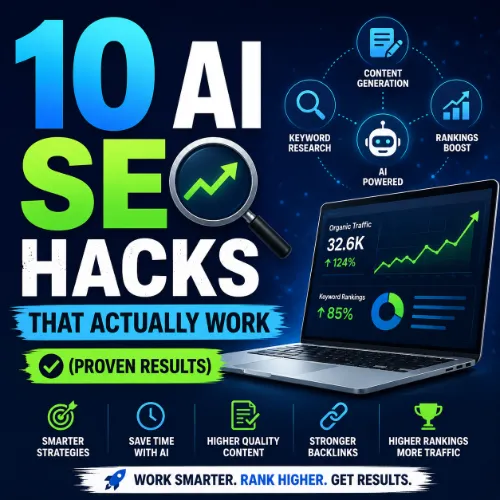
10 AI SEO Hacks That Actually Work
Each hack includes a clear explanation and an actionable step you can implement today.
1. Use AI to Build Topic Clusters from Search Data
Instead of guessing which subtopics to cover, feed your primary keyword into an AI clustering tool. It will analyze search results and group related queries by intent. This gives you a ready-made content map that targets multiple long-tail keywords in one post.
Actionable step: Use a tool like Ahrefs or MarketMuse to generate a list of semantically related terms. Build a single pillar page that covers the main topic and link to supporting articles for each cluster.
2. Automate Keyword Gap Analysis with AI Prompts
Competitor analysis becomes faster when you use AI to compare keyword profiles. Copy your competitor’s top-ranking URLs into an AI prompt that asks for missing keywords and content gaps. The AI returns a list of terms they rank for but you do not.
Actionable step: Export your competitor’s organic keywords from Ahrefs. Ask ChatGPT to identify themes and suggest headers for new posts targeting those gaps.
3. Generate SEO-Optimized Headlines with AI Formulas
Headlines drive clicks, but writing them is painful. Use AI to apply proven formulas like list numbers, how-to structures, or emotional triggers. Feed your target keyword and audience into a prompt, and let the AI produce 10 alternatives.
Actionable step: Use a tool like CoSchedule’s Headline Analyzer to score AI-generated headlines. Pick the one with the highest balance of clarity and curiosity.
4. Optimize Content for Entities Instead of Keywords Alone
Google understands topics through entities — people, places, concepts, and their relationships. AI can scan your draft and flag missing entities that top-ranking pages mention. Adding them naturally improves topical relevance.
Actionable step: Paste your draft into a tool like Frase or Clearscope. Review the entity suggestions and integrate the most relevant ones into your subheadings and body paragraphs.
5. Summarize Competitor Content with AI Briefs
Reading 20 competing articles to understand the landscape takes hours. Use an AI summarizer to extract the main points, common questions, and unique angles from each. This gives you a content brief in minutes.
Actionable step: Copy the top 3–5 SERP results into ChatGPT and ask for a comparison of their key arguments and data points. Use this summary to write a more comprehensive post.
6. Automate Internal Link Suggestions with AI
Internal linking boosts SEO by distributing authority, but manually finding link opportunities is tedious. AI can scan your site structure and recommend relevant anchor texts and target pages.
Actionable step: Use a plugin like Link Whisper or an AI script to generate internal link suggestions after publishing. Always review suggestions for context.
7. Rewrite Old Content for Freshness with AI
Outdated content loses rankings. AI can rewrite passages to include current statistics, improve readability, and incorporate new keywords. This refreshes the page without a full rewrite. For a related guide, see 11 Proven Ways to Improve Google Rankings Fast.
Actionable step: Identify underperforming pages in Google Search Console. Use Jasper or ChatGPT to rewrite the introduction and update at least three data points per page.
8. Predict Search Trends with AI Forecasting
AI tools can model search volume trends based on historical data and seasonal patterns. This helps you create content before demand peaks.
Actionable step: Use Google Trends’ rising queries or an AI-powered forecasting tool like Exploding Topics. Schedule articles for topics showing upward momentum.
9. Generate FAQ Schema Markup from Content
Structured data helps your pages appear in rich results. AI can extract questions from your content and format them as FAQ schema, saving you the manual markup work.
Actionable step: Paste your final draft into Schema App or a custom GPT prompt. Validate the output with Google’s Rich Results Test before deploying.
10. Automate Outreach Email Sequences with AI
Link building requires personalized emails at scale. AI can generate subject lines, openers, and body paragraphs tailored to each prospect’s site. This increases reply rates while slashing preparation time.
Actionable step: Build a prospect list using Ahrefs’ broken link checker. Use an AI writing tool to create 5 unique email templates and personalize each with the prospect’s recent post.
SEO Entities and Their Functions
Understanding the key components of SEO analysis helps you apply the hacks above with precision. Below are the most relevant entities and how they support AI SEO hacks.
- Keyword entities — Organic keywords and keyword difficulty (KD) show demand and competition. AI can cluster them by intent, helping you pick terms you can realistically rank for.
- Backlink entities — Referring domains and dofollow/nofollow links reveal authority. Use AI to identify broken backlinks on competitor sites that you can request.
- Page entities — Top pages by traffic or links highlight which URLs earn value. AI can analyze these to suggest content updates or internal link targets.
- SERP entities — Featured snippets, People Also Ask, and AI Overviews indicate the format Google rewards. Use AI to structure your content for these rich results.
- Content entities — Authors, topics, and published dates affect freshness. AI can scan your archive and recommend older posts to refresh.
Useful Resources
Deepen your knowledge of AI SEO hacks with these trusted guides.
- Ahrefs Blog: SEO Strategy Guide — Comprehensive advice on keyword research, link building, and content planning.
- Moz Blog: How to Use AI for SEO — Practical applications of AI in search optimization with real examples.
Frequently Asked Questions About AI SEO hacks
What are AI SEO hacks ?
AI SEO hacks are automated techniques using artificial intelligence to speed up keyword research, content optimization, link building, and performance analysis.
Do AI SEO hacks really work?
Yes, when applied correctly. They save time and reveal insights that manual methods miss, leading to higher rankings and traffic.
Can AI replace human SEO experts?
No. AI handles repetitive tasks, but strategic thinking, creative writing, and relationship building still require human expertise.
Which AI tools are best for SEO?
Popular options include ChatGPT for content generation, Ahrefs for keyword and backlink data, Frase for content optimization, and MarketMuse for topic clustering.
How do I start using AI for SEO?
Begin with one task, such as generating headline ideas or summarizing competitor articles. Gradually add more hacks as you see results.
Is AI-generated content penalized by Google?
Google’s guideline penalizes low-quality content, not AI use per se. Review and edit AI output to ensure it is helpful, accurate, and original.
How do I find keyword ideas with AI?
Feed a seed keyword into a tool like Ahrefs or use ChatGPT to generate long-tail variations. Then cluster them by search intent.
What is entity-based SEO?
Entity-based SEO focuses on optimizing for people, places, and concepts rather than exact-match keywords. AI helps identify and include relevant entities.
How can AI help with link building?
AI can generate personalized outreach emails, find broken link opportunities, and identify unlinked brand mentions.
What is the best way to rewrite old content with AI?
Use AI to update statistics, improve sentence flow, and add new internal links. Always verify facts and keep the original tone.
How do I measure AI SEO results?
Track organic traffic, keyword rankings, click-through rates, and conversion metrics before and after implementing each hack.
Can AI predict search trends?
Yes, by analyzing historical data and seasonal patterns, AI tools like Exploding Topics can forecast rising search volume.
Should I use AI for meta descriptions?
Absolutely. AI can generate compelling meta descriptions that include target keywords and a clear call to action, saving you time.
How do I avoid keyword stuffing with AI?
Set a keyword density limit before generating content. Review the output and replace overused terms with synonyms.
What is a content brief in AI SEO?
An AI-generated brief outlines target keywords, competitor insights, suggested headings, and entity recommendations for a new article.
Can AI help with local SEO?
Yes. AI can identify local keywords, generate location-specific content, and optimize Google Business Profile descriptions.
How often should I update AI-generated content?
Review performance monthly. Refresh any page that drops in rankings or has outdated data using your AI rewriting hack.
Is it expensive to use AI for SEO?
Many tools offer free tiers or affordable plans. Even a simple ChatGPT subscription can yield significant time savings.
How do I ensure AI content sounds human?
Read the output aloud, add personal anecdotes, and adjust sentence length. Run it through a readability checker like Hemingway Editor.
Can AI help with YouTube SEO?
Yes. AI can optimize video titles, descriptions, tags, and even generate transcriptions for better indexing.