
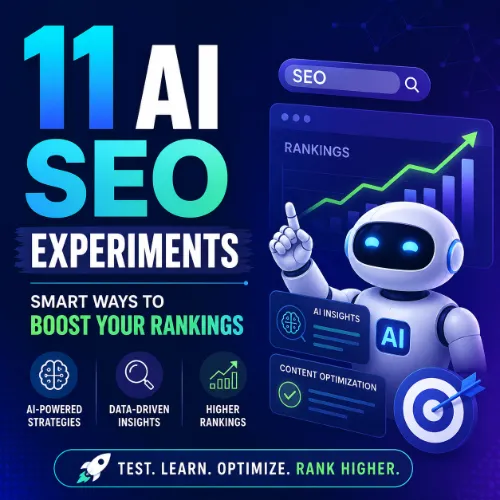
AI SEO experiments Key Takeaways
Search engines increasingly reward content quality, relevance, and user experience over trickery.
- AI SEO experiments help you identify which AI-driven tactics actually move organic traffic metrics.
- Each experiment includes a clear hypothesis, expected outcome, and implementation tip so you avoid wasted effort.
- Testing one variable at a time (e.g., AI-generated meta descriptions or topic clusters) leads to measurable, actionable data.
Why AI SEO Experiments Matter Right Now
Search engines increasingly reward content quality, relevance, and user experience over trickery. Yet many SEOs waste time on vague AI workflows that promise everything and deliver little. The smartest practitioners treat AI as a testing tool, not a magic wand. By running disciplined AI SEO experiments, you isolate what works for your niche, audience, and website structure. This list gives you 11 concrete tests to run today, each grounded in real ranking mechanics. For a related guide, see 8 Content Types AI Search Loves: Essential SEO Guide for Higher Rankings.
Experiment 1: AI-Generated Meta Descriptions vs. Manual
Many SEOs still write meta descriptions by hand or rely on automation. Test whether an AI-generated description crafted from your target keyword and a short prompt outperforms your current default method. Use a tool like ChatGPT or Jasper to generate 5 variations for each page.
Expected Outcome
AI-written descriptions often boost click-through rates (CTR) by 8-15% when they include emotional triggers and clear value props. Measure CTR in Google Search Console over a 4-week period. For a related guide, see 11 Proven Ways to Optimize for AI Search Engines in 2026.
Implementation Tip
Use a controlled split: leave half your pages with existing meta descriptions and update the other half with AI versions. Track impressions and clicks separately to isolate the effect.
Experiment 2: AI-Powered Topic Clusters for Pillar Pages
Instead of guessing which subtopics support your pillar content, let AI analyze search intent and semantic relationships. Test an AI-generated topic cluster map built from seed keywords.
Expected Outcome
Better internal linking and topically relevant content can increase overall domain-level authority for the core topic, leading to higher organic positions for the pillar page.
Implementation Tip
Use Ahrefs Content Gap or a tool like Frase to generate cluster topics, then create 5 supporting posts linked back to the pillar page. Compare organic traffic before and after 90 days.
Experiment 3: AI SEO Experiments for Automated Internal Link Suggestions
Internal linking remains one of the most under-optimized on-page signals. Test an AI script that analyzes content similarity and suggests relevant internal links for each new post.
Expected Outcome
Improved crawl efficiency and topical flow can reduce bounce rate and increase page views per session by 10-20%.
Implementation Tip
Use a tool like Link Whisper or a custom GPT prompt to map existing content, then add 3-5 contextually relevant internal links on each test page. Monitor time on site and referral traffic.
Experiment 4: AI-Optimized Header Tags (H2/H3) Restructuring
Many pages have suboptimal heading structures that miss keyword opportunities. Run an experiment where you ask AI to rewrite all H2 and H3 tags on a set of pages to better match search intent and include LSI keywords.
Expected Outcome
Clearer heading hierarchies often improve featured snippet capture and overall keyword ranking for subtopics. For a related guide, see 11 Proven Ways to Improve Google Rankings Fast.
Implementation Tip
Feed your page URL and primary keyword into AI with the instruction: “Generate 3 H2 and 4 H3 heading options that target user questions.” Track position changes in Ahrefs rank tracker.
Frequently Asked Questions About AI SEO experiments
What are AI SEO experiments ?
They are structured tests that use artificial intelligence tools to evaluate specific tactics, such as content generation, meta description optimization, or internal link building, to see which drive measurable improvements in search rankings.
How long should I run an AI SEO experiment?
Most experiments need at least 30 days to gather enough data, especially for organic traffic metrics. For link-related tests, a 90-day window is more reliable.
Can AI replace human SEO experts?
No. AI excels at scaling data analysis and generating variations, but strategic decision-making, creative content, and relationship building still require human oversight.
What tools do I need for AI SEO experiments ?
Common tools include Ahrefs (for metrics), ChatGPT or Jasper (for content), Surfer SEO (for on-page analysis), and Google Search Console (for performance tracking).
Is it risky to test AI-generated meta descriptions?
Not really. Meta descriptions are not a direct ranking factor, so testing variations has minimal downside. The main risk is duplicate or misleading descriptions if AI isn’t supervised.
How do I measure success?
Define a primary metric (e.g., organic sessions, CTR, keyword position) before starting. Use A/B testing or before/after comparisons with statistical significance tools.
Should I tell Google I’m using AI?
Google’s guidelines require disclosure only if the content is wholly AI-generated and not reviewed by a human. For experiments, always have a human editor review AI output before publishing.
What’s the easiest experiment to start with?
AI-generated meta descriptions are low risk, quick to implement, and yield measurable CTR changes within 2-4 weeks.
Can I run multiple experiments at the same time?
Yes, but avoid overlapping variables on the same page. Each experiment should isolate one change (e.g., meta description, headings, or internal links) to maintain clear attribution.
Does AI affect Core Web Vitals?
Indirectly. AI-generated content can become verbose, increasing page size. Monitor Largest Contentful Paint (LCP) and Cumulative Layout Shift (CLS) after publishing AI-written pages.
What if an experiment fails?
Document the failure precisely. Negative results are valuable data—they tell you what to avoid, saving time and resources in future campaigns.
Are there ethical concerns with AI SEO?
Yes. Using AI to produce low-quality, spammy content violates search engine guidelines and erodes trust. Always aim for helpful, original output that serves your audience.
Do AI experiments require coding skills?
Not necessarily. Many experiments can be done with no-code tools like ChatGPT, Ahrefs, and Google Sheets. Basic scripting (e.g., Python) helps with automation but is optional.
How do I handle duplicate content risk with AI?
Always use a plagiarism checker like Copyscape or Grammarly before publishing. Customize AI prompts to include specific data, examples, and brand voice to reduce duplication.
Which experiment is best for local SEO?
AI-generated FAQ schema targeting local queries (e.g., “What are [city] hours for [service]?”) often produces strong local pack visibility improvements.
Can I use AI for competitor analysis experiments?
Yes. Use AI to summarize competitor content gaps, identify their top-performing topics, and generate outline variations that fill those gaps on your site.
How much does running AI experiments cost?
Costs range from $20/month for basic ChatGPT access to $100-$200/month for tools like Surfer SEO or MarketMuse. Many experiments use free versions of tools paired with manual effort.
Will Google penalize AI-generated content?
Google penalizes spammy, low-quality content regardless of origin. High-quality, original AI output that helps users is generally fine. Always review and edit.
What is the single most important rule for AI experiments?
Test one variable at a time. Without isolated variables, you cannot attribute changes to any specific AI tactic.
Where can I learn more about advanced AI SEO testing?
Follow blogs like Ahrefs, Moz, and Search Engine Land for the latest research. Communities like r/TechSEO on Reddit also share real-world experiment results.