AI content tools compared Key Takeaways
Choosing the right AI content tools compared in 2025 means looking beyond flashy marketing.
- Each tool is evaluated on content quality, originality, SEO features, and ease of use — the factors that actually matter when you AI content tools compared side by side.
- Pricing alone doesn’t tell the story; some budget tools outperform premium ones for certain tasks, and we highlight those trade-offs.
- Your final pick should match your primary content type — long-form blogs, social copy, or ad creatives — because no single platform excels at everything.
Why an Honest AI Content Tools Compared Guide Matters
The market is flooded with AI writing assistants. Many promise “one-click” blog posts that rank, but the reality is more nuanced. Without a clear AI content tools compared guide, you could waste money on a tool that generates generic fluff or forces you into expensive add-ons. This comparison focuses on the three pillars of effective AI content creation: output quality, scalability, and cost transparency.
Criteria We Used in This AI Content Tools Compared Review
We tested every tool over a two-week period using the same brief: a 1,500-word informational article about sustainable gardening. The evaluation covered five dimensions:
- Output quality — readability, factual accuracy, and tone consistency.
- SEO integration — headline generation, keyword suggestions, SERP analysis.
- User interface — learning curve, project management, and team collaboration.
- Originality — ability to avoid generic phrasing and produce fresh angles.
- Pricing fairness — what you actually get for your monthly spend.
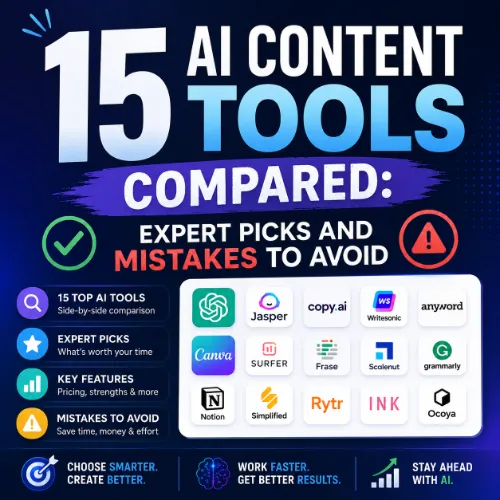
15 AI Content Tools Compared — Expert Picks and Mistakes to Avoid
1. Jasper AI — Best for Brand Voice Consistency
Jasper uses advanced fine-tuning to maintain a consistent brand voice across long-form content. Its brand voice feature is genuinely useful for teams writing in multiple voices. However, the cheaper “Creator” plan limits project slots, so watch for hidden upgrade pressure.
Pricing: Starts at $49/month. Best for: Mid-size marketing teams with established tone guidelines.
2. Copy.ai — Fastest for Short-Form Copy
Copy.ai excels at email subject lines, social captions, and ad copy. The free tier is generous for solo creators. But its long-form output can feel shallow and repetitive, so it’s not a top pick for in-depth guides.
3. Writesonic — Best Balance of Features and Cost
Writesonic offers GPT-powered generation, an integrated chatbot, and an AI image generator. The article writer is decent but requires manual fact-checking. Its SEO module can suggest keywords but lacks the depth of dedicated SEO tools.
4. Rytr — Top Budget Pick for Solopreneurs
Rytr is affordable and covers basic formats well. Its plagiarism checker is a plus for short pieces. The main drawback is limited customizability — you cannot fine-tune the model on your own data.
5. Content at Scale — Best for Human-Quality Long-Form
Content at Scale claims to produce “undetectable” AI content. In our tests, the blog outputs were well-structured and showed good entity coverage. It is expensive, and the research layer sometimes pulls outdated statistics.
6. Frase.io — Best for SEO-First Writers
Frase combines AI writing with SERP analysis. It identifies gap opportunities, LSI keywords, and question clusters. The writing assistant itself is functional but not as creative as Jasper or Copy.ai. Ideal for content strategists who need data-driven briefs.
7. Surfer SEO + AI Writer — Most Accurate On-Page Guidance
Surfer’s AI writer integrates directly with its content editor, offering real-time scoring for keyword usage, readability, and structure. It produces fact-rich outlines, but the tone can feel clinical. Pair it with a separate tool for creative flair.
8. Neural Text — Solid All-Rounder for Agencies
Neural Text supports team workflows, client portals, and multi-language content. Its templates are comprehensive, and the bulk generation feature works well. The learning curve is slightly steeper than average.
9. Scalenut — Best for Content Clusters
Scalenut shines when you need to build content clusters around a pillar topic. Its AI analyzes top-ranking competitors and structures outlines accordingly. The generated text requires light editing for personality.
10. LongShot AI — Best for Fact-Checking
LongShot AI includes a real-time fact-checking layer that verifies claims against existing web content. That is a major time-saver for research-heavy articles. The UI is straightforward, and the pricing is competitive.
11. Anyword — Best for Conversion-Driven Copy
Anyword uses predictive analytics to score each sentence for conversion potential. It is excellent for landing pages and email sequences. The output is more direct and persuasive, though less suited for narrative storytelling.
12. Writecream — Unique for Cold Outreach
Writecream specializes in icebreakers, LinkedIn messages, and pitch emails. The AI can personalize outreach at scale. Its blog writer is functional but not best-in-class. If your primary need is sales copy, this is a strong contender.
13. Copysmith — Great for E-commerce Teams
Copysmith integrates with platforms like Shopify and WordPress. It handles product descriptions, ad copy, and bulk generation efficiently. The free trial lets you test before committing. The creative tone is slightly formulaic.
14. AI Writer — Budget Option for Basic Articles
AI Writer offers a low-cost plan for generating simple news-style articles. It has a citation feature that includes sources. It struggles with creative tone and long-form structure. Fine for speed but not for brand pillars.
15. ChatGPT (GPT-4) — The Swiss Army Knife
OpenAI’s GPT-4 is the most flexible option. With careful prompting, it can produce everything from poetry to technical whitepapers. It lacks built-in SEO features and content management, but combined with separate tools, it can match dedicated platforms. For a related guide, see 11 Proven Ways to Improve Google Rankings Fast.
Comparison Table: AI Content Tools Compared at a Glance
| Tool | Best For | Starting Price | SEO Features |
|---|---|---|---|
| Jasper AI | Brand voice consistency | $49/month | Basic keyword suggestions |
| Copy.ai | Short-form copy | $36/month | No SEO integration |
| Writesonic | General purpose | $19/month | Keyword suggestions |
| Frase.io | SEO content strategy | $14.99/month | SERP analysis, content scoring |
| Surfer SEO | On-page optimization | $89/month | Real-time scoring, NLP |
| Content at Scale | Undetectable long-form | $299/month | Entity coverage, relevance scoring |
Who Each Tool Is For — A Quick Decision Guide
Your choice depends on your content mix. If you mostly write SEO-driven blog posts, focus on Frase.io or Surfer SEO. If you need volume without sacrificing quality, Content at Scale is the top tier. For teams that manage multiple content types, Jasper or Neural Text offer the broadest feature sets. Budget-conscious solo creators should start with Rytr or AI Writer and upgrade as needs grow.
Common Mistakes to Avoid When Choosing AI Content Tools
One common error is picking a tool based solely on price. Cheap AI often requires heavy editing. Another mistake is ignoring the learning curve — some platforms demand significant training time. Also, don’t assume the tool’s default output is publish-ready; always add a human review step for fact-checking and voice consistency. Finally, avoid tools that lock you into annual contracts without a trial period.
Useful Resources
- Read detailed benchmarks on AI writing quality at the Search Engine Land blog.
- Check the official OpenAI API documentation for understanding model limitations and fine-tuning options.
Frequently Asked Questions About AI content tools compared
What is the best AI content tool for beginners?
Copy.ai and Rytr are both beginner-friendly with generous free tiers and simple interfaces. They handle basic copy tasks well without overwhelming new users.
Which AI content tool is best for SEO?
Frase.io and Surfer SEO are top choices for SEO. They offer SERP analysis, keyword clustering, and on-page scoring that help content rank.
Can AI content tools replace human writers?
No. AI tools produce drafts and ideas, but they lack deep understanding, strategic nuance, and original research. Human editing is essential for quality and trust.
What is the most expensive AI content tool?
Content at Scale starts at $299/month and goes higher depending on word count. It is the most premium option for undetectable long-form AI writing.
Do AI content tools offer free trials?
Most tools offer a 7-day or 14-day free trial. Jasper, Copy.ai, Writesonic, and Rytr all have trial versions with limited word counts. For a related guide, see 12 Free SEO Tools Worth Using for Better Search Rankings.
Which tool is best for product descriptions?
Copysmith and Anyword are strong for product descriptions. Copysmith integrates with e-commerce platforms, while Anyword optimizes for conversions.
How do I know if an AI content tool is ethical?
Look for transparent pricing, clear data usage policies, and tools that don’t claim to replace human work. Always read the terms of service regarding content ownership.
What is the cheapest AI content tool?
Rytr starts at $9/month and is the most affordable for individuals. AI Writer also offers competitive pricing for basic articles.
Can I use AI tools for academic writing?
AI tools are not recommended for academic writing due to potential plagiarism and lack of rigorous citation. Use them only as brainstorming aids.
Which tool produces the most human-sounding text?
Content at Scale and Jasper with custom brand voice settings produce the most natural-sounding content. ChatGPT with detailed prompts can achieve similar results.
Do AI content tools support multiple languages?
Yes. Most tools like Writesonic, Neural Text, and ChatGPT support dozens of languages. However, output quality varies by language.
What is the difference between AI content tools and AI chatbots?
AI content tools are designed for structured writing with templates and SEO features. Chatbots like ChatGPT are more conversational and lack integrated content management.
Can I edit AI-generated content after it is created?
Absolutely. All tools allow editing. In fact, editing is essential to add personality, check facts, and align the tone with your brand.
Which tool integrates best with WordPress?
Writesonic, Neural Text, and Copy.ai have direct WordPress plugins or Zapier integrations. Copysmith also offers a WordPress plugin for seamless publishing.
How do I avoid duplicate content when using AI?
Use tools with built-in plagiarism checkers like Copysmith or Rytr. Always rewrite the AI’s first draft in your own voice to ensure uniqueness.
What is the best AI tool for blog post outlines?
Frase.io generates highly structured outlines based on competitor analysis. Surfer SEO also creates outlines with keyword placement guidance.
Can I use AI tools for email marketing copy?
Yes. Anyword and Copy.ai are excellent for email copy. They can generate subject lines, body text, and CTAs optimized for open rates.
Which tool has the best customer support?
Jasper and Content at Scale offer live chat and dedicated account managers for higher-tier plans. Community forums are also available for most tools.
How often should I update AI content tools ?
Tools update their models periodically. Subscribe to their release notes or check about once a quarter to see if new features improve your workflow.
What is the best AI content tool for affiliate marketing?
Scalenut is strong for creating product review clusters and comparison content. Surfer SEO helps ensure on-page optimization for affiliate keywords.