
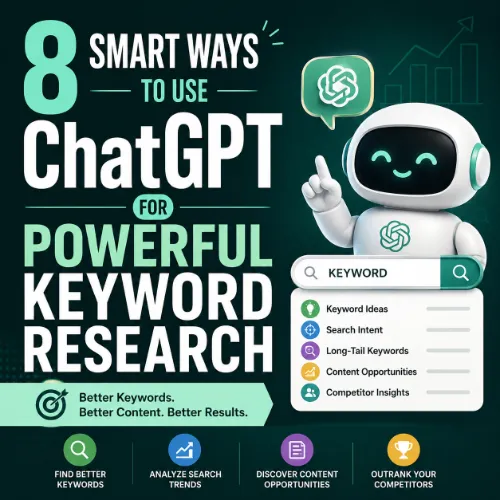
ChatGPT for keyword research Key Takeaways
ChatGPT for keyword research transforms how content marketers uncover and prioritize search terms.
- ChatGPT for keyword research helps generate seed ideas, cluster topics by intent, and extract long-tail variations from competitor content.
- Using ChatGPT alongside tools like Ahrefs or SEMrush gives you both creative breadth and data-driven validation.
- Effective prompts with context around audience, intent, and content gap yield more actionable keyword suggestions than generic queries.
Why ChatGPT for Powerful keyword research Changes the Game
Keyword research sits at the heart of every successful SEO strategy. Yet the process can feel tedious: brainstorming hundreds of terms, checking search volume, grouping by intent. ChatGPT for keyword research streamlines the early stages by generating ideas you might never uncover from an autocomplete drop-down alone. It also helps you understand semantic relationships between topics, making your content more comprehensive and ranking-ready. For a related guide, see 10 ChatGPT Prompts for SEO Content: Best Prompts to Boost Rankings.
When you combine ChatGPT with data from a tool like Ahrefs, you get the best of both worlds: AI-assisted creativity and concrete metrics such as keyword difficulty and search volume. The key is treating ChatGPT as a research assistant, not a replacement for verified data sources.
1. Brainstorm Seed Keywords from Your Core Topic
Start by feeding ChatGPT a broad topic and asking for related seed keywords. For example, prompt: “Generate 20 keyword ideas for a blog about sustainable gardening.” The model will return a mix of head terms (e.g., “organic gardening tips”), mid-tail phrases, and potential long-tail queries you may have missed.
Take this list and cross-reference it with your AI keyword research tool of choice to validate search volume and difficulty. Use the top-performing seeds to build your content clusters.
2. Expand Seed Keywords into Long-Tail Variations
Long-tail keywords often drive higher conversion rates because they match specific user intent. Ask ChatGPT: “For the keyword ‘home composting,’ list 15 long-tail questions a beginner might ask.” You’ll get phrases like “how to compost in an apartment” or “best compost bin for small gardens.”
These phrases are gold for blog posts, FAQs, and landing pages. They also help you capture voice search queries and featured snippet opportunities with minimal competition.
3. Group Keywords by Search Intent
ChatGPT can classify keywords by intent: informational, navigational, commercial, or transactional. Provide a list of 30 terms and ask it to sort them. This saves hours of manual categorization and ensures your content matches what users actually want.
For instance, if you run an e-commerce site selling running shoes, “best running shoes for flat feet” is commercial, while “how to choose running shoes” is informational. Grouping correctly prevents you from writing a product page that should have been a guide.
4. Generate Content Cluster Ideas from a Head Term
Content clusters improve topical authority and internal linking. Prompt ChatGPT: “List 10 subtopics related to ‘email marketing automation’ that could form a content cluster.” The model will suggest pillars like “drip campaigns,” “segmentation strategies,” and “A/B testing subject lines.” For a related guide, see 15 GEO Strategies to Rank in ChatGPT and Gemini (Proven).
Map each subtopic to a keyword phrase and create interlinked articles. This structure signals expertise to search engines and can boost rankings across the entire cluster.
5. Reverse-Engineer Competitor Content
Paste a competitor’s blog post or landing page into ChatGPT and ask: “Extract the primary and secondary keywords from this article.” The AI identifies terms the page targets plus related LSI keywords you might have overlooked.
Use this insight to find content gaps. If the competitor ranks for “organic soil amendments” but not for “soil pH for vegetables,” that gap becomes your opportunity.
Frequently Asked Questions About ChatGPT for keyword research
Is ChatGPT accurate for keyword research?
ChatGPT provides creative and contextual suggestions, but it does not have real-time search volume or keyword difficulty data. Always verify its outputs with tools like Ahrefs or Google Keyword Planner.
Can ChatGPT replace traditional keyword tools?
No. ChatGPT for keyword research works best as a brainstorming and clustering assistant. Traditional tools provide the quantitative metrics you need to make data-driven decisions.
How do I prompt ChatGPT for better keyword ideas?
Be specific: include your audience, topic, and desired keyword type (e.g., long-tail, question-based). For example: “Generate 15 long-tail keywords for a vegan baking blog targeting beginners.”
What is the difference between ChatGPT and AI keyword research tools?
Dedicated AI keyword research tools like Ahrefs or SEMrush have built-in databases, metrics, and competitor analysis. ChatGPT is a general-purpose language model that can assist with ideation but lacks a keyword index.
Can ChatGPT find low-competition keywords?
It can suggest niche or long-tail phrases that are often less competitive. However, you need a keyword tool to measure actual competition levels.
Should I include the focus keyword in every H2?
No. Place the focus keyword naturally in at least two H2s, but use LSI and related terms in the others to maintain readability and avoid keyword stuffing.
Does ChatGPT help with keyword clustering?
Yes. You can feed ChatGPT a list of keywords and ask it to group them by intent or topic. It helps you structure content silos quickly.
Can I use ChatGPT to extract keywords from a competitor page?
Paste the page text into ChatGPT and ask it to identify the primary and secondary keywords. Use the output to find content gaps.
What are LSI keywords and how does ChatGPT help?
LSI (latent semantic indexing) keywords are terms semantically related to your main subject. ChatGPT can generate many of these quickly, improving your content’s relevance.
Does ChatGPT support multiple languages for keyword research?
Yes. You can prompt ChatGPT in many languages, and it will generate keyword ideas in that language. Verify with a local keyword tool for accuracy.
How do I use ChatGPT for YouTube keyword research?
Ask for video title ideas and keyword phrases that match search queries on YouTube. For example: “List 10 trending YouTube keywords for DIY home repairs.”
Can ChatGPT generate question-based keywords?
Absolutely. Prompt it with “Write 20 questions a beginner would ask about [topic].” These are perfect for FAQ sections and featured snippets.
What is the best way to combine ChatGPT with Ahrefs?
Use ChatGPT to generate a large list of seed and long-tail keywords. Then paste those into Ahrefs Keyword Explorer to filter by volume, difficulty, and traffic potential.
Does ChatGPT know about search intent?
Yes, when prompted correctly. Ask it to classify keywords as informational, navigational, commercial, or transactional.
How many keyword ideas can ChatGPT produce in one session?
There is no hard limit, but for quality, request 20–30 at a time. You can run multiple prompts with different angles for more variety.
Can ChatGPT help with keyword mapping for a site structure?
Yes. Describe your site structure and ask ChatGPT to assign keywords to each page or category. It can suggest a logical hierarchy.
Is ChatGPT better than free keyword tools?
It depends on the task. ChatGPT excels at ideation and content planning, while free tools like Google Keyword Planner provide actual search data. Use both.
How do I avoid duplicate keyword suggestions from ChatGPT?
Add a note in your prompt like “Avoid repeating similar phrases” or ask for 20 unique terms with different modifiers.
Can ChatGPT help with negative keyword research for PPC?
Yes. Give it a list of your core keywords and ask it to identify terms that are irrelevant or have off-target intent. This can reduce wasted ad spend.
What is the biggest mistake when using ChatGPT for keywords?
Treating its output as final, validated data. Always cross-check with a real keyword tool before investing time in content creation.