AI replacing traditional SEO tasks Key Takeaways
SEO professionals once spent entire days manually analyzing search results, building spreadsheets, and combing through logs.
- AI tools now handle keyword clustering, content brief generation, and even first-draft writing, reducing research time by up to 70%.
- Automated technical audits surface crawl errors, duplicate content, and schema opportunities within minutes instead of hours.
- Predictive analytics help SEO teams prioritize topics with the highest traffic potential before investing in creation.
What You Need to Know About AI is replacing traditional SEO tasks
SEO professionals once spent entire days manually analyzing search results, building spreadsheets, and combing through logs. Today, machine learning performs many of those traditional SEO automation duties faster and often more accurately. This shift does not mean the end of SEO jobs — it means the skills needed are different. Understanding which AI SEO tasks can be safely delegated helps you stay competitive, deliver faster results, and avoid being replaced by someone who uses AI better than you do. For a related guide, see 12 Free SEO Tools Worth Using for Better Search Rankings.
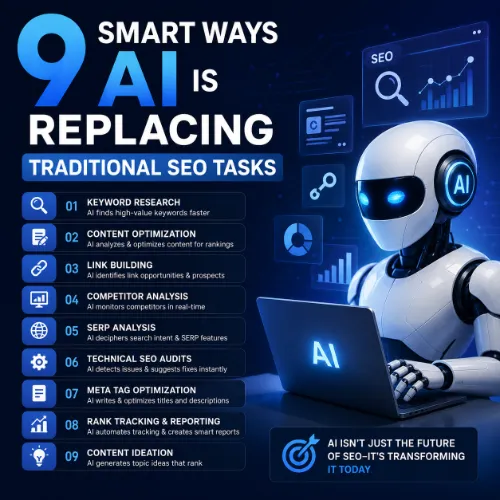
1. Automated Keyword Research and Clustering
Traditional keyword research meant typing terms into a tool, exporting hundreds of rows, and manually grouping them by intent. AI now analyzes search intent, semantic relationships, and user behavior to create clusters instantly.
Tools like Ahrefs, Semrush, and Surfer use natural language processing to suggest topic clusters and identify which keywords overlap. Instead of guessing whether “buy running shoes” and “best running sneakers” target the same content, AI scores the intent alignment and suggests page architecture. This AI replacing traditional SEO tasks in research saves 5–10 hours per campaign.
2. Content Brief and Outline Generation
Writing a thorough content brief once required manual analysis of top-ranking pages, SERP features, and word count patterns. AI now ingests the top 10 results, extracts the subheadings, common questions, and key entities, and produces a structured outline.
For instance, a tool like Frase.io or Clearscope uses machine learning to identify which terms the top results use consistently. It then generates a brief that includes recommended headings, word count targets, and related questions. This AI SEO tasks automation ensures your content meets search intent before a single word is written.
3. First-Draft Content Writing
While AI cannot replace a human editor, it can produce a competent first draft from a solid brief. Large language models like GPT-4 write coherent paragraphs that cover the core points, allowing writers to focus on voice, nuance, and fact-checking.
Many enterprises now use AI writing assistants for authoritative content such as product descriptions, definitions, and lists. The key is editing — not starting from scratch. This is one of the most visible examples of AI replacing traditional SEO tasks in action, cutting production time by half.
4. Metadata and Schema Markup Optimization
Crafting unique meta titles and descriptions for hundreds of pages used to be tedious and error prone. AI can generate optimized meta tags at scale by analyzing page content, target keywords, and character limits. It also writes JSON-LD schema for FAQ, HowTo, and Article types with near-zero errors.
For example, a tool like RankMath or Schema App automates schema injection for WordPress, reducing manual work and improving click-through rates through richer search listings.
5. Technical Site Audits at Machine Speed
Running a full technical audit manually — checking redirect chains, broken links, duplicate titles, and crawl budget — takes an experienced SEO analyst a full day. AI-powered crawlers like Screaming Frog combined with machine learning classification now flag issues in minutes and prioritize them by severity.
AI can also detect patterns that humans miss, such as subtle changes in internal linking structures that confuse crawlers. Automating these traditional SEO automation inspections allows teams to fix problems before they become ranking issues.
6. Competitor Analysis and Gap Detection
Manual competitor analysis involved exporting domains, comparing backlink profiles, and scanning content side by side. AI platforms like Ahrefs and Similarweb automatically identify keyword gaps, content topics your competitors rank for that you do not, and link-building opportunities using pattern recognition.
One example: an AI tool can scan 50 competitor sites and instantly produce a report showing every topic where they outrank you with estimated traffic potential. This insight transforms strategy from reactive to proactive — a clear win for AI SEO tasks.
7. Backlink Analysis and Outreach Automation
Analyzing referring domains, anchor text distribution, and link velocity used to require painstaking spreadsheet work. AI now classifies backlinks by quality, flags toxic links automatically, and even generates personalized outreach emails.
Tools like Pitchbox and Buzzstream use natural language models to customize email templates based on the recipient’s recent content. While final personalization still needs human oversight, the grunt work is handled by AI, making link building scalable. This is a prime example of AI replacing traditional SEO tasks in off-page optimization.
8. Performance Reporting and Predictive Insights
Monthly reporting often meant copying data from Google Search Console and Analytics into slides. AI automates report generation, highlights anomalies, and suggests causes. More advanced systems like BrightEdge use predictive analytics to forecast traffic changes based on algorithm updates or seasonal trends.
This allows SEO managers to respond before traffic drops — not after. AI SEO tasks in reporting also include anomaly detection, surfacing sudden ranking shifts without waiting for a human to notice.
9. Local SEO and Google Business Profile Management
Local SEO managers spent hours updating NAP (name, address, phone) citations and responding to reviews. AI can now monitor review sentiment, suggest responses, and identify citation inconsistencies across directories. Tools like SOCi and Yext use machine learning to keep local listings accurate across hundreds of platforms.
Automating these repetitive traditional SEO automation tasks frees local SEO specialists to engage with customers directly and craft more nuanced promotional strategies.
SEO Entities and Their Functions
When working with AI SEO tasks, understanding key entities makes analysis more precise:
- Domain entities: Root domain, subdomain, and URL-level analysis help identify whether performance belongs to the whole site, a section like blog.example.com, or a single page such as example.com/page.
- Keyword entities: Organic keywords, keyword difficulty, search volume, and SERP features show demand, competition, and ranking opportunity.
- Backlink entities: Referring domains, anchor text, dofollow/nofollow status, and new/lost backlinks clarify authority and link risk.
- Technical SEO entities: Crawl issues, redirect chains, canonicals, and indexability status reveal obstacles that prevent crawling and ranking.
- Metrics entities: DR (Domain Rating), UR (URL Rating), traffic value, and referring domains count summarize authority and search visibility.
Useful Resources
For deeper exploration of AI replacing traditional SEO tasks, these resources provide reliable guidance:
- Ahrefs Blog: AI in SEO — The Complete Guide — Comprehensive look at how AI tools automate keyword research, content creation, and link building.
- Search Engine Land: AI in SEO — What Works and What Doesn’t — Expert analysis of practical AI applications for SEO professionals.
As AI replacing traditional SEO tasks continues reshaping the industry, the smartest approach is not to fear automation but to master it. By delegating repetitive traditional SEO automation to intelligent tools, you reclaim time for the strategic thinking that only a human can provide. The future of search belongs to those who combine machine efficiency with human creativity.
Frequently Asked Questions About AI replacing traditional SEO tasks
Will AI replace SEO jobs entirely?
No. AI replaces repetitive, data-intensive tasks, not strategic thinking, creativity, or ethical judgment. SEO roles will shift toward strategy, oversight, and using AI as a co-pilot.
What is the biggest benefit of AI for SEO?
The biggest benefit is speed. AI can analyze thousands of pages, keywords, or backlinks in minutes — work that would take a human days — allowing faster iteration and larger-scale optimization.
Can AI write SEO content that ranks?
AI can write content that ranks if given a strong brief, edited by a human, and supplemented with original expertise. Raw AI content often lacks unique perspective, which Google’s helpful content guidelines penalize. For a related guide, see 11 Proven Ways to Improve Google Rankings Fast.
Which traditional SEO tasks are easiest to automate with AI?
Keyword clustering, content brief generation, meta tag creation, technical audit prioritization, and basic competitor analysis are among the easiest tasks to automate effectively with current AI tools.
What are the risks of over-relying on AI for SEO?
Over-reliance can lead to generic content, missed brand voice, and algorithm penalties. AI also lacks real-time awareness of cultural nuance, breaking news, or subjective expertise, making human review essential.
How do AI tools improve keyword research?
AI tools analyze search intent, semantic relationships, and user behavior to group keywords into topical clusters, identify question-based queries, and predict which terms offer the best traffic opportunity.
Is AI used for link building?
Yes. AI helps identify link prospects, classify backlinks by quality, and generate personalized outreach emails. However, final personalization and relationship building still require human effort.
What AI tools are best for technical SEO?
Screaming Frog with AI plugins, Sitebulb, and DeepCrawl provide automated crawl analysis with machine learning prioritization. They flag redirect chains, duplicate content, and indexation issues faster than manual audits.
Can AI predict Google algorithm updates?
AI cannot predict exact update dates or details, but it can detect patterns from past updates and identify potential ranking signals. Predictive analytics tools forecast traffic impacts based on historical data.
How does AI help with local SEO?
AI automates citation consistency checks, monitors review sentiment across directories, and suggests review responses. It also analyzes local search trends to optimize for area-specific keywords.
Is AI content considered plagiarism?
No, AI generates original text based on patterns learned from training data. However, it can inadvertently reproduce phrases from its training data, so plagiarism detection tools should still be used.
What skills should SEOs learn to stay relevant with AI?
Data analysis, prompt engineering for AI tools, editorial judgment, content strategy, and technical implementation skills will remain in high demand as automation handles routine tasks.
Does Google penalize AI-generated content?
Google’s guidelines penalize low-quality, unoriginal content regardless of how it is produced. AI content that is well-edited and adds unique value is not penalized automatically.
Can AI conduct competitor gap analysis?
Yes. AI tools compare your domain against competitors to identify keywords they rank for that you do not, along with estimated traffic potential, making strategic planning more efficient.
How much time does AI save in SEO workflows?
Depending on the task, AI can reduce time by 50–80%. For example, keyword research that took 8 hours can be done in 1–2 hours, and technical audits in 30 minutes instead of a day.
What are the limitations of AI for SEO?
AI lacks true understanding, cannot form original research, struggles with highly specialized niches, and requires careful prompt engineering. It also cannot build genuine relationships or negotiate partnerships.
Should small businesses use AI for SEO?
Absolutely. Affordable AI tools can level the playing field by automating tasks that small teams cannot afford to do manually, such as competitor analysis and content brief creation.
How do AI tools handle SERP feature targeting?
AI analyzes which result types (featured snippets, People Also Ask, video) appear for target queries and suggests content formats and structures optimized to win those features.
Can AI help with SEO for ecommerce?
Yes. AI automates product description generation, category page optimization, internal linking suggestions, and pricing schema markup for thousands of SKUs in minutes.
What is the future of AI in SEO?
The future points to fully integrated AI that handles real-time personalization, predictive optimization, and automated performance reporting, while humans focus on strategy, brand storytelling, and ethical oversight.