
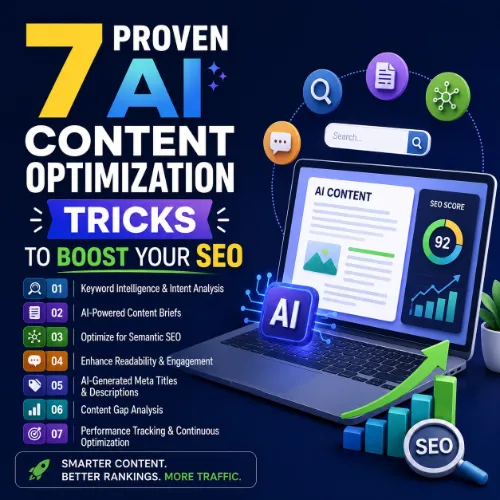
AI content optimization Key Takeaways
Mastering AI content optimization is no longer optional — it’s the new baseline for competitive SEO.
- Use AI for deep keyword research and content gap analysis, but always layer in human editorial judgment for tone and authority.
- Automate structured data, readability checks, and meta writing to save hours per post, then refine with a human edit.
- Monitor performance and let AI suggest updates to keep your content fresh and aligned with search intent shifts.
Why AI Content Optimization Is a Game Changer for SEO
Search engines are getting smarter, and so are the tools that help you create content. AI content optimization means using machine learning and natural language processing to analyze what works in search results, then applying those insights to your own pages. Instead of guessing which keywords to target or what structure to use, you can let data guide your decisions. But — and this is the important part — the best results still come from blending AI efficiency with human creativity and expertise. For a related guide, see 11 AI SEO Experiments: Smart Ways to Boost Your Rankings.
The Shift from Keyword Stuffing to Intent Optimization
Ten years ago, SEO was mostly about repeating a keyword until the algorithm noticed. Today, AI content optimization tools evaluate topic relevance, semantic depth, readability, and user intent. They can tell you if your content answers the questions people actually ask, and whether your page competes with the top results for a given query. For a related guide, see 10 AI SEO Hacks That Actually Work (Proven Results).
Trick 1: Use AI to Uncover Content Gaps Your Competitors Miss
One of the most powerful AI content optimization tricks is feeding your top-performing competitors into an AI tool and asking it to identify topics they cover poorly or not at all. Tools like Ahrefs or Clearscope can generate a list of related subtopics that rank in the top 10 for your target keyword. Then, you can build a more comprehensive resource that covers everything — and does it better.
Practical Step
Run a content gap report in your SEO tool (Ahrefs Content Gap or Semrush Keyword Gap). Paste the list into ChatGPT or a dedicated content optimization platform, and ask it to group the missing terms into logical sections for a single article. You’ll often find 10–15 related phrases you never considered.
Trick 2: Optimize for Search Intent — Not Just Keywords
AI content optimization tips often emphasize intent over volume. A high-volume keyword might drive traffic, but if the searcher wants a product page and you write a blog post, you won’t convert. Use AI to categorize your target keywords by intent (informational, navigational, commercial, transactional) and then tailor your content format accordingly.
Example
If you target “best email marketing software for small business,” the intent is commercial — people want comparisons and reviews. An AI tool can scan the top SERP results and tell you the average word count, number of bullet lists, and presence of tables. Match that format, and you immediately signal relevance to search engines.
Trick 3: Automate Readability and Structure Checks
Readability is a ranking factor, and AI is great at catching issues humans miss. Tools like Hemingway Editor, Grammarly, or Originality.ai can flag long sentences, passive voice, and complex vocabulary. But for AI content optimization, go a step further: ask an AI to rewrite your densest paragraph in simpler language, then compare the two versions. You keep the depth but improve accessibility.
Quick Wins
- Keep sentences under 20 words where possible.
- Use subheadings every 200–300 words.
- Include bulleted lists for scannability.
Trick 4: Generate Metadata and Schema That Actually Clicks
Meta descriptions and title tags are still the first impression on SERPs. Use AI to generate 5–10 meta description variations for each page, then A/B test them. For structured data, AI can also write the JSON-LD for FAQ, HowTo, and Article schema — saving you hours of manual markup. This is one of the most underrated AI content optimization tricks for boosting click-through rates.
Pro Tip
Ask your AI tool to include the target keyword in the first 60 characters of your title tag and in the first 120 characters of your meta description. Most tools can do this with a simple prompt like “Write a clickable meta description under 160 characters that includes the focus keyword and a benefit.”
Trick 5: Optimize Content for Featured Snippets and AI Overviews
With Google AI Overviews and featured snippets becoming more prominent, you need content that answers questions directly and concisely. Use AI to extract the most common questions from “People Also Ask” boxes and write short, bullet-style answers early in your article. Then, echo those answers in your conclusion for maximum visibility.
How to Do It
Install a free PAA scraper browser extension or use Ahrefs’ Content Explorer. Pull the top 20 questions for your focus keyword. Feed them into ChatGPT and ask for a 40–60 word answer for each. Embed those answers as a table or a series of
headings near the top of your post.
Trick 6: Use AI for Internal Linking Recommendations
Internal links help Google understand your site structure and distribute authority. But manually mapping every page is tedious. Many AI content optimization platforms now suggest internal links based on content similarity and existing link profiles. You can also use a prompt like: “Given the topics covered in this post, recommend three existing articles on my site that are logically related.”
Best Practice
Don’t just add links — add context. AI can suggest anchor text variations that feel natural instead of forced. For example, instead of “click here” it might recommend “learn more about our keyword research process” as the anchor.
Trick 7: Refresh Old Content with AI-Generated Updates
Content decay is real. Pages that once ranked start slipping as new information emerges. Use AI to identify which of your older posts have declining traffic or outdated examples. Then, ask the AI to rewrite specific sections with current data, add new statistics, and update the introduction to reflect 2025 realities. This is a high-ROI AI content optimization tip because Google rewards freshness.
Implementation
Export your Google Search Console data for the last 6 months. Filter for pages with a 20%+ drop in clicks. For each page, ask an AI tool to “update this section with 2025 statistics and rewrite the conclusion to include a clear call-to-action.” Then human-edit the output.
SEO Entities and Their Functions
To make AI content optimization work, you need to understand the core entities that drive analysis and decision-making:
- Keyword entities — organic keywords, keyword difficulty (KD), search volume, and traffic potential tell you what people search for and how hard it will be to rank.
- Backlink entities — referring domains, anchor text, dofollow/nofollow links, and new/lost backlinks show where authority comes from and where it’s leaking.
- Page entities — top pages by traffic or links, broken pages, and internal pages reveal which URLs earn visibility and which need repair.
- Competitor entities — competing domains, content gap opportunities, and shared keywords help you find areas where you can overtake rivals.
- Metrics entities — Domain Rating (DR), URL Rating (UR), and traffic value summarize site authority and market value.
Useful Resources
For deeper learning on AI content optimization, check out these trusted sources:
- Ahrefs Content Optimization Guide — A comprehensive walkthrough of on-page SEO factors and how to optimize for them.
- Neil Patel’s AI SEO Strategies — Practical advice on combining AI tools with traditional SEO tactics.
Frequently Asked Questions About AI Content Optimization
Frequently Asked Questions About AI content optimization
What is AI content optimization ?
It’s the process of using artificial intelligence tools to analyze, improve, and structure content so it ranks better in search engines while remaining engaging for readers.
Can AI replace human content writers?
No, AI is best used as an assistant — handling research, structure, and repetitive tasks — while humans provide creativity, tone, and subject-matter expertise.
What tools are best for AI content optimization ?
Popular options include Ahrefs, Semrush, Clearscope, Surfer SEO, MarketMuse, and ChatGPT. Each has strengths for different parts of the optimization workflow.
How does AI help with SEO keyword research?
AI can analyze large datasets to find long-tail keywords, question-based queries, and semantic clusters that human researchers might overlook.
Will AI-generated content hurt my site’s ranking?
Only if it’s low-quality, duplicate, or lacks originality. Google rewards helpful content regardless of how it was created, as long as it meets EEAT standards.
How do I avoid keyword stuffing when using AI?
Use AI to generate variations of your focus keyword and related terms, then manually review for natural integration. Aim for a keyword density of 0.5–2%.
Can AI optimize existing blog posts?
Yes, AI can recommend adding missing subheadings, updating stats, improving readability, and inserting internal links to refresh and strengthen old content.
What is a content gap in SEO?
A content gap is a topic or question that your competitors cover but your site doesn’t. AI helps you find these gaps so you can fill them with high-quality content.
How does AI understand search intent?
AI models analyze top-ranking pages, their structure, and the types of questions they answer to infer whether the intent is informational, commercial, or transactional.
Should I use AI for meta descriptions?
Yes, AI can generate multiple compelling meta descriptions quickly. Just be sure to customize the final version to include your target keyword and a clear value proposition.
What is semantic SEO and how does AI help?
Semantic SEO means covering topics broadly and naturally. AI helps by suggesting related terms, synonyms, and entity connections that improve topical authority.
Can AI analyze competitor content?
Absolutely. AI tools can compare your content against top-ranking competitor pages and highlight missing topics, weak sections, and structural differences.
How do I optimize for AI overviews?
Structure your content with clear question-answer pairs, bulleted lists, and concise summaries early in the post to increase the chance of being featured in AI overviews.
Is AI content optimization expensive?
Costs vary widely — from free tools like Hemingway and ChatGPT to premium platforms costing $100–$500/month. Start with one tool and scale as needed.
How long does it take to see results?
SEO improvements from optimization typically take 4–12 weeks to materialize, depending on competition, content quality, and how quickly Google re-crawls your pages.
Can AI help with local SEO content?
Yes, AI can generate location-specific landing pages, local keyword lists, and content that includes city names, landmarks, and region-specific phrases.
What is EEAT in the context of AI content?
EEAT stands for Experience, Expertise, Authoritativeness, and Trustworthiness. AI content must be human-reviewed to ensure it meets these quality standards.
How do I measure the success of AI optimization?
Track changes in organic traffic, keyword rankings, click-through rates, and engagement metrics like time on page and bounce rate using Google Analytics and Search Console.
Does AI handle image optimization?
Some AI tools can generate alt text, suggest file names, and even compress images — but you’ll still need to manually select the most relevant visual.
What’s the biggest mistake in AI content optimization ?
Over-reliance on AI without human oversight. Publishing AI-written content directly without fact-checking, editing, or adding original insight often leads to generic, low-quality pages.