
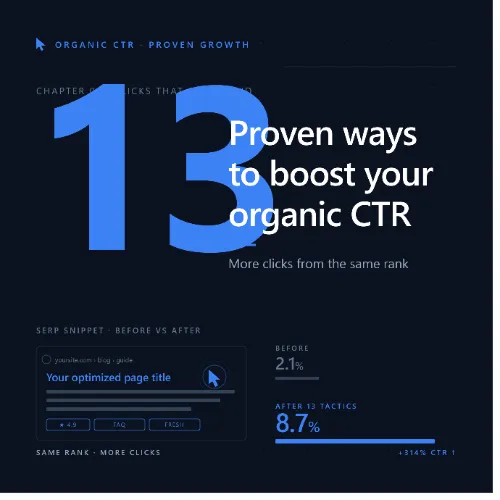
improve organic CTR Key Takeaways
Improving your organic click-through rate is one of the fastest ways to grow search traffic without increasing rankings.
- improve organic CTR by writing titles that match search intent and include power words.
- Meta descriptions act as your mini-ad—make every character count with a clear value proposition.
- Structured data (schema markup) unlocks rich results like star ratings and FAQs that earn more clicks.
Why improve organic CTR Should Be a Priority in Your SEO Strategy
Organic click-through rate is one of the most underrated metrics in SEO. Many marketers obsess over rankings, but a page ranking #1 with a poor CTR can lose traffic to a lower-ranked page that earns more clicks. By learning how to improve organic click through rate, you get more value out of every position improvement. Even a small increase in CTR can translate into thousands of extra visitors monthly. The strategies below are proven in the field, backed by data from industry tools like Ahrefs’ CTR studies.
13 Proven Ways to Increase Organic CTR
1. Match Your Title to Search Intent
The title tag is the most influential element for CTR. It must signal that your page perfectly answers the searcher’s query. For example, if someone searches “ways to increase organic CTR,” your title should not be a vague brand phrase—it should use the exact keywords and promise a list. Use numbers, power words (e.g., “proven,” “ultimate,” “expert”), and keep it under 60 characters to avoid truncation.
2. Write Meta Descriptions That Sell the Click
Your meta description is your free ad space. Include the target keyword naturally, add a clear benefit, and create curiosity. Keep it within 155-160 characters. According to Moz, descriptions that include a call-to-action or a question can lift CTR by 5-10%. Instead of “Learn about CTR,” try “Discover 13 proven ways to improve organic click-through rate and start seeing more traffic today.”
3. Use Structured Data to Unlock Rich Results
Rich snippets—star ratings, recipe times, FAQs, product prices—stand out dramatically on the SERP. Adding FAQ schema, HowTo schema, or Review schema can boost your CTR by 20-30%. Google often displays these elements above the organic listing, drawing the eye. Ensure your schema markup is valid by testing with Google’s Rich Results Test.
4. Optimize for Featured Snippets and People Also Ask
When your content appears in a featured snippet or inside a PAA box, it occupies prime real estate and often earns a click-through even if you rank #2 or #3. To win snippets, directly answer common questions early in your article using a clear
or
5. Write Compelling, Clickable URLs
Search engines often display the URL slug in the SERP. A clear, keyword-rich URL (e.g., /improve-organic-ctr/) reassures users your page is relevant. Avoid generic strings like /page123. Keep slugs short and descriptive—this small change can bump CTR by 2-3%.
6. Use Emotion-Driven or Curiosity-Gap Headlines
Headlines that evoke curiosity or emotion outperform plain ones. Phrases like “What Nobody Tells You About CTR” or “The Simple Trick That Increased Our CTR by 40%” create a gap between what the reader knows and what they could learn. But stay accurate—clickbait that misleads hurts trust and can increase bounce rate.
7. Add Numbers and Specifics
Specificity builds credibility. Titles with numbers (e.g., “13 Ways”) outrank those without. So do promises of data: “Increase CTR by 22% in 7 Days.” Numbers act as cognitive anchors, making your listing feel more concrete and valuable.
8. Leverage Brand Authority in the Snippet
If you have a recognized brand, include it in the title or meta description (especially after a pipe separator). For new sites, use social proof like “Trusted by 10,000+ Marketers.” Brand mentions increase click-through because Google users trust known entities. A strong brand can improve organic click through rate by 10-15% for branded queries.
9. Optimize for Mobile Snippets
More than 60% of searches happen on mobile devices. On mobile, the visible SERP real estate is even smaller. Ensure your title and meta description read well on small screens—avoid long strings that truncate. Use shorter sentences, and place the most important information at the front of both title and description.
10. Add a Table of Contents with Jump Links
Though not directly in the SERP, a table of contents (with ID anchors) helps Google understand your content structure and sometimes generates sitelinks. Sitelinks can lift CTR by providing users multiple entry points to your site. Use clear, keyword-rich headings that act as mini-answers.
11. Use Power Words and Urgency Sparingly
Words like “instant,” “free,” “new,” “exclusive,” “proven,” and “secret” grab attention. But use them naturally—overdoing it can feel spammy. One power word per title or description is often enough. Test variations: “13 Proven Ways to Improve Organic CTR Instantly” versus “Improve Organic CTR: 13 Steps.” For a related guide, see 11 Proven Ways to Improve Google Rankings Fast.
12. Target Long-Tail Keywords with Clear Intent
Long-tail queries (e.g., “how to improve organic CTR for ecommerce blog”) have higher CTR because the searcher’s intent is precise. Write dedicated sections or posts that fully satisfy those queries. Include improve organic click through rate naturally in these pages to signal relevance without stuffing. For a related guide, see 8 Search Intent Mistakes Killing Your SEO Rankings (Avoid These).
13. Continuously A/B Test Your SERP Listings
SEO is not static. Use Google Search Console to track your impressions, clicks, and average CTR for key pages. Test different titles, descriptions, and even URL structures over several weeks. Tools like SplitSignal (formerly SEO A/B testing software) can help measure the impact. Monitoring and iterating is the final way to sustainably improve organic CTR.
SEO Entities and Their Functions
Understanding the entities involved in CTR optimization helps you make smarter decisions. Here are the key components and what they do for your analysis:
- Keyword entities: Organic keywords, keyword difficulty, search volume, and SERP features reveal demand, competition, and the type of result required (e.g., listicle, video, product page).
- SERP entities: Featured snippets, People Also Ask, sitelinks, and local packs indicate which content format and answer structure is rewarded for a given query.
- Page entities: Top pages by traffic, top pages by links, and broken pages help you identify your best-performing content and fix underperformers.
- Metrics entities: DR, UR, traffic value, and organic traffic summarize authority, URL strength, and market visibility—key for prioritizing which pages to optimize first.
- Technical SEO entities: Canonical tags, crawl issues, duplicate content, and Core Web Vitals expose obstacles that prevent your pages from being indexed or appearing with a good user experience.
Useful Resources
To deepen your understanding of CTR optimization, explore these authoritative sources:
- Ahrefs: Click-Through Rate Study — In-depth data on average CTR by position, industry, and query type.
- Moz: Meta Description Guide — Best practices for writing descriptions that earn clicks.
Improving your organic CTR is a continuous process that starts with understanding user intent and ends with data-driven refinement. Apply the 13 strategies above, monitor your progress in Google Search Console, and watch your traffic grow even if your rankings stay the same. Start with one tactic today—rewrite your top underperforming page title—and see the difference for yourself.
Frequently Asked Questions About improve organic CTR
What is a good organic click-through rate?
Average CTR varies by industry and query. For top-3 positions, 20-40% is common. A “good” CTR exceeds your industry average and improves over time through optimization.
How do I find my current organic CTR in Google Search Console?
In Google Search Console, go to Performance > Search results. The table shows average CTR for your queries and pages. You can filter by date range and device.
Can I improve CTR without changing rankings?
Yes. Optimizing title tags, meta descriptions, and structured data can boost CTR even if your ranking stays the same. Rich snippets especially increase visibility.
Does longer content improve CTR?
Not directly. But in-depth content often ranks for more long-tail keywords and earns featured snippets, which can lift CTR. Always focus on answering intent succinctly.
Why is my CTR low even though I rank #1?
Possible reasons: your title or meta description is unappealing, a featured snippet steals the click, or searchers immediately find what they need (zero-click search).
How do I use schema markup to improve CTR?
Implement FAQ schema, HowTo schema, or product schema. When Google displays a rich result (like an expanded FAQ), it often increases eye-grabbing space and CTR.
Does adding a date to the title help?
For time-sensitive content (like news, recipes, or tech guides), a date signals freshness. It can boost CTR by 5-10% for queries where recency matters.
Should I include keywords in URLs?
Yes. A descriptive, keyword-rich URL gives users and search engines context. Keep it short, readable, and relevant to the page topic.
How often should I update my meta descriptions?
Review them quarterly or whenever you notice a CTR drop. Testing new descriptions every 6-8 weeks is a good practice for competitive queries.
Does mobile optimization affect CTR?
Absolutely. If your mobile page loads slowly or displays poorly, users may bounce, signaling low relevance and lowering your CTR over time.
What is a and ldquo;zero-click search and rdquo; and how does it relate to CTR?
Zero-click searches happen when Google answers the query directly (e.g., featured snippet, knowledge panel). Even if you rank #1, users may not click your page. You can adapt by targeting snippet opportunities.
How can I use emotion in my titles without being clickbait?
Focus on legitimate benefits and outcomes. Instead of “Shocking results!”, use “How we increased CTR by 40% in 30 days.” Specific, honest emotional hooks build trust.
Does using numbers in titles really boost CTR?
Yes, studies show titles with odd numbers (especially 7, 10, 13) outperform even-numbered ones. Numbers promise a structured, scannable answer.
Can social proof in meta descriptions help?
Definitely. Phrases like “Trusted by 50,000+ marketers” or “Featured in Forbes” signal authority and can lift CTR by 10-15% for competitive queries.
How do I test different titles for the same page?
Use Google Search Console to compare performance before and after a change. For a more scientific approach, use an SEO A/B testing tool like SplitSignal or Optimizely.
What is the impact of sitelinks on CTR?
Sitelinks give users multiple entry points, often raising CTR for branded queries by 15-30%. Ensure your site structure is clear and your pages have unique, descriptive titles.
Should I use and ldquo;pipe and rdquo; or and ldquo;dash and rdquo; separators in title tags?
Both work, but pipes (|) are more common and scan-friendly. Dashes may be used for clarity. Google treats them equally. Choose one style and use it consistently.
How long should my meta description be?
Write between 130 and 160 characters. Google may display up to 170-180 characters on desktop, but shorter descriptions are less likely to be truncated on mobile.
Does internal linking affect CTR?
Indirectly. Good internal links help users discover more pages and increase engagement signals, which can improve your site authority and over time, your CTR.
Can video thumbnails improve organic CTR?
Yes. For video results, a compelling thumbnail can significantly increase click-through. Optimize video titles, descriptions, and use schema to enhance visibility.