
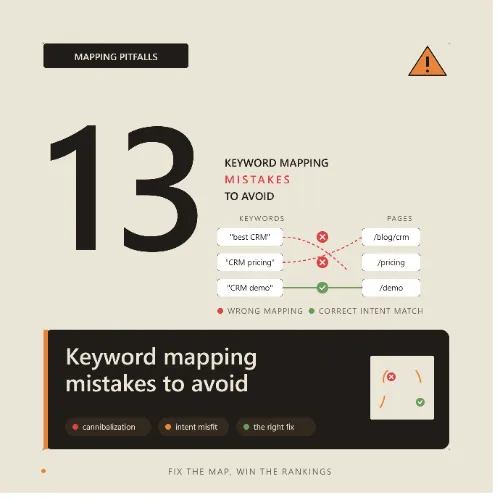
keyword mapping mistakes Key Takeaways
Keyword mapping is the backbone of a focused SEO strategy, yet many sites undermine their own efforts by making avoidable errors.
- The most common keyword mapping mistakes include overstuffing pages, ignoring search intent, and failing to update maps after algorithm changes.
- Each mistake has a straightforward fix that improves topical authority, click-through rates, and overall organic visibility.
- By auditing your current map against these pitfalls, you can prioritize fixes that deliver the highest traffic gains.
Why Keyword Mapping Mistakes Happen—and How to Avoid Them
Keyword mapping seems simple: match each page to a primary keyword plus a few related terms. In practice, keyword mapping mistakes creep in because of competing priorities, siloed teams, or outdated data. A wrong map can send mixed signals to Google, confuse your audience, and inflate your content workload without improving rankings. Let’s break down the thirteen errors you need to correct. For a related guide, see Ai Saves Time In Seo: 5 Costly Mistakes to Avoid in 2026.
Mistake 1: Assigning Multiple Primary Keywords to One Page
When a page targets two or three high-volume keywords as primaries, none of them wins. Instead of splitting authority, choose one primary keyword per page and let LSI terms support it. For example, a page about “content marketing strategy” should not also try to rank for “social media advertising.” That secondary term deserves its own page.
Mistake 2: Ignoring Search Intent
One of the costliest keyword mapping mistakes is mapping a keyword with commercial intent to an informational article. If “best budget espresso machine” lands on a guide about how espresso machines work, you lose traffic and conversions. Always map based on intent—informational, navigational, commercial, or transactional—not just keyword similarity.
Mistake 3: Mapping Keywords Without Considering User Journey
A top-of-funnel keyword like “what is SEO” should map to a beginner guide, not a product page. Map keywords to the stage your audience is in, then build internal links to guide them deeper. This reduces bounce rates and improves the perceived expertise of your site.
Mistake 4: Overlooking Search Volume in Favor of Competition
Low difficulty (KD) is tempting, but mapping a page to a keyword that only gets 10 searches a month rarely moves the needle. Balance KD with traffic potential. Use tools like Ahrefs or Semrush to check both metrics before committing a page to a keyword.
Mistake 5: Failing to Update Keyword Maps After Algorithm Updates
Google’s algorithms evolve, and so should your maps. What worked during BERT might need adjustment after the Helpful Content Update. Schedule quarterly audits of your keyword-to-page assignments to catch shifts in SERP features or intent.
Mistake 6: Mapping Keywords to Pages Without Existing Authority
A brand-new blog post has no authority. Mapping a competitive keyword to a fresh page can lead to frustration. Instead, map high-competition terms to existing pages that already have backlinks and traffic, and build new content around lower-competition opportunities first.
Mistake 7: Creating Orphan Pages with No Internal Links
Keyword mapping is useless if the mapped page is an orphan. Every page targeting a primary keyword should be linked from at least one relevant hub or category page. Orphan pages lose link equity and struggle to rank.
Mistake 8: Mapping Multiple Pages to the Same Keyword
Often called keyword cannibalization, this happens when two pages compete for the same primary term. Google may serve the wrong page, diluting CTR. Determine which page has stronger authority, consolidate content, and redirect or de-optimize the weaker one.
Mistake 9: Neglecting Long-Tail Keyword Variations
Many site owners map only head terms and ignore long-tail phrases that match specific queries. Long-tail keywords often convert better and face less competition. Add one or two long-tail variations per page to capture voice search and niche queries.
Mistake 10: Mapping Based on Tools Alone Without Manual Review
Keyword research tools provide data, but they don’t understand your business or audience. A keyword may have high volume but irrelevance to your offer. Before mapping, manually review SERP results to confirm the intent matches what your page delivers.
Mistake 11: Forgetting to Map Keywords to Existing Pages
Teams often create new content for every keyword without checking if an existing page could be optimized. This creates content bloat. Audit your current pages first—sometimes a simple update and internal link adjustment ranks a page better than writing a new one.
Mistake 12: Mapping Keywords Without a Content Cluster Strategy
Random keyword mapping leads to a disjointed site structure. Instead, group related keywords into topic clusters around a pillar page. This builds topical authority and signals to Google that your site covers the subject comprehensively. For a related guide, see 11 Topical Authority Mistakes to Avoid for SEO Success.
Mistake 13: Not Documenting Your Keyword Map
A keyword map that exists only in someone’s head is fragile. Use a spreadsheet or a tool like Ahrefs’ Keyword Explorer to document each page, its primary keyword, secondary terms, intent, and last update. Share it with your content and SEO teams to ensure consistency.
How to Audit for Keyword Mapping Mistakes
To identify keyword mapping mistakes in your own site, export your existing pages and their targeted keywords. Look for duplicates, mismatches in intent, and pages that lack internal links. Compare each page’s ranking data against its assigned keyword to see if the map is working. You can also run a site audit using Ahrefs Site Audit to uncover technical issues that may affect mapped keywords.
SEO Entities and Their Functions
Understanding the entities that underpin keyword mapping helps you make smarter decisions. Here’s how the key entities support your strategy:
- Keyword entities including organic keywords, search volume, keyword difficulty (KD), and traffic potential guide which terms deserve a dedicated page.
- Page entities like top pages by traffic, best by links, and broken pages help you decide where to map high-value keywords.
- SERP entities such as featured snippets, People Also Ask, and AI Overviews indicate what content format your target keyword requires.
- Competitor entities like competing domains and content gap opportunities reveal where your map may be missing valuable queries.
- Metrics entities including DR (Domain Rating), UR (URL Rating), and organic traffic value let you prioritize pages that can realistically rank for competitive terms.
Useful Resources
For a deeper dive into keyword research and mapping best practices, explore these resources:
- Keyword Mapping: The Complete Guide – Ahrefs’ comprehensive walkthrough on how to build and maintain a keyword map.
- Search Engine Land’s Guide to Keyword Research – A trusted resource covering the fundamentals of finding and organizing keywords.
Frequently Asked Questions About keyword mapping mistakes
What is keyword mapping in SEO?
Keyword mapping is the process of assigning a primary keyword and supporting terms to each page on your website to guide content creation, internal linking, and optimization.
How often should I update my keyword map?
Update your keyword map at least once per quarter or after any major Google algorithm update, and whenever you publish a new page or change a page’s focus.
Can I map the same keyword to multiple pages?
Mapping the same primary keyword to multiple pages creates cannibalization. Choose one authoritative page and consolidate content on the others.
What is the biggest keyword mapping mistake?
Ignoring search intent is widely considered the biggest keyword mapping mistake because it misaligns your content with what users actually want.
How do I fix keyword cannibalization?
Identify which page has higher authority, 301-redirect the weaker page to the stronger one, and merge content to avoid duplication.
What tools can help with keyword mapping?
Tools like Ahrefs, Semrush, and Google Sheets are popular for keyword mapping. They provide data on search volume, difficulty, and existing rankings.
Should I map keywords to old pages or new pages?
Map high-competition keywords to existing pages with authority, and map lower-competition or long-tail keywords to new pages to build fresh content equity.
What is a keyword map template?
A keyword map template is a spreadsheet with columns for page URL, primary keyword, secondary keywords, search intent, volume, KD, and status, making it easy to track assignments.
How do I know the intent of a keyword?
Look at the current top-ranking pages for that keyword. If they are product pages, the intent is commercial; if they are guides, the intent is informational.
Can keyword mapping improve internal linking?
Yes. A well-documented keyword map helps you identify which pages should link to each other, strengthening topical clusters and distributing link equity.
What is a content cluster?
A content cluster is a group of related pages that all link to a central pillar page, signaling comprehensive coverage of a topic to search engines.
Should I map keywords by volume only?
No. Volume alone ignores competition, intent, and relevance. Use a combination of volume, difficulty, and traffic potential to make informed mapping decisions.
What is an orphan page?
An orphan page has no internal links pointing to it. Orphan pages are invisible to crawlers and users, making keyword mapping ineffective.
How do I find orphan pages on my site?
Use a site audit tool like Ahrefs or Screaming Frog to crawl your site and identify pages with zero internal inbound links.
What is search volume in SEO?
Search volume is the average number of times a keyword is searched in a given period, usually monthly. It estimates traffic potential but not conversion potential.
What is keyword difficulty (KD)?
Keyword difficulty is a score from 0 to 100 that estimates how hard it is to rank for a keyword based on the authority of current top-ranking pages.
What is the difference between a primary and secondary keyword?
A primary keyword is the main term a page aims to rank for. Secondary keywords are related terms that support the topic without competing for the same ranking.
Can keyword mapping help with local SEO?
Yes. Map local keywords like “plumber in Austin” to location-specific pages, and use local SERP entities like maps and reviews to guide optimization.
What is a long-tail keyword?
A long-tail keyword is a longer, more specific phrase (usually three or more words) with lower search volume but higher intent and lower competition.
How many keywords should I map to one page?
Assign one primary keyword per page, plus up to three secondary LSI terms. Avoid stuffing more because it dilutes topical focus.