
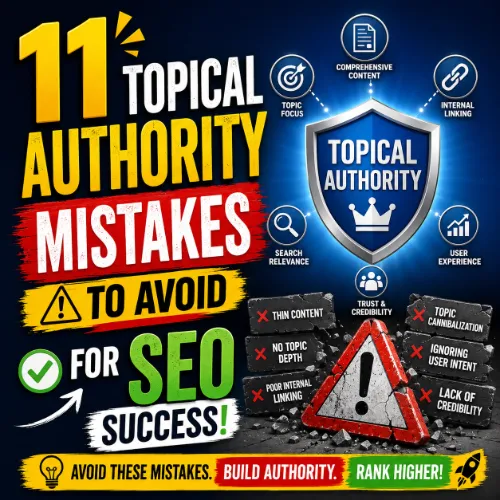
topical authority mistakes Key Takeaways
Building true topical authority is one of the most powerful moves you can make for long-term SEO success — but it’s easy to slip up.
- Most topical authority mistakes come from shallow coverage — you need real depth and structure to win.
- Consistency matters: publishing one perfect guide and then going silent won’t build trust with search engines.
- Santol Lucky’s 2026 approach shows that luck favors the well-prepared: treat your content like a complete library, not a random collection of posts.
What Are topical authority mistakes and Why Do They Hurt Your SEO?
Think of topical authority as your website’s reputation for being the go-to source on a specific subject. When Google sees your site consistently publishing high-quality, interconnected content on one topic, it rewards you with higher rankings. But when you make topical authority mistakes, you confuse both your audience and the search algorithms.
For example, if you run a coffee blog but suddenly start writing about car repairs without any connection to coffee, you weaken your site’s focus. That’s one of the most common topical authority mistakes — straying too far from your core topic. The fix? Stay laser-focused on your niche, and only branch out when you can clearly link back to your main subject. For a related guide, see 7 Proven Ways AI Predicts SEO Trends: Avoid Common Mistakes.
11 Topical Authority Mistakes That Kill Your Rankings
We’ve rounded up the biggest topical authority mistakes we see sites make, plus practical ways to avoid them. These come straight from Santol Lucky’s 2026 playbook — a set of lucky SEO tips 2026 that emphasize consistency, depth, and smart internal linking. For a related guide, see 15 SEO Trends: Essential Mistakes to Avoid in 2026.
1. Writing Thin, Surface-Level Content
One of the most damaging topical authority mistakes is publishing 300-word posts that barely scratch the surface. Google’s algorithms now prioritize comprehensive, in-depth articles that fully answer a user’s query. If you keep your posts short and shallow, you signal that you aren’t an expert.
Instead, aim for 1,500–2,500 words per pillar topic. Cover subtopics, include examples, and add data. Your readers will stay longer, and search engines will notice.
2. Ignoring Internal Linking Between Related Posts
Your content needs to form a web, not a list of lonely pages. Without strong internal links, you miss a huge opportunity to build topical authority by showing Google how your posts connect. This is one of the easiest avoid topical authority mistakes fixes — simply link from a new guide to your existing related content. For a related guide, see Keyword Research Mistakes: Proven 7 Costly Errors to Avoid.
For example, if you’re writing about SEO tools, link to your earlier post on keyword research. Those links tell search engines, “Hey, these two pages are part of the same expert library.”
3. Publishing Inconsistently
Posting ten articles in one week and then nothing for two months creates confusion. Search engines like a steady cadence. SEO topical authority errors often happen when a site stops publishing for long periods — Google may demote your pages because it sees them as outdated or abandoned.
Set a realistic schedule, even if it’s one solid post per week. Consistency builds trust.
4. Not Covering Related Subtopics
If you only write about the most popular aspect of your niche, you leave gaps that competitors will fill. For true topical authority, you need to cover the whole landscape.
Let’s say you run a fitness blog. Don’t just write about workouts — also cover nutrition, recovery, supplements, and equipment reviews. Each subtopic strengthens your overall authority.
5. Using the Same Target Keyword on Multiple Pages
Keyword cannibalization confuses search engines about which page to rank. It’s a classic topical authority mistakes example. Instead of aiming ten pages at “best running shoes,” combine them into one ultimate guide and link out to specific reviews.
6. Forgetting to Update Old Content
What you wrote in 2022 might be outdated by 2026. Stale content is one of the silent SEO topical authority errors. Refresh your articles with new data, updated examples, and fresh internal links.
7. Creating Content Siloed in Different Categories
Don’t hide your content in separate silos that never cross-pollinate. Your readers and search engines both benefit when you cross-link between categories. For instance, connect your “technical SEO” category with “content marketing” through shared topics and internal links. This reduces topical authority mistakes and builds a stronger knowledge graph.
8. Neglecting User Intent
Writing a “how-to” title but delivering a “what is” article frustrates users and raises bounce rates. Each piece of content must match the search intent behind the keyword. This is one of the most overlooked avoid topical authority mistakes factors.
9. Copying Competitor Content Structure
It’s tempting to look at a competitor’s table of contents and mimic it. But that leads to duplicate structures and no unique value. Instead, find gaps in their coverage and fill those first. That’s how you build genuine authority without committing topical authority mistakes.
10. Ignoring Topic Clusters and Pillar Pages
One of the most powerful strategies for 2026 is the cluster model. A single pillar page links out to many cluster posts that dive deeper. If you skip this structure, you’re missing out on one of the best lucky SEO tips 2026.
11. Failing to Build Contextual Link Neighborhoods
Your site’s external backlinks should come from sites relevant to your niche. If you’re a gardening site and all your links come from tech blogs, that sends a mixed signal. Focus on earning links from topical neighbors. This final point rounds out the most common topical authority mistakes and shows how crucial a strategic link profile is.
SEO Entities and Their Functions
Understanding SEO entities helps you avoid topical authority mistakes at a technical level. Here’s how key entities affect analysis and decision-making.
- Website / Domain entities: Root domain, subdomain, and URL-level analysis show whether performance comes from your whole site, a section like blog.example.com, or a single page.
- Keyword entities: Organic keywords, keyword difficulty, search volume, and SERP features reveal demand, competition, and what kind of result you need to rank for.
- Backlink entities: Referring domains, anchor text, and dofollow/nofollow links help you evaluate authority, link quality, and outreach priorities.
- Content entities: Articles, authors, published dates, and social shares help you track editorial quality and engagement.
- SERP entities: Featured snippets, People Also Ask, and sitelinks show what format your content should use to win premium real estate.
- Technical SEO entities: Crawl issues, redirect chains, and Core Web Vitals expose obstacles that block ranking improvements.
- Competitor entities: Competing domains and content gap opportunities show where you can catch up and surpass rivals.
Useful Resources
To dive deeper into building topical authority, check out these two resources.
- Ahrefs: Topical Authority in SEO — The Complete Guide
- Search Engine Land: Why topical authority is the future of SEO
Frequently Asked Questions About topical authority mistakes
What are topical authority mistakes in SEO?
Topical authority mistakes are errors in content strategy that prevent a website from being seen as an expert on a specific subject. Examples include publishing shallow posts, ignoring internal links, and covering unrelated topics.
Why should I avoid topical authority mistakes ?
Avoiding these mistakes helps Google recognize your site as a trusted resource, which leads to higher rankings, more organic traffic, and stronger brand credibility.
How many topical authority mistakes do most beginner sites make?
Most new sites make at least 5 to 7 of the 11 mistakes listed above, especially thin content, lack of internal linking, and inconsistent publishing.
Can topical authority mistakes hurt my traffic overnight?
Usually they harm your growth over time, not overnight. But a Google algorithm update can amplify their impact quickly, so it’s best to fix them proactively.
What is the most common SEO topical authority error ?
Writing thin, surface-level content is the most frequent mistake. Many sites focus on quantity over quality and miss the depth that builds true authority.
How does Santol Lucky’s 2026 advice relate to topical authority mistakes ?
Santol Lucky’s 2026 tips emphasize structured content clusters, consistent publishing, and smart internal linking — all of which directly prevent the most damaging topical authority mistakes.
What are lucky SEO tips 2026 for avoiding authority mistakes?
Some of the luckiest SEO tips for 2026 include building pillar pages, updating old content quarterly, and linking every new post to at least three existing articles.
Do topical authority mistakes affect local SEO?
Yes, they do. If you run a local business and write about unrelated global topics, you dilute your local relevance. Stay focused on local themes.
Can I recover from topical authority mistakes ?
Absolutely. Conduct a content audit, consolidate or update thin posts, and start building a proper topic cluster structure. Recovery takes 3 to 6 months in most cases.
How long does it take to build topical authority after fixing mistakes?
If you consistently publish high-quality, interlinked content for 4 to 8 months, you’ll see noticeable improvements. Full authority can take a year or more.
What is the biggest avoid topical authority mistakes tip for beginners?
Start by mapping out one main topic and writing at least 10 interconnected articles before adding a second topic. This builds a solid foundation.
Should I delete old content to fix topical authority mistakes ?
Not always. Often, updating and merging old posts is better than deleting. Delete only if the content is completely irrelevant or harmful to your brand.
Do topical authority mistakes affect backlinks?
Yes, thin content and scattered topics attract fewer and lower-quality backlinks. Fixing your authority strategy often improves your link profile naturally.
What tools help identify SEO topical authority errors ?
Tools like Ahrefs and Semrush can show you content gaps, thin pages, keyword cannibalization, and internal link issues that signal authority problems.
How often should I review my site for topical authority mistakes ?
Every 3 to 6 months is ideal. This allows you to catch issues early before they compound.
Can topical authority mistakes occur on a single page?
Yes. A page that tries to cover too many unrelated topics without clear focus can confuse search engines. Stick to one clear topic per page.
What role does user experience play in topical authority ?
UX is critical. If users bounce quickly because of slow loading or poor navigation, Google interprets that as a lack of authority, even if your content is good.
Are there topical authority mistakes specific to e‑commerce?
Yes, e‑commerce sites often neglect blog content and only focus on product pages, missing the chance to build broader category authority.
How do topical authority mistakes affect voice search?
Voice search prefers concise, authoritative answers. If your site lacks clear topical depth, it’s less likely to be featured in voice results.
Can I outsource fixing topical authority mistakes ?
You can hire an SEO consultant or content strategist, but you’ll still need to be involved to define your core topics and approve the content direction.