
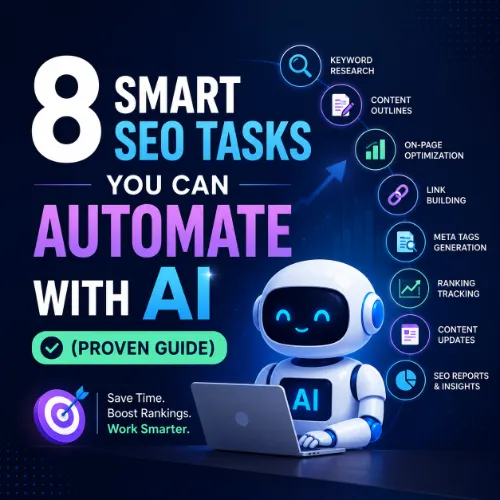
automate SEO tasks with AI Key Takeaways
Search engine optimization involves dozens of recurring tasks—tracking keyword positions, auditing site health, researching backlinks, and writing meta tags.
- automate SEO tasks with AI to speed up keyword research, content optimization, and technical audits.
- AI tools help you monitor rankings, analyze competitors, and generate data-driven insights without manual effort.
- Start with small automations like reporting and link checks, then scale to advanced workflows for long-term growth.
Why You Should automate SEO tasks with AI in 2025
Search engine optimization involves dozens of recurring tasks—tracking keyword positions, auditing site health, researching backlinks, and writing meta tags. Without automation, these tasks eat up hours each week. AI-powered tools now handle much of this work with impressive accuracy. By choosing to automate SEO tasks with AI, you free up time for creative and strategic work that truly moves the needle.
What Makes AI Different from Traditional Automation
Traditional automation follows fixed rules—like sending a scheduled report. AI adapts. It learns from data patterns, suggests content improvements, predicts ranking changes, and even writes draft meta descriptions. This flexibility means you can automate SEO tasks with AI in ways that respond to real-time changes in search algorithms and user behavior.
8 Proven Tasks to automate SEO tasks with AI
The following list covers the most impactful areas where AI automation saves time and improves results. Each task includes a clear explanation and a practical tip to get started today.
1. Keyword Research and Clustering
Keyword research used to mean manually entering terms into tools and sorting spreadsheets. AI now automates the discovery of related keywords, long-tail phrases, and question-based queries. It also groups keywords into topical clusters based on search intent, saving hours of manual categorization. For a related guide, see 14 Semantic Search Trends Every SEO Must Follow in 2026.
Practical tip: Use an AI-powered keyword tool like Ahrefs Keywords Explorer or Semrush to generate cluster suggestions. Set up automated alerts for new keyword opportunities in your niche.
2. Content Brief Generation
Creating thorough content briefs helps writers produce optimized articles faster. AI analyzes top-ranking pages for a target keyword and extracts common headings, word counts, questions, and entity mentions. It then generates a structured brief with recommended sections and key points to cover.
Practical tip: Tools like Frase or MarketMuse let you input a keyword and receive a complete brief in minutes. Review and customize it before handing it to your writer.
3. AI-Powered Content Writing and Optimization
AI writing assistants can draft entire blog posts, product descriptions, or meta tags. They also optimize existing content by suggesting improvements for readability, keyword density, and internal linking. This is one of the most popular ways to automate SEO tasks with AI because it directly produces publishable material.
Practical tip: Use a tool like Jasper or Copy.ai to generate first drafts. Then run them through an optimizer like Surfer SEO to ensure they match search intent and include relevant entities.
4. Automated Internal Linking Suggestions
Internal linking strengthens site architecture and distributes authority. AI scans your site’s content and suggests relevant internal links based on topic similarity and current link gaps. It can even automate the insertion of links into older posts.
Practical tip: Link Whisper or InLinks analyze your site and provide link recommendations. Schedule a monthly review to approve and apply their suggestions.
5. Technical SEO Audits and Error Detection
Technical SEO audits involve checking for broken links, duplicate content, slow pages, and crawl errors. AI automates this by running continuous scans and alerting you only when something needs attention—reducing noise and manual inspection time.
Practical tip: Set up automated weekly audits with Screaming Frog or Sitebulb integrated with your project management tool. Focus on critical issues like 404 errors and redirect chains first.
6. Rank Tracking and SERP Monitoring
Checking keyword rankings daily is impractical. AI tools track positions automatically and report changes, including average position, visibility, and SERP feature appearances. They also identify ranking drops caused by algorithm updates or new competitor content.
Practical tip: Use AccuRanker or Wincher for daily rank updates. Configure email alerts for significant drops or wins to stay informed without logging into dashboards.
7. Backlink Analysis and Outreach Prioritization
Monitoring your backlink profile—new links, lost links, and toxic links—can be automated with AI. These tools also help prioritize outreach by scoring prospects based on domain authority, relevance, and likelihood of linking.
Practical tip: Ahrefs and Majestic offer automated backlink reports. Use the new/lost links filter to spot opportunities for reclaiming broken links or re-engaging with past contacts.
8. Automated Reporting and Dashboard Updates
Creating monthly SEO reports can take hours. AI aggregates data from multiple sources (Google Search Console, Analytics, rank trackers) and generates visual dashboards with commentary on trends. This keeps stakeholders informed without manual data pulling.
Practical tip: Google Data Studio or Databox connect to your tools and auto-update reports. Schedule them to email your team each week so everyone stays aligned.
SEO Entities and Their Functions
Understanding key SEO entities helps you interpret the data AI tools provide. Here is a concise overview:
- Website / Domain entities: Root domain, subdomain, and URL-level analysis reveal performance ownership—whether results apply to the whole site, a section like blog.example.com, or a single page.
- Keyword entities: Organic keywords, keyword difficulty (KD), search volume, and SERP features show demand, competition, and ranking opportunity.
- Backlink entities: Referring domains, anchor text, dofollow/nofollow links, and broken backlinks help evaluate link quality and prioritize outreach.
- Page entities: Top pages by traffic or links uncover which URLs earn visibility and engagement.
- Content entities: Articles, authors, topics, and social shares help evaluate editorial quality and topical authority.
- SERP entities: Featured snippets, People Also Ask, AI Overviews, and local packs indicate what content format rewards ranking.
- Technical SEO entities: Crawl issues, redirect chains, canonicals, and Core Web Vitals expose obstacles to indexing and page experience.
- Competitor entities: Competing domains, content gap opportunities, and shared keywords show where rivals win traffic.
- Metrics entities: DR (Domain Rating), UR (URL Rating), traffic value, and organic traffic summarize authority and visibility.
Useful Resources
To go deeper on these techniques, check out the following resources:
- Ahrefs: AI SEO Automation Guide – Covers tools and workflows for automating keyword research, content, and link building.
- Moz: How to Automate SEO with AI – Practical advice on balancing automation with human oversight.
Frequently Asked Questions About automate SEO tasks with AI
Learning to automate SEO tasks with AI is a practical step toward smarter, faster optimization. Start with one task from this list, pick a tool that fits your budget, and build from there. Your future self—with more time for creative strategy—will thank you. For a related guide, see 9 Proven Ways to Build Topical Authority Faster.
Frequently Asked Questions About automate SEO tasks with AI
What does it mean to automate SEO tasks with AI ?
It means using artificial intelligence tools to handle repetitive SEO workflows—like keyword research, content optimization, reporting, and technical audits—without manual labor at every step.
Can AI fully replace human SEO work?
No, AI handles repetitive tasks but lacks human creativity, strategic judgment, and nuanced understanding of a brand’s voice. The best results come from combining AI efficiency with human oversight.
Which SEO tasks are easiest to automate with AI?
Keyword research, rank tracking, technical audits, internal linking suggestions, and reporting are among the easiest to automate because they rely on data patterns rather than creative decisions.
How much time can AI save in SEO workflows?
Depending on your volume, AI can reduce time spent on repetitive tasks by 50-80%, freeing several hours per week for strategic activities like content planning and competitor analysis.
Do I need technical skills to automate SEO tasks with AI ?
Most AI SEO tools are user-friendly and require no coding. Familiarity with basic SEO concepts and tool setup is enough to get started.
What tools help automate SEO tasks with AI ?
Popular options include Ahrefs, Semrush, Surfer SEO, Frase, Link Whisper, AccuRanker, and Screaming Frog. Each specializes in different aspects of SEO automation.
Is AI content writing safe for SEO?
Yes, as long as you edit and fact-check the output. Google focuses on helpful, original content, not how it was generated. Always review AI drafts for accuracy and brand tone.
Can AI help with local SEO automation?
Yes, AI tools can automate local keyword research, monitor Google Business Profile changes, and generate location-specific content. This is especially useful for multi-location businesses.
How does AI improve keyword research?
AI analyzes search volume, competition, and user intent across thousands of queries instantly. It clusters related terms and surfaces long-tail variations you might miss manually. For a related guide, see 11 Affiliate SEO Mistakes That Kill Revenue – Avoid These Now.
Will AI help with link building?
Indirectly yes. AI identifies broken link opportunities, unlinked brand mentions, and high-authority prospects, streamlining outreach lists. But relationship building still requires human touch.
Can AI automate technical SEO audits?
Yes, tools like Screaming Frog and Sitebulb use AI to crawl your site, detect issues like redirect chains and duplicate content, and prioritize fixes by severity.
What is the cost of AI SEO automation tools?
Costs range from free (limited features) to $100-$500 per month for premium tools. Many offer trial periods so you can test their value before committing.
How do I start automating SEO without overwhelming my team?
Start with one task—like rank tracking or reporting—using a single tool. Once your team is comfortable, expand to content optimization and backlink monitoring.
Can AI help with competitor analysis?
Yes. Tools like Ahrefs and Semrush track competitor keywords, backlinks, and content gaps automatically, showing you where to focus for competitive advantage.
Does Google penalize sites that use AI for SEO?
No, but Google penalizes spammy or low-quality content regardless of how it is created. Use AI as an assistant, not a replacement for quality standards.
How do AI tools handle algorithm updates?
AI monitors fluctuations in rankings and traffic, often spotting patterns faster than manual analysis. Some tools adjust their recommendations based on new algorithm signals.
What is the best AI tool for small business SEO?
For small budgets, tools like Wincher for rank tracking and Copy.ai for content creation offer affordable entry points. Combine them with free Google Search Console insights.
Can I integrate AI SEO tools with my existing CRM?
Many AI SEO tools offer API access or native integrations with platforms like HubSpot, Salesforce, and WordPress, allowing seamless data flow.
How often should I review AI-generated SEO reports?
Weekly reviews are ideal for staying agile. Monthly deep dives are enough for strategic adjustments. Set automated alerts for critical changes like traffic drops or lost rankings.
What is the biggest risk of automating SEO with AI?
The biggest risk is relying on AI without human validation—leading to incorrect recommendations, generic content, or missed strategic opportunities. Always apply critical thinking.