
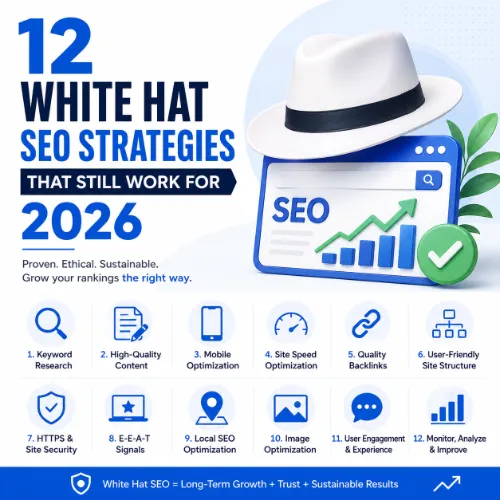
white hat SEO strategies Key Takeaways
Ethical, Google-approved SEO tactics remain the only reliable path to sustainable rankings.
- white hat SEO strategies focus on user experience, content quality, and natural link signals rather than exploiting algorithm loopholes.
- Google’s Helpful Content System and Core Web Vitals updates reward sites that prioritize genuine user value over shortcut tactics.
- Implementing these 12 strategies systematically can improve organic traffic, click-through rates, and long-term domain authority without risking penalties.
What Makes white hat SEO strategies Essential in 2026
Google processes billions of searches daily, and its algorithm updates increasingly prioritize pages that demonstrate expertise, trustworthiness, and user-first design. White hat SEO strategies align with these priorities by focusing on creating valuable content, earning backlinks naturally, and ensuring a seamless technical experience. Unlike black hat methods that chase short-term gains, white hat techniques build a foundation that withstands algorithm changes and delivers compounding returns over time. For a related guide, see 7 Smart SEO Monetization Strategies Beyond Ads – Proven Methods.
Many site owners feel pressure to use aggressive tactics because results seem faster. However, the 2023 and 2026 Google updates (including the September 2023 Helpful Content Update and March 2026 Spam Update) penalized hundreds of thousands of sites that relied on AI-generated fluff, link schemes, and keyword stuffing. The businesses that survived and grew were those already practicing ethical optimization.
Strategy 1: Deep Keyword Research with Search Intent Mapping
Effective white hat SEO strategies begin with understanding what people actually search for and why. Keyword research today goes beyond volume and difficulty. You need to map each query to a specific search intent: informational, navigational, commercial, or transactional. For example, a user searching “best running shoes for flat feet” expects a comparison guide or review roundup, not a product category page.
How to Implement
Use tools like Ahrefs or Google Keyword Planner to identify topic clusters. Group keywords by intent and create content that directly satisfies the dominant intent. Include related LSI terms naturally to signal topical depth. For local searches, append city or region names and check the local SERP pack presence.
Strategy 2: E-E-A-T Content Optimization
Google’s E-E-A-T framework (Experience, Expertise, Authoritativeness, Trustworthiness) is not a direct ranking factor but a quality guideline. Google’s Search Quality Rater Guidelines use E-E-A-T to evaluate content. White hat SEO techniques that work all incorporate E-E-A-T signals: author bios, cited sources, original research, and clear credentials.
Quick Implementation Tip
Add an author byline with a short bio that includes the writer’s relevant experience. Link to external authoritative sources for statistics and claims. Include a “Last updated” date to show freshness. For YMYL (Your Money or Your Life) topics, consider expert review or medical advisory disclaimers.
Strategy 3: Technical SEO Foundation – Crawlability and Indexability
Even the best content is worthless if search engines cannot find or index it. A clean technical foundation ensures Google’s crawlers can access your pages efficiently. White hat SEO strategies emphasize fixing crawl errors, removing orphan pages, and optimizing XML sitemaps.
Key Actions
- Submit an updated XML sitemap via Google Search Console.
- Fix 404 errors and redirect chains using a 301 redirect map.
- Ensure noindex tags are only used intentionally for thin content or admin pages.
- Use a clear internal linking structure that distributes PageRank to cornerstone content.
Strategy 4: Core Web Vitals and Page Experience Optimization
Google’s page experience signals include Largest Contentful Paint (LCP), First Input Delay (FID), and Cumulative Layout Shift (CLS). These metrics directly affect rankings in mobile search results. White hat SEO techniques that work prioritize speed and stability.
Quick Tip
Use PageSpeed Insights to identify specific issues. Common fixes include lazy-loading images, reducing server response time, and eliminating render-blocking JavaScript. Even a 0.1-second improvement in LCP can boost conversion rates by up to 8%.
Strategy 5: Content Clusters and Topic Authority
Instead of creating isolated blog posts, build topic clusters around a pillar page. This signals topical authority to Google and improves internal linking. For example, a pillar page on “Content Marketing Strategy” would link to cluster posts about keyword research, distribution, and analytics.
Why It Still Works
Google’s knowledge graph and entity recognition favor sites that cover a topic comprehensively. A well-structured cluster can rank for hundreds of long-tail keywords and earn featured snippets.
Strategy 6: Earning High-Quality Backlinks via Digital PR and Guest Authoring
Backlinks remain a top three ranking factor. White hat SEO strategies focus on earning links rather than buying or exchanging them. Digital PR involves creating newsworthy content (original surveys, industry reports, interactive tools) that journalists naturally reference. Guest authoring on reputable sites builds relationships and contextual backlinks.
Implementation Approach
Identify 10–15 authoritative sites in your niche using Ahrefs’ Link Intersect tool. Pitch guest post ideas that provide unique value to their audience. Include a relevant internal link to your cornerstone content, not a product page.
Strategy 7: Internal Linking Optimization for Page Authority Pass
Internal links pass authority from high-DR pages to deeper content. Many site owners neglect this. A strategic internal linking plan ensures that your most important articles receive the most link equity. For a related guide, see 10 Internal Linking Strategies That Boost SEO (Proven).
Quick Tip
Use descriptive anchor text that includes the target page’s focus keyword. For example, instead of “click here,” use “learn more about advanced keyword research techniques.”
Strategy 8: Schema Markup for Rich Results
Structured data helps Google understand content context and display rich snippets—star ratings, FAQs, recipes, events, product prices—in search results. Rich snippets improve click-through rates by 20–30%.
Implementation
Add FAQ schema to your FAQ section. Use Article schema for blog posts and Product schema for e-commerce. Test your markup using Google’s Rich Results Test tool.
Strategy 9: Mobile-First Design and Responsive Layout
Over 60% of Google searches occur on mobile devices. Google predominantly uses the mobile version of pages for ranking and indexing. White hat SEO techniques that work ensure the mobile experience mirrors desktop in content and features.
Quick Action
Test mobile usability in Google Search Console. Fix issues like text too small to read, clickable elements too close together, and viewport not set.
Strategy 10: User Engagement Signals – Dwell Time and Bounce Rate Reduction
While not direct ranking factors, user engagement signals (dwell time, bounce rate, pogo-sticking) tell Google whether searchers find your content satisfying. Improving these signals indirectly boosts rankings.
How to Improve
- Write clear intros that match the search query promise.
- Use subheadings, bullet lists, and short paragraphs to improve readability.
- Include a table of contents (auto-generated) for long articles.
- Add internal links to related content to keep users browsing.
Strategy 11: Local SEO with Google Business Profile Optimization
For businesses with physical locations, local SEO is essential. Google Business Profile (GBP) listings influence the local pack and map results. White hat SEO strategies include complete GBP information, regular posts, and genuine review management.
Quick Tip
Ensure NAP (Name, Address, Phone) consistency across directories. Encourage satisfied customers to leave Google reviews and respond to every review—positive or negative—professionally.
Strategy 12: Regular Content Audits and Refreshing Old Posts
Google favors fresh, accurate content. A content audit every 6 months identifies outdated statistics, broken links, and underperforming articles. Updating old posts with new information, internal links, and improved formatting can boost traffic by up to 100%.
Implementation Process
Use Google Analytics and Google Search Console to find pages with declining impressions or high bounce rates. Update the title and meta description to better match current search intent. Add new sections answering emerging user questions.
SEO Entities and Their Functions
Understanding how search engines interpret your site requires knowing key entities and their roles in ranking analysis:
- Referring Domains (Backlink entity): The number of unique websites linking to yours. More quality referring domains correlate with higher rankings.
- Keyword Difficulty (Keyword entity): A metric (often 0–100) estimating how hard it is to rank for a keyword based on current top-ranking pages’ authority.
- Core Web Vitals (Technical SEO entity): Real-world user metrics (LCP, FID, CLS) that Google uses as ranking signals to gauge page experience.
- Featured Snippets (SERP entity): Answer boxes at the top of Google search that provide concise answers. Optimizing for featured snippets can drive significant traffic.
- Domain Rating (Metrics entity): A third-party metric (like Ahrefs’ DR) that estimates a site’s overall backlink profile strength on a 100-point scale.
Useful Resources
For deeper dives into white hat SEO techniques that work, check these authoritative sources:
- Google SEO Starter Guide — Official guidance from Google on ethical optimization practices.
- Ahrefs: White Hat SEO – The Complete Guide — Detailed tactics and case studies from a leading SEO tool provider.
Frequently Asked Questions About white hat SEO strategies
What are white hat SEO strategies ?
White hat SEO strategies are ethical, Google-approved techniques that focus on providing genuine value to users. They include content creation, keyword research, link earning, and technical optimization without violating search engine guidelines.
Do white hat SEO strategies still work in 2026?
Yes, white hat SEO strategies are the only tactics that work sustainably in 2026. Google’s algorithms increasingly penalize manipulative practices, rewarding sites that prioritize user experience and content quality.
How long do white hat SEO strategies take to show results?
Results vary, but most white hat strategies show initial improvements within 3–6 months. Earning backlinks and building topical authority can take 6–12 months for significant ranking gains.
What is the difference between white hat and black hat SEO?
White hat SEO follows search engine guidelines and focuses on long-term value. Black hat SEO uses manipulative tactics like keyword stuffing, cloaking, and link farms to achieve quick but risky results that often lead to penalties.
Can I combine white hat SEO strategies with paid ads?
Absolutely. Paid ads (PPC) and organic white hat SEO complement each other. PPC drives immediate traffic while SEO builds sustainable visibility. Both can share keyword data for cross-channel insights.
Which white hat SEO strategy is most important for a new website?
For a new site, start with deep keyword research and content creation. Focus on one topic cluster to build topical authority before investing heavily in link building.
Do backlinks matter for white hat SEO in 2026?
Yes, backlinks remain a top three ranking factor. White hat strategies earn links naturally through high-quality content, digital PR, and guest authoring.
Is guest posting still a white hat SEO strategy?
Guest posting is a white hat strategy if done correctly: writing unique, valuable content for reputable sites and avoiding excessive self-promotion or link manipulation.
What is the role of E-E-A-T in white hat SEO?
E-E-A-T (Experience, Expertise, Authoritativeness, Trustworthiness) is a quality framework Google uses to evaluate content. White hat strategies naturally incorporate E-E-A-T signals like author credentials and cited sources.
How do I know if my SEO strategy is white hat?
If your tactics comply with Google Search Essentials (formerly Webmaster Guidelines), focus on user value, and avoid shortcuts like buying links or duplicating content, you are using white hat SEO.
Can white hat SEO strategies help with local search rankings?
Yes, white hat strategies like optimizing your Google Business Profile, acquiring local citations, and earning local backlinks directly improve local pack rankings.
What is a content cluster in white hat SEO?
A content cluster is a group of interconnected articles around a central pillar page. It signals topical authority and improves internal linking, helping all related pages rank better.
Do white hat SEO techniques work for e-commerce sites?
Yes, e-commerce sites benefit from white hat strategies like product page optimization, informational content for non-commercial queries, technical SEO for crawl efficiency, and earning reviews and backlinks.
Is AI content allowed in white hat SEO?
AI-generated content is allowed as long as it provides genuine value and is not produced solely for ranking. Google rewards helpful, original content regardless of production method.
How often should I update old content for white hat SEO?
Aim to audit and refresh cornerstone content every 6 months. Update statistics, add new sections based on emerging questions, and improve readability metrics.
What are the risks of not using white hat SEO strategies ?
Without white hat techniques, your site may underperform or receive manual penalties. Black hat tactics can cause drastic traffic drops and deindexing, requiring months to recover.
Can white hat SEO strategies improve conversion rates?
Yes. White hat SEO improves user experience, page speed, and content relevance, all of which contribute to higher conversion rates from organic traffic.
Do social signals affect white hat SEO rankings?
Social shares are not a direct ranking factor, but they increase content visibility and can lead to more backlinks and traffic, which indirectly support SEO.
What tools help implement white hat SEO strategies ?
Popular tools include Google Search Console, Google Analytics, Ahrefs (for keyword research and backlink analysis), Screaming Frog (technical audit), and PageSpeed Insights.
Is mobile optimization part of white hat SEO?
Absolutely. Mobile-first indexing means Google uses the mobile version of your site for ranking. Responsive design and fast mobile load times are core white hat requirements.