
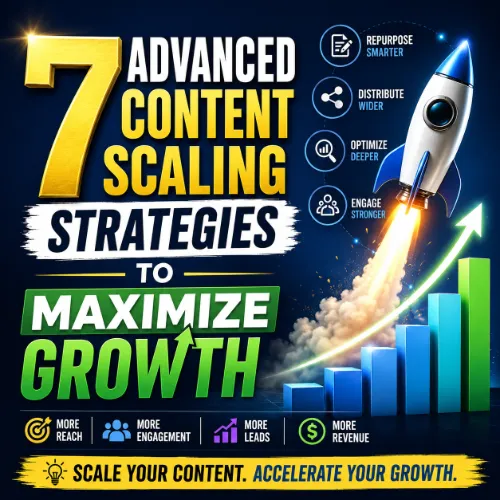
advanced content scaling strategies Key Takeaways
Scaling content production without sacrificing quality is one of the biggest challenges in modern digital marketing.
- Effective advanced content scaling strategies rely on process, not just tooling, to maintain editorial standards
- Prioritizing high-traffic topics and repurposing existing assets drives faster returns than creating from scratch
- Automation and delegation must be balanced with human oversight to preserve brand voice and accuracy
What Readers Should Know About Advanced Content Scaling Strategies
Producing content at scale has become a necessity for competitive industries, yet most teams struggle to maintain quality as volume increases. Content scaling strategies that treat every piece as a standalone asset with clear goals—traffic, backlinks, conversions—tend to outperform blanket production approaches. Whether you manage a ten-person team or work as a solo creator, the principles remain the same: plan meticulously, automate wisely, and measure relentlessly.
Below are seven proven methods to scale content production without diluting your brand or weakening your SEO performance.
1. Build a Topic Cluster Architecture With Data-Driven Prioritization
A topic cluster organizes content around a core pillar page and links related subtopics to it, signaling topical authority to search engines. This advanced content scaling technique requires upfront research but pays off in compounding ranking strength.
Select Pillar Topics Based on Opportunity
Use keyword research tools to identify queries with high search volume and manageable competition. Look for topic clusters where your site can fill a content gap—for example, “headless CMS security” if competitors only cover basic CMS security. The pillar page should comprehensively answer the primary user intent, while cluster pages cover specific byproducts of that intent.
Map Cluster Content in Batches
Prepare outlines for 10–15 cluster articles at once. This batch planning step reduces context-switching and ensures each article naturally links back to the pillar and to other related cluster posts. Over time, this structure boosts domain authority on the topic and accelerates indexing of new pages.
2. Repurpose High-Performing Assets Into Multiple Formats
Repurposing is one of the fastest advanced content scaling strategies because it leverages existing research and editorial investment. A single well-researched blog post can become a video script, an infographic, a podcast outline, a LinkedIn carousel, and a newsletter edition.
Identify Your Top 20% of Content
Analyze your Google Search Console and analytics to find pages that generate the most traffic, backlinks, or conversions. These are prime candidates for repurposing. For instance, a guide on “email segmentation best practices” with 5,000 monthly visits can be turned into a YouTube tutorial and a downloadable checklist.
Use Templates for Fast Transformation
Create standardized templates for each format—video script outline, infographic wireframe, social media post sequence. Using templates cuts production time per repurposed asset by up to 60% while maintaining brand consistency.
3. Implement an Editorial Pipeline With Automation Checkpoints
Scaling content without a clear pipeline leads to bottlenecks and quality inconsistencies. An automated editorial pipeline assigns tasks, tracks progress, and enforces standards at every stage.
Map Your Workflow Stages
Define stages such as: Topic Research, Outline Approval, First Draft, Editing, SEO Optimization, Design, Review, and Publishing. Use project management tools (e.g., Notion, Airtable, Asana) with automation rules—when a draft moves to “Editing,” automatically assign it to an editor and send a Slack notification.
Set Content Quality Checks
Incorporate automated checks for keyword density, readability score, heading structure, and internal linking. Tools like Yoast SEO or Surfer SEO integrate with your CMS to flag issues before publication. This ensures every scaled piece meets a baseline quality threshold.
4. Use AI-Assisted Drafting With Human Refinement
Artificial intelligence can dramatically accelerate content creation, but full automation often produces generic, factually shaky output. The most effective advanced content scaling strategies combine AI speed with human expertise.
Generate Structured Outlines First
Ask AI to produce a detailed outline based on your chosen topic and target keywords. Review the outline for logical flow, completeness, and accuracy. Only then proceed to generate a full draft—this human oversight at the planning stage prevents the article from going off-track.
Edit for Voice and Authority
After the AI draft is generated, a human writer should fact-check statistics, add original insights, and adjust tone to match your brand voice. This hybrid workflow can triple output without sacrificing the uniqueness that earns backlinks and audience trust.
5. Delegate Through a Scalable Writer Network
Even with automation, most teams eventually need more human bandwidth. Building a network of vetted freelance writers allows you to scale content production on demand, but only if you invest in onboarding and feedback loops.
Create a Style Guide and Brief Template
Develop a comprehensive brief that includes the target keyword, outline, competitor examples, tone requirements, and formatting rules. Share this with every writer before their first assignment. Consistently using a brief reduces revision cycles and improves first-draft quality.
Offer Constructive Feedback Regularly
Freelancers perform better when they understand your expectations. Provide specific feedback on the first few articles: “Please include a table comparing these two features in the next piece.” Over time, your network learns your preferences and requires less hand-holding.
6. Optimize for Search Intent at Scale
Advanced content scaling techniques must account for user intent to avoid creating low-value pages that never rank. Intent optimization means matching your content format to what searchers actually want. For a related guide, see 8 Advanced Technical SEO Techniques to Avoid Risky Mistakes.
Classify Intent Early in Research
For each keyword cluster, determine whether the primary intent is informational, navigational, commercial, or transactional. Informational queries (e.g., “how to optimize meta descriptions”) need detailed guides or tutorials. Commercial queries (e.g., “best AI writing tools”) require comparisons and reviews. Align your content format accordingly.
Build Templates for Each Intent Type
Create pre-approved structures for listicles, tutorials, product comparisons, and definitive guides. When scaling, writers simply populate the template with research relevant to the specific keyword, ensuring every piece matches user expectations and reduces bounce rates.
7. Audit and Refresh Content to Multiply Existing Value
Refreshing existing content is often three times faster than creating new articles and can yield immediate ranking improvements. This underutilized advanced content scaling strategy compounds your library’s visibility over time.
Identify Pages With Decaying Traffic
Use Google Search Console or a tool like Ahrefs to find pages that have lost 20%+ traffic over the past 6–12 months. Check if competitors have published newer, more comprehensive content on the same topic. If so, update your page with fresh statistics, expanded sections, and improved readability.
Add Internal Links and Updated Stats
During a refresh, add 2–3 new internal links to your most recent pillar or cluster articles. Update any statistics, examples, and screenshots. Republish with a revised date—this often triggers a crawl and potential ranking restoration.
SEO Entities and Their Functions
When scaling content, you can’t afford to overlook the entities that signal relevance and authority to search engines. Here are key entities and how they support decision-making during scaling:
- Keyword entities such as organic keywords, keyword difficulty (KD), and search volume reveal which topics have demand and how hard they are to rank for. Use these to prioritize your cluster articles.
- Backlink entities like referring domains and new/lost backlinks help you identify which pieces attract links naturally—these are prime repurposing candidates.
- Page entities including top pages by traffic and best by links show where your site already has authority. Double down on those topics.
- SERP entities, especially featured snippets and People Also Ask boxes, guide the structure of new content. Format answers as lists or tables to target featured snippet placement.
- Competitor entities such as content gap opportunities and shared keywords reveal topics your rivals cover that you don’t—this is your next content batch.
Useful Resources
For deeper dives into content scaling frameworks and SEO techniques, explore these external guides:
- Ahrefs: How to Scale Content Without Sacrificing Quality
- Moz: SEO Copywriting Best Practices for Scalable Content
Frequently Asked Questions About advanced content scaling strategies
What are advanced content scaling strategies ?
Advanced content scaling strategies are systematic methods to increase content production volume while maintaining or improving quality, SEO performance, and audience engagement. They go beyond basic batch creation to include data-driven topic selection, repurposing, automation, and delegation.
How do content scaling strategies differ from basic content planning?
Basic content planning focuses on calendar management and topic ideation. Content scaling strategies incorporate automation, intent optimization, topic clustering, and performance analysis to multiply output without linear increases in resources.
Can small teams use advanced content scaling techniques ?
Yes. Small teams can adopt topic clustering, repurposing, and AI-assisted drafting with minimal upfront investment. The key is to start with one or two techniques and scale gradually as processes mature.
What is the biggest risk of scaling content too quickly?
The biggest risk is quality dilution—publishing thin, inaccurate, or poorly structured content that damages credibility and ranking potential. Maintaining editorial standards through checkpoints and human review is essential.
How often should we refresh older content?
Refresh content when traffic declines by 20% or more, or when competitors publish newer, more comprehensive guides on the same topic. A regular quarterly audit cycle works well for most teams.
Do topic clusters really improve rankings?
Yes. Topic clusters signal topical authority to search engines, improve internal linking structure, and increase the chances of ranking for related keyword variations. Many sites see 30–50% traffic growth on cluster topics within 6–12 months.
What role does AI play in content scaling?
AI accelerates drafting, outlines, and data analysis but should not replace human oversight. The best results come from AI-assisted drafting combined with human editing for voice, accuracy, and originality.
How do I measure the success of scaled content?
Track organic traffic growth, keyword rankings, backlinks earned, conversion rates, and content production speed. Compare these metrics before and after implementing scaling techniques.
Should we outsource content creation for scaling?
Outsourcing to a vetted network of freelance writers can be effective, provided you invest in robust briefs, style guides, and feedback processes to maintain quality and brand voice.
What is the ideal content volume for scaling?
There is no universal number. The ideal volume depends on your team size, budget, and quality standards. Start by increasing output by 25–50% and adjust based on performance and resource availability.
How do I find topics for content scaling?
Use keyword research tools to identify content gaps and high-opportunity topics. Analyze competitor content, search query reports in Google Search Console, and question forums like Reddit or Quora.
What is the most cost-effective scaling technique?
Repurposing existing high-performing content is typically the most cost-effective technique because it uses already researched information and proven assets, requiring less time and budget than creating entirely new content.
How long does it take to see results from content scaling?
Results depend on competition and content quality. Some improvements in traffic and rankings appear within 1–3 months, but significant compounding effects often take 6–12 months of consistent scaling.
Does content scaling affect domain authority?
Scaling high-quality, well-optimized content can improve domain authority by increasing the number of indexed pages and backlink potential. Low-quality scaling can harm authority through keyword stuffing or thin content penalties.
What tools support content scaling strategies ?
Popular tools include Ahrefs or SEMrush for keyword research and competitor analysis, Surfer SEO for on-page optimization, Jasper or ChatGPT for AI drafting, and project management tools like Asana or Trello for workflow tracking.
How do I maintain brand voice across scaled content?
Create a detailed brand voice and tone guide, share it with all writers and editors, and review the first few pieces from each new contributor closely. Regular feedback loops help reinforce consistency.
Can content scaling hurt my site’s user experience?
If scaling tasks are prioritized over quality and user intent, it can produce content that doesn’t satisfy searchers, leading to increased bounce rates and reduced dwell time—both negative signals for search engines.
Should I include internal links in every scaled piece?
Yes. Internal linking distributes authority across your site and helps search engines understand content relationships. Aim for at least 2–4 internal links per article, linking to related pillar or cluster pages. For a related guide, see 12 Advanced Internal Linking Strategies for Better SEO.
What is a content scaling bottleneck?
A bottleneck is any stage in your content pipeline that slows production—such as slow approvals, limited design resources, or unclear guidelines. Identifying and resolving bottlenecks is crucial for smooth scaling.
How do I prioritize which content to scale first?
Prioritize topics with high search volume, low competition, and clear alignment with your business goals. Use data from keyword research and competitor analysis to identify the biggest opportunities.