semantic SEO strategies 2026 Key Takeaways
In 2026, SEO success will feel like a stroke of swerte — but it’s actually the result of smart semantic signaling.
- Master semantic SEO strategies 2026 by focusing on entity-relationship mapping and user intent.
- Link building remains crucial, but only when anchored in contextually relevant, authoritative sources.
- Content that satisfies multiple SERP features — from featured snippets to People Also Ask — earns compounding traffic.
Why semantic SEO strategies 2026 Change the Link Game
Search engines now interpret content like a human reader: they look at meaning, context, and connections between topics. This shift makes semantic SEO strategies 2026 essential for any site that wants sustainable growth. Gone are the days when exact-match keywords ruled. Today, Google’s AI models understand related concepts, synonyms, and the relationship between entities. For a related guide, see 15 Advanced SEO Strategies Experts Use.
For example, a page about “coffee brewing” might also rank for “French press method” if it covers the topic thoroughly. That’s semantic depth in action. Paired with a strong link profile — what we call the SantoLLUCKY approach — your site can capture traffic from multiple related queries without keyword stuffing.
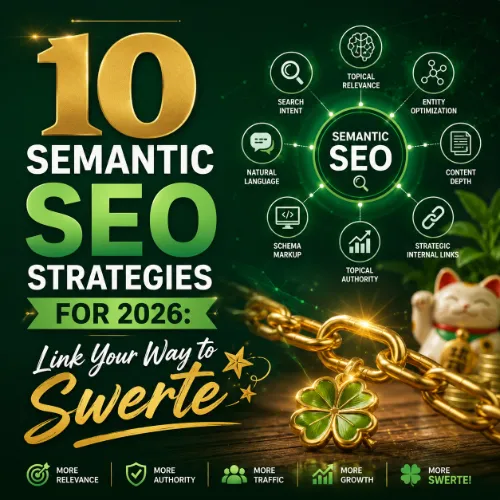
Below are 10 actionable strategies that blend semantic depth with smart link building.
1. Build Topical Clusters Around Core Entities
Instead of writing isolated articles, organize content into clusters centered on one main topic. Each cluster includes a pillar page (comprehensive guide) and several supporting articles that explore subtopics. This structure signals to search engines that your site is an authority on that entity.
How to Identify Your Core Entities
Start with your niche. If you run a travel blog, your core entities might be “budget travel,” “solo backpacking,” and “Southeast Asia.” Use keyword research tools to find related terms, then group them by search intent. Link supporting articles back to the pillar page using descriptive anchor text.
Example: A pillar page titled “Ultimate Budget Travel Guide” links to cluster pages like “Cheap Hostels in Bangkok” and “How to Save on Flights.”
2. Optimize for Entity Relationships, Not Just Keywords
Google’s Knowledge Graph connects entities (people, places, things) through relationships. Your content should naturally mention related entities and explain how they connect. This helps search engines understand the context of your page.
For instance, if you write about “semantic SEO strategies 2026,” also mention related entities like “content clusters,” “structured data,” and “topic authority.” Use semantic HTML elements like <strong> to highlight entities, but avoid over-optimization.
Using Schema Markup for Entities
Add structured data types such as Thing, Product, or Article with relevant properties. This gives search engines explicit signals about what your page represents.
3. Earn Contextual Backlinks From Authoritative Sources
Backlinks remain a top ranking factor, but context matters more than ever. A link from a relevant, high-authority page carries more weight than dozens of unrelated links. Focus on earning links from sites that publish content about the same entities as your page.
One effective tactic is broken link building: find a broken link on a relevant resource page, then offer your content as a replacement. Use tools like Ahrefs to identify referring domains with broken links.
4. Incorporate People Also Ask and Featured Snippet Answers
SERP features like People Also Ask (PAA) and featured snippets often appear for question-based queries. Answer common questions directly in your content using clear, concise paragraphs. Structure answers as standalone H3 sections so Google can easily extract them.
For example, if your topic is “semantic SEO strategies 2026,” include a section like “What is the difference between semantic SEO and traditional SEO?” and answer it in two to three sentences.
5. Use Internal Links With Descriptive Anchor Text
Internal links help distribute link equity and signal topic relationships. Instead of generic anchors like “click here,” use phrases that describe the target page’s content. For instance, “learn how topical authority boosts rankings” links to your pillar page more effectively than “read more.”
Include at least three to five internal links per article, connecting to related cluster content or the main pillar.
6. Match Search Intent With Content Format
Search intent determines whether a query wants an article, a list, a tutorial, or a product page. Before writing, analyze the top-ranking pages for your target keyword. If most results are step-by-step guides, create a tutorial-style post. If they’re listicles, write a list article.
For semantic SEO strategies 2026, the top results combine listicle structure with practical explanations — exactly what this article does.
7. Refresh Content Regularly to Maintain Semantic Relevance
Search engines favor fresh content. Update your articles every six to twelve months with new data, examples, and links. This signals that your page remains relevant and authoritative. When you publish major updates, re-crawl the page using Google Search Console.
8. Leverage Social Shares as Indirect Ranking Signals
While social shares aren’t a direct ranking factor, they amplify visibility and attract natural backlinks. Encourage shares by including shareable formats: infographics, checklists, or data-driven tables. Promote your content on LinkedIn, X, and relevant communities.
9. Monitor Your Competitors’ Content Gaps
Use Ahrefs or Semrush to identify keywords your competitors rank for but you don’t. Focus on terms that have high search volume and low keyword difficulty. Create content that covers those gaps with more depth, updated data, and stronger link building.
10. Measure Success With Entity-Focused KPIs
Track metrics that reflect semantic performance: organic keyword growth for related terms, featured snippet ownership, and traffic from People Also Ask results. Use Ahrefs’ Top Pages report to see which URLs earn the most traffic and links.
SEO Entities and Their Functions
Understanding key SEO entities helps you make informed decisions. Here’s a quick guide to the most relevant ones for semantic SEO strategies 2026:
- Referring domains: The number of unique domains linking to your site. More high-quality referring domains indicate stronger authority.
- Organic keywords: The search terms for which your site ranks in organic results. Track growth in semantic variations.
- Featured snippets: The answer box at the top of some SERPs. Appearing here can dramatically increase click-through rates.
- Keyword Difficulty (KD): A metric that estimates how hard it is to rank for a keyword. Use it to prioritize low-competition opportunities.
- Core Web Vitals: Metrics measuring page experience (loading, interactivity, visual stability). They directly impact rankings.
Summary Checklist: Your Path to SEO Swerte
| Strategy | Action Item | Priority |
|---|---|---|
| Topical clusters | Create pillar page + supporting posts | High |
| Entity relationships | Add related entities and schema markup | High |
| Contextual backlinks | Broken link building on relevant sites | High |
| SERP features | Write direct answers for PAA queries | Medium |
| Internal linking | Use descriptive anchor text | Medium |
| Intent matching | Match content format to SERP results | High |
| Content refreshes | Update articles every 6 months | Medium |
| Social amplification | Create shareable assets | Low |
| Competitor gaps | Fill missing content opportunities | High |
| KPI tracking | Monitor entity-focused metrics | Medium |
Semantic SEO strategies 2026 aren’t just about ranking higher — they’re about building a site that search engines trust as an authoritative source. Combine these tactics with consistent link building, and you’ll turn SEO luck into a replicable system.
Useful Resources
Learn more about entity-focused SEO from these trusted sources:
- Google’s Guide to Structured Data — official documentation on implementing schema markup for entities.
- Ahrefs Blog: Semantic SEO — a comprehensive guide covering clusters, entities, and intent matching.
Frequently Asked Questions About semantic SEO strategies 2026
What are semantic SEO strategies?
Semantic SEO strategies focus on understanding and signaling the meaning behind search queries, using entities, relationships, and contextual signals rather than exact-match keywords.
How is semantic SEO different from traditional SEO?
Traditional SEO relied on exact-match keywords and link counts. Semantic SEO emphasizes topic clusters, entity relationships, and user intent.
Do I need to use schema markup for semantic SEO?
Schema markup is highly recommended as it provides explicit signals about entities and relationships, helping search engines understand your content structure.
What tools help with semantic SEO?
Ahrefs, Semrush, and Google Search Console are essential for keyword research, entity analysis, and performance tracking.
How important are backlinks for semantic SEO?
Backlinks remain critical, but context and relevance matter more than sheer volume. Links from semantically related pages carry higher value.
What is a topical cluster?
A topical cluster is a content structure where one comprehensive pillar page links to multiple supporting articles covering related subtopics.
How do I find entities related to my topic?
Use Google’s Knowledge Graph API, Ahrefs’ Content Explorer, or analyze top-ranking pages for mentioned entities.
Can I optimize old content for semantic SEO?
Yes, update old articles with fresh data, add internal links to new cluster content, and include schema markup where missing.
What are SERP features in semantic SEO?
SERP features include featured snippets, People Also Ask, sitelinks, and AI Overviews. Optimizing for these increases visibility and click-through rates.
How does user intent affect content creation?
Matching content format to user intent (informational, navigational, transactional) ensures your page satisfies what searchers are looking for.
What is an entity in SEO?
An entity is any distinct thing — person, place, concept, or object — that can be identified and linked in a knowledge graph.
How many pages should a topical cluster have?
A cluster typically includes one pillar page and three to ten supporting articles, depending on the breadth of the topic.
Does internal linking affect semantic rankings?
Yes, internal links with descriptive anchor text help search engines understand topic relationships and distribute link equity across your site. For a related guide, see 12 Advanced Internal Linking Strategies for Better SEO.
What is the role of social shares in semantic SEO?
Social shares drive visibility and can lead to natural backlinks, but they are not a direct ranking factor.
How often should I refresh content for semantic SEO?
Refresh content every six to twelve months with updated information, new examples, and fresh internal links.
What is keyword difficulty in semantic SEO?
Keyword difficulty (KD) estimates how hard it is to rank for a term. Choose keywords with moderate KD and high relevance to your entities.
Can I use semantic SEO for local businesses?
Yes, local SEO benefits from entity optimization by connecting your business to location-specific entities and attributes.
What is the best way to measure semantic SEO success?
Track growth in organic keyword rankings for semantic variations, featured snippet ownership, and traffic from People Also Ask results.
How do I avoid keyword stuffing in semantic SEO?
Focus on covering the topic comprehensively rather than repeating the same keyword. Use synonyms and related entities naturally.
What is the future of semantic SEO beyond 2026?
AI-driven search will rely even more on entity relationships and contextual understanding, making semantic SEO a long-term competitive advantage.