
Google algorithm updates Key Takeaways
Google’s core and targeted algorithm updates have fundamentally reshaped how websites earn visibility, turning SEO from a keyword-stuffing game into a user-first discipline.
- Major Google algorithm updates like Panda, Penguin, and BERT shifted focus from manipulation to relevance, authority, and natural language understanding.
- Each update teaches a lasting principle: prioritize user experience, earn genuine links, optimize for mobile and speed, and match search intent.
- Adapting to these changes means investing in high-quality content, technical excellence, and E-E-A-T signals rather than chasing short-term tactics.
Why Understanding Historic Google Algorithm Updates Matters
Every SEO professional knows the frustration of waking up to a traffic drop after an unannounced update. But the most significant Google algorithm updates didn’t just penalize bad practices—they rewarded websites that truly helped users. By studying the updates that changed SEO forever, you gain a blueprint for sustainable organic growth. For a related guide, see 12 Ways to Recover After a Google Update.
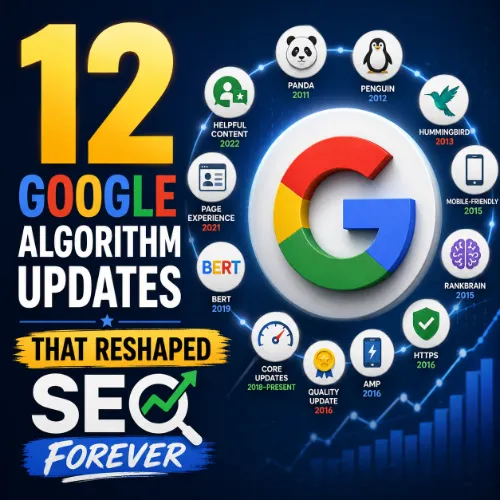
12 Google Algorithm Updates That Reshaped SEO Forever
Below are the twelve most impactful updates, ordered roughly by chronology and lasting influence. Each entry explains what changed, how it affected search, and the key lesson you can apply today.
1. Florida (2003) – The First Major Quality Filter
Before Florida, SEO was largely about keyword density and hidden text. The Florida update targeted keyword stuffing and manipulative on-page tactics, forcing the industry to think about relevance for the first time. SEO takeaway: Write for humans, not crawlers.
2. Big Daddy (2005) – Infrastructure and Canonicalization
Big Daddy improved Google’s crawling infrastructure and introduced better handling of duplicate content and URL canonicalization. It set the stage for clean site architecture. SEO takeaway: Consolidate duplicate pages and use 301 redirects properly.
3. Jagger (2005) – Link Quality Over Quantity
Jagger devalued paid links, link farms, and reciprocal link schemes. It marked the beginning of Google’s war on artificial link building. SEO takeaway: Build links editorially by creating content worth citing.
4. Vince (2009) – Large Brand Boost
Vince gave a significant ranking boost to large, authoritative brands for head terms, making it harder for smaller sites to compete on generic queries. SEO takeaway: Build brand authority through consistent off-site signals and trust.
5. Caffeine (2010) – Freshness Index
Caffeine rebuilt Google’s infrastructure for faster indexing and fresher results. Real-time content—news, blogs, timely topics—started ranking quickly. SEO takebook: Keep your website fresh with regular updates, especially for time-sensitive topics.
6. Panda (2011) – Quality Raters and Thin Content
Panda targeted low-quality, thin, and scraped content while rewarding in-depth, original reporting. It was the first wide-scale algorithm aimed at content quality. SEO takeaway: Every page should offer unique value—no duplicate or shallow content.
7. Penguin (2012) – Link Spam Penalty
Penguin devalued spammy links and over-optimized anchor text. After Penguin, unnatural link profiles could sink entire sites. SEO takeaway: Audit your backlink profile regularly and disavow toxic links.
8. Hummingbird (2013) – Intent and Conversational Search
Hummingbird shifted from matching exact keywords to understanding query intent and context. It paved the way for voice search and long-tail queries. SEO takeaway: Optimize for semantic topics, question phrases, and user intent.
9. Mobilegeddon (2015) – Mobile-Friendliness
This update boosted mobile-friendly pages in mobile search results. It was the first explicit mobile ranking signal. SEO takeaway: Use responsive design and test mobile usability with Google’s tools.
10. RankBrain (2015) – Machine Learning
RankBrain introduced AI to interpret novel queries and measure user satisfaction signals (click-through, dwell time, pogo-sticking). SEO takeaway: Write compelling meta descriptions and satisfy search intent immediately.
11. BERT (2019) – Natural Language Understanding
BERT used bidirectional transformer models to grasp word relationships in context, especially for prepositions and modifiers. It dramatically improved understanding of natural language queries. SEO takeaway: Write naturally, don’t force exact-match keywords.
12. Helpful Content System (2022 and later) – People-First Content
This ongoing system rewards content written primarily to help people, not to rank. It penalizes content designed solely for search engine traffic. SEO takeaway: Always ask: “Does this page genuinely help my audience?”
Common Traits Across These Google Algorithm Updates
Looking back, several patterns emerge. First, every update aimed to align search results with user satisfaction. Second, updates grew more sophisticated, moving from keyword matching to intent, semantics, and machine learning. Third, penalties became more precise—affecting specific pages rather than entire domains in later years. Understanding these trends helps you future-proof your SEO strategy.
How to Adapt Your SEO Strategy to Future Updates
Instead of fearing the next unnamed update, build a foundation that aligns with Google’s core principles. Focus on E-E-A-T: experience, expertise, authoritativeness, and trust. Invest in technical SEO (Core Web Vitals, structured data, secure HTTPS). Create content that answers real questions and earns natural backlinks. Monitor your analytics and core web vitals regularly. When an update hits, analyze the impact using tools like Google Search Console and a solid SEO platform such as Ahrefs or Semrush. The sites that survive—and thrive—are those that treat SEO as a long-term user experience discipline, not a game of loopholes. For a related guide, see 10 Proven Ways to Survive Google Updates as an Affiliate Site.
Useful Resources
For a deeper dive into each update’s history and data, check these authoritative sources:
- Moz Google Algorithm Change History – A comprehensive timeline of confirmed and unconfirmed updates.
- Google Search Central: Updates – Official Google announcements and guidance.
Frequently Asked Questions About Google algorithm updates
What is the most impactful Google algorithm update ever?
Panda (2011) is widely considered the most impactful because it fundamentally changed how Google evaluates content quality, punishing thin and duplicate content at scale.
Do Google algorithm updates still happen?
Yes, Google releases hundreds of unconfirmed updates each year and several confirmed core updates. The Helpful Content System is an ongoing initiative.
How long does it take to recover from a Google update penalty?
Recovery time varies. Manual penalties can take weeks to months after you fix the issue and submit a reconsideration request. Algorithmic penalties may lift after the next update cycle.
How can I monitor my site for algorithm updates?
Use Google Search Console to track ranking and traffic changes, and follow trusted SEO news sources like Search Engine Land, Moz, and Google Search Central.
Did BERT replace RankBrain?
No, BERT and RankBrain work together. RankBrain focuses on query mapping and user signals, while BERT improves understanding of word context within longer queries.
How often does Google update its core algorithm?
Google confirms several broad core updates per year, but smaller unconfirmed updates occur daily.
What was the first major Google algorithm update?
The Florida update in November 2003 is widely considered the first major algorithm update that specifically targeted search engine spam.
What is the difference between a core update and a targeted update?
A core update broadly changes how Google evaluates relevance and quality, while a targeted update (like Penguin) focuses on a specific issue such as link spam.
Can I recover from a Penguin penalty without disavowing links?
Yes, if the penalty is algorithmic and you have since removed or disavowed the spammy links, recovery can happen after a data refresh without manual disavow.
What is the best way to prepare for future Google updates?
Focus on E-E-A-T: publish original, well-researched content, earn natural backlinks, ensure your site is technically sound, and prioritize user experience.
Does Google confirm all algorithm updates?
No, Google only confirms broad core updates and a few named updates. Many smaller changes remain unconfirmed.
How does the Helpful Content System work?
It uses a site-wide signal to evaluate whether content is written primarily for search engines or for people. Sites with low- value content may see broad traffic drops.
Are historical updates like Panda still part of the current algorithm?
Yes, the principles of Panda are now incorporated into Google’s core algorithm. The separate filter no longer exists, but its quality signals remain.
What role does user experience play in modern Google updates?
User experience is critical. Updates like Page Experience and Core Web Vitals directly measure page speed, interactivity, and visual stability as ranking factors.
How can I tell if my site was hit by a Google update?
Compare your organic traffic and rankings before and after the update date. A sudden drop (20% or more) that correlates with a confirmed or reported update is a strong indicator.
What should I do if my traffic drops after an update?
First, verify which pages lost traffic. Then audit your content quality, backlinks, and technical health. Make improvements and wait for the next update—recovery often requires a refresh.
Is there a way to see which updates affected competitor sites?
You can use tools like Ahrefs or Semrush to view competitor traffic history. Sudden drops can be cross-referenced with known update dates for clues.
What is a “Panda penalty” today?
There is no separate Panda penalty. The quality signals Panda introduced are now part of Google’s core evaluation. Thin content still risks lower rankings.
How often does Google refresh the Index?
Google continuously crawls and indexes the web. Freshness updates are real-time, but major index refreshes for ranking changes can take days to weeks.
Where can I learn more about upcoming Google updates?
Follow Google’s official blog, Search Engine Land, and the Google Search Central YouTube channel for early announcements and analysis.