
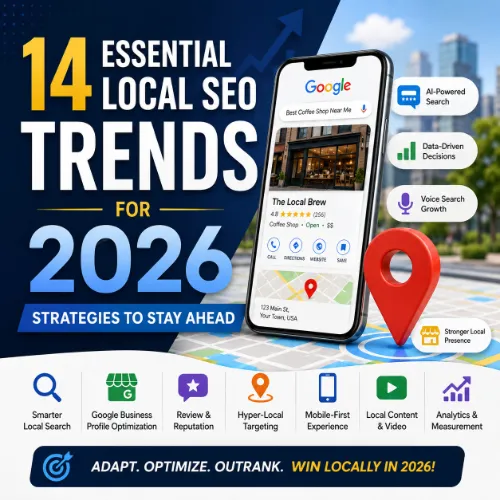
local SEO trends 2026 Key Takeaways
Local SEO is evolving faster than ever, driven by AI-generated search results, hyper-personalized local packs, and stricter authenticity signals.
- Google AI Overviews and local packs now blend organic and paid data — optimizing for both is non-negotiable.
- Voice and visual search are reshaping how customers find local services; structured data and FAQ content win here.
- Review management, local link building, and Google Business Profile completeness remain foundational, but their weighting has shifted toward recency and diversity.
Why Adapting to local SEO trends 2026 Is Critical for Your Business
Local search is no longer just about claiming your Google Business Profile and adding a few keywords. The local SEO trends 2026 reveal a shift toward AI-curated local results, where customer behavior signals, entity understanding, and hyperlocal content determine visibility. If you ignore these changes, competitors who embrace them will capture the traffic that used to land on your site. For a related guide, see 14 Semantic Search Trends Every SEO Must Follow in 2026.
The Rise of AI-Driven Local Results
Google’s Search Generative Experience (SGE) and AI Overviews now pull data from local packs, reviews, and even social media posts. For a local business, that means your digital presence must be coherent across Google, Yelp, Facebook, and your own site. In 2026, inconsistency is penalized more harshly than ever. For a related guide, see 10 Hidden Google Ranking Signals You Must Not Ignore in 2026.
Entity Recognition and Local Context
Google understands entities — places, people, services, brands — and connects them to geographic intent. A plumber in Austin is not just a business listing; it’s an entity linked to local neighborhoods, service categories, and customer reviews. This increased understanding means your content must answer specific local queries naturally, not just stuff keywords.
The 14 local SEO trends 2026 You Need to Know
Below are the 14 trends shaping local search this year, each with a clear explanation and an actionable step you can take right now.
1. AI Overviews Dominating Local Queries
Google AI Overviews now appear at the top of many local searches, summarizing information from multiple sources. To get featured, structure your content with clear answers to common local questions using bullet points, tables, and concise paragraphs.
Action: Create a dedicated FAQ page for your most common customer questions and use structured data (FAQ schema).
2. Conversational and Long-Tail Voice Search
Voice search continues to grow, especially for local queries like “best pizza place near me open now.” People speak differently than they type, so your content should include natural, conversational phrases.
Action: Conduct a content audit and rewrite pages to include question-based headings and full-sentence answers.
3. Hyperlocal Content and Neighborhood Targeting
Generic city-level targeting is no longer enough. Google rewards businesses that create content referencing specific neighborhoods, landmarks, and community events.
Action: Publish blog posts about local festivals, sponsor a neighborhood sports team, and mention street names in your service area descriptions.
4. Zero-Click Searches and Local Packs
Many local queries now end on the search results page without a click. Your Google Business Profile must be complete and optimized because it’s often the only thing users see.
Action: Add menu items, services, scheduling links, and Q and A directly to your profile.
5. Review Recency and Response Rate
While overall rating matters, Google now weighs recency and response rate more heavily in 2026. A business with 50 reviews from 2022 will rank lower than one with 10 recent reviews and active replies.
Action: Set up a review generation workflow and respond to all reviews — positive and negative — within 48 hours.
6. Visual Search with Google Lens
Customers now use Google Lens to take photos of products, signs, or storefronts and get local results. This trend amplifies the importance of high-quality, tagged images on your site and Google Business Profile.
Action: Optimize all images with descriptive filenames and alt text, and upload 10+ interior and exterior photos to your profile.
7. Local Link Building with Genuine Community Signals
Links from local newspapers, community blogs, and chamber of commerce websites are more valuable than ever. These “local authority” signals tell Google you are a real business participating in the community.
Action: Partner with local influencers, sponsor charity events, and pitch stories to local journalists about your business.
8. Google Business Profile Attributes and Posts
GBP posts — offers, events, updates — and detailed attributes (women-led, wheelchair accessible, free Wi-Fi) improve your chances of appearing in filtered searches.
Action: Fill out every attribute that applies and post at least once a week with a seasonal offer or event.
9. Schema Markup for Local Businesses
Structured data helps Google understand your business type, services, hours, and reviews. In 2026, LocalBusiness, Product, and FAQ schema are baseline requirements.
Action: Use a schema generator to add LocalBusiness markup to your homepage and service pages.
10. Social Media Integration in Local Search
Google now indexes posts from Facebook, Instagram, and TikTok for certain local queries. A strong social presence with location tags boosts overall local visibility.
Action: Tag your location in every post, use local hashtags, and encourage customers to check in.
11. Mobile-First and Core Web Vitals
Mobile optimization has been a factor for years, but 2026 brings tighter Core Web Vitals thresholds. Pages must load in under 2.5 seconds on mobile to compete in local packs.
Action: Run a mobile speed test on your key pages and compress images, remove render-blocking resources, and use browser caching.
12. Personalized Local Results
Google uses device history, past searches, and location to deliver unique local results. This trend makes it harder to rank without a diverse content strategy that covers multiple intents.
Action: Create separate landing pages for different customer personas — families, professionals, students — who might search for your service differently.
13. Customer Data and First-Party Signals
With the decline of third-party cookies, Google relies more on first-party data from your website, app, or CRM to determine relevance. Engaged users signal quality.
Action: Collect email addresses through a local discount offer and track on-site behavior with analytics.
14. Ethical AI and Google E-E-A-T for Local Businesses
Experience, Expertise, Authoritativeness, and Trustworthiness (E-E-A-T) apply to local businesses too. Google checks if you have real-world authority — licenses, certifications, location photos, and a verifiable address.
Action: Add an “About Us” page with team bios, certifications, and a real street map showing your business location.
How to Prioritize These local SEO trends 2026 for Your Business
Not every trend applies equally to every local business. A restaurant will benefit more from visual search and review recency, while a law firm should focus on schema and link building. Start with the trends that match your industry and capacity.
| Trend | Highest Impact For | Effort Level |
|---|---|---|
| AI Overviews | All businesses | Medium |
| Voice Search | Service area businesses | Low |
| Hyperlocal Content | Multi-location brands | Medium |
| Review Recency | Restaurants, hospitality | Low |
| Visual Search | Retail, salons, real estate | Low |
| Schema Markup | Medical, legal, home services | Medium |
SEO Entities and Their Functions
Understanding key entities helps you fine-tune your local SEO strategy for 2026. Here are the most relevant ones, explained in context of local search.
- Local SERP packs: These map + listing results dominate local queries. To appear, your profile signals (address, category, reviews) must be precise and consistent across all platforms.
- Referring domains: Local link building relies on quality referring domains from local news, community blogs, and directories. More relevant domains = stronger local authority.
- Keyword difficulty (KD): For local keywords like “Austin plumber,” KD can be low because of geographic long-tail variations. Low KD doesn’t mean easy rank — you must also optimize for the local pack.
- Core Web Vitals: LCP (Largest Contentful Paint) and CLS (Cumulative Layout Shift) directly impact mobile local rankings, especially for user experience-sensitive queries.
- Brand mentions: Unlinked mentions of your business name on local forums, directories, or social media contribute to entity understanding and trust signals.
Useful Resources
To deepen your understanding of local SEO trends 2026, refer to the following credible sources:
- Google’s guidance on creating helpful, reliable content — essential reading for aligning with E-E-A-T signals.
- Semrush’s local SEO guide — a practical resource for keyword research, audit checklists, and link building strategies.
Conclusion: Act on local SEO trends 2026 Before Your Competitors Do
The businesses that will win local search in 2026 are those that adopt these trends early. Start by auditing your Google Business Profile, publishing one hyperlocal content piece this month, and improving your review response speed. The biggest mistake is waiting for proof — by then, the competitive window will have closed.
Frequently Asked Questions About local SEO trends 2026
What is the most important local SEO trend for 2026?
Adapting to AI Overviews is the most critical trend. Google now generates answers from multiple local sources, so structured content and strong review signals are essential to be chosen as a source.
How do AI Overviews change local SEO?
AI Overviews pull data from GBP reviews, website content, and third-party sites. You must optimize all three channels and use clear, concise answers to common questions to increase your chance of being cited.
Is voice search still important for local SEO in 2026?
Yes. Voice search accounts for nearly 30% of local queries. Optimize for conversational long-tail keywords and include natural, spoken-language phrases in your content.
What is hyperlocal content?
Hyperlocal content targets specific neighborhoods, streets, or landmarks within a city rather than just the city name. Examples include “Best coffee near Lincoln Park” or “Denver plumber serving the Highlands.”
How many Google reviews do I need to rank in 2026?
There is no fixed number, but 20+ recent reviews with active responses outperform 100 older reviews. Focus on recency and diversity of review sources (Google, Yelp, Facebook).
Do I still need to claim my Google Business Profile?
Yes. A verified and fully completed GBP is the most important factor for local pack rankings. Ensure your hours, services, and attributes are up to date.
What is the role of social media in local SEO 2026?
Social media posts with location tags now appear in Google search results for certain local queries. Active social profiles also serve as third-party signals of legitimacy.
How does visual search affect local SEO?
Google Lens lets users search with photos. Optimizing images with descriptive filenames, alt text, and geotags helps your business appear in visual search results for nearby products or places. For a related guide, see 15 Essential Local SEO Tips for Small Businesses to Dominate Search.
What are zero-click searches?
Zero-click searches are queries that end on the search results page without a user clicking any link. Local packs and AI Overviews often fulfill the intent directly, making GBP optimization critical.
Should I build links from local directories?
Yes, but prioritize quality over quantity. A link from a local newspaper, chamber of commerce, or community blog is far more valuable than ten links from low-quality directories.
What is structured data for local SEO?
Structured data (schema markup) is code added to your website that helps Google understand business details: name, address, hours, reviews, services. Use LocalBusiness and FAQ schema.
How fast should my local website load?
For local mobile searches, aim for a Largest Contentful Paint (LCP) of under 2.5 seconds. Use Google PageSpeed Insights to test and improve your Core Web Vitals.
Does user location still affect local rankings?
Yes. Google uses the user’s physical location (with permission) and search history to deliver personalized local results. This is why hyperlocal content matters more than ever.
What is E-E-A-T and why does it matter for local businesses?
E-E-A-T stands for Experience, Expertise, Authoritativeness, and Trustworthiness. Google uses these signals to evaluate content quality. For local businesses, showing real-world credentials and customer trust builds authority.
How do I optimize for more than one city?
Create separate service area pages for each city with unique content about that specific location: local landmarks, client testimonials, and city-specific keywords. Avoid duplicate content.
Is it worth posting multiple times a week on GBP?
Yes. Regular posts signal activity and relevance. Post 3–4 times per week with offers, events, new photos, or seasonal updates to improve your profile’s visibility.
What are the biggest local SEO mistakes in 2026?
Ignoring review responses, publishing duplicate location pages, neglecting mobile speed, and failing to keep GBP attributes up to date are the most common costly mistakes.
Do I need a separate mobile site for local SEO?
No. A responsive design that adjusts to any screen size is standard and recommended by Google. A separate mobile site can cause maintenance and duplication issues.
How does first-party data help local SEO?
First-party data (email signups, on-site behavior, appointments) helps Google understand that users engage with your business. High engagement signals trust and relevance.
Should I use AI tools for local SEO?
Yes, but with caution. AI tools can help generate FAQ content, suggest keywords, and audit profiles, but human quality control is essential to maintain authenticity and avoid spam signals.