
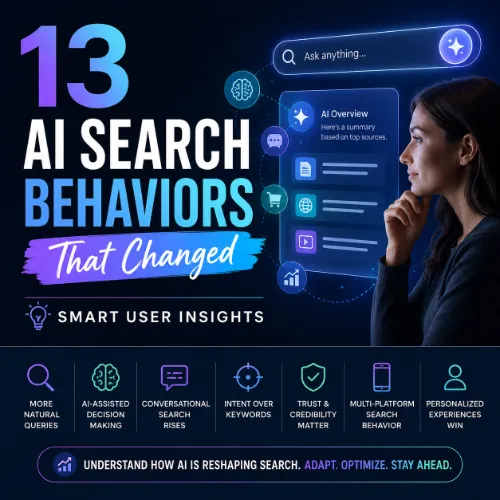
AI search behaviors Key Takeaways
Artificial intelligence has fundamentally reshaped how people search for information, products, and services.
- Users now expect direct answers, not just links, thanks to AI Overviews and featured snippets.
- Conversational and long-tail queries have surged as voice search and AI assistants become mainstream.
- Search intent has shifted from broad keyword matching to context-aware, semantic understanding.
How AI Reshaped Modern Search Habits
The rise of machine learning and natural language processing has transformed search from a simple keyword matching exercise into a context-driven experience. Instead of typing disjointed phrases, users now ask full questions, expect personalized results, and rely on AI-generated summaries. This shift demands a new approach to SEO and content strategy. For a related guide, see 15 AI SEO Tools Worth Trying in 2026: Expert Picks.
Below are 13 specific search behaviors changed by AI that every marketer should understand.
1. Voice Search Replaces Typed Queries
With smart speakers and mobile assistants, people speak naturally. Queries like “best Italian restaurant near me open now” have overtaken short typed phrases. This shift toward conversational language means content must answer full questions.
2. Zero-Click Searches Dominate
AI-powered featured snippets and knowledge panels now answer queries directly on the SERP. Users rarely need to click through, which changes how you measure traffic success. Optimize for snippet extraction by providing clear, concise answers.
3. Long-Tail Keyword Growth
AI understands context better, so users feel comfortable typing longer, more specific queries. For example, “how to fix a leaky kitchen faucet with a cartridge” rather than just “faucet repair.” Content that addresses niche, detailed questions performs better.
4. Personalized Search Results Based on History
AI tailors results using past behavior, location, and device. Two people searching for “coffee shops” may see completely different lists. This emphasizes the need for local SEO and creating content that appeals to your specific audience segments.
5. Visual and Video Search Rise
Users now search with images and videos. Google Lens and similar tools let people snap a photo to find products or information. Optimizing images with descriptive alt text and structured data is no longer optional.
6. People Also Ask Panels Drive Exploration
AI generates dynamic “People Also Ask” boxes that encourage users to explore related topics. This behavior increases session depth but also creates new opportunities to rank for question-based queries. Structure content with FAQ sections to capture these.
7. Search Intent Becomes More Specific
AI understands whether a user wants to buy, learn, or compare. Searches for “best running shoes” now differentiate between casual joggers and marathon runners. Tailor content to match transactional, informational, or navigational intent precisely.
8. Reduced Reliance on Exact Match Keywords
Because AI interprets synonyms and related concepts, exact match keywords are less important. You can rank for “affordable smartphones” even if you use the phrase “budget-friendly cell phones.” Focus on topical relevance instead.
9. Increased Use of Natural Language Questions
Users now type full questions like “What is the best time to visit Japan?” rather than “Japan best time visit.” Content should include direct question-and-answer formats to match these queries.
10. Local Search Precision Improves
AI combines location data with real-time context. Searches for “plumber” now factor in traffic, business hours, and reviews dynamically. Keep Google Business Profile updated and encourage recent reviews to stay competitive.
11. Mobile-First Micro-Moments Multiply
Users search in short bursts: “how to tie a tie,” “weather today,” or “store hours.” AI prioritizes fast-loading, mobile-optimized pages for these micro-moments. Core Web Vitals now directly impact rankings. For a related guide, see 11 Essential AI Tools for Technical SEO: Smart Solutions for 2026.
12. Multimodal Searches Blend Text, Voice, and Images
AI allows users to combine inputs — for example, taking a photo of a plant and asking, “What is this and how do I care for it?” Content that supports multiple media types (text, images, video) captures this behavior.
13. Trust Signals and E-E-A-T Gain Importance
AI evaluates expertise, experience, authoritativeness, and trustworthiness. Users behave more cautiously, clicking on results from recognized sources. Build topical authority through in-depth, well-cited content and transparent author bios.
Practical Implications of These AI Search Behaviors
Adapting to these changes requires a strategic overhaul. Start by auditing your content for conversational tone, question coverage, and mobile usability. Use structured data to help AI understand your page context. Monitor your site’s performance in AI Overviews and featured snippets using tools like Google Search Console.
Consider creating dedicated FAQ pages, video content, and schema markup for how-to guides. Prioritize local SEO if you have a physical presence. Finally, track long-tail keyword opportunities with keyword research tools to capture emerging queries.
SEO Entities and Their Functions
To effectively respond to these AI search behaviors, understanding key SEO entities helps you analyze performance and opportunities.
- Keyword entities: organic keywords, keyword difficulty (KD), search volume, and traffic potential help identify which queries you can realistically rank for and how much value they offer.
- SERP entities: featured snippets, People Also Ask, and AI Overviews indicate what content format Google rewards for a given query.
- Backlink entities: referring domains, dofollow/nofollow links, and new/lost links reveal authority growth and link quality issues.
- Technical SEO entities: crawl issues, Core Web Vitals, and indexability status expose obstacles that prevent AI from properly understanding your pages.
- Competitor entities: content gap opportunities and competing domains show where rivals win traffic and where you can differentiate.
Useful Resources
For deeper exploration of how AI is changing search behavior, check these credible sources:
Frequently Asked Questions About AI search behaviors
What are AI search behaviors ?
AI search behaviors refer to how users interact with search engines when algorithms use artificial intelligence to understand context, intent, and natural language. These include voice queries, zero-click searches, and personalized results.
How has AI changed the way people search?
AI has shifted searches from short keywords to full questions and voice commands. It also delivers direct answers in snippets, reducing the need to click through to a website.
Why are featured snippets important for AI search?
Featured snippets provide immediate answers, matching user intent for quick information. Optimizing for snippets helps capture zero-click search traffic and builds credibility.
What is a zero-click search?
A zero-click search occurs when a user finds the answer directly on the search results page without clicking any link. AI Overviews and featured snippets are prime examples.
How does voice search affect SEO?
Voice search favors conversational, long-tail queries. SEO strategies must include natural language phrasing, FAQ sections, and local optimization to capture these queries.
What are long-tail keywords and why do they matter?
Long-tail keywords are specific, often multi-word phrases. AI’s semantic understanding makes them more common, and they often have lower competition and higher conversion intent.
How does AI personalize search results?
AI uses historical data, location, device, and search context to tailor results. This means two users may see different results for the same query.
What is visual search and how does it work?
Visual search lets users search using an image instead of text. AI analyzes the image content to find related products or information. Tools like Google Lens enable this behavior.
How can I optimize for People Also Ask boxes?
Structure content with clear question-and-answer formats, use FAQ schema, and cover related topics comprehensively. This increases the chance of appearing in those dynamic boxes.
What is search intent and why is it crucial for AI?
Search intent is the user’s goal behind a query — informational, navigational, commercial, or transactional. AI matches results to intent, so content must align with the intended purpose.
Do exact match keywords still work with AI search?
Exact match keywords are less critical because AI understands synonyms and related terms. Focus on topical relevance and user intent rather than exact phrasing.
How does AI affect local search results?
AI combines location data, real-time signals, and user behavior to deliver highly relevant local results. Keeping Google Business Profile accurate and collecting reviews is essential.
What are micro-moments in search?
Micro-moments are intent-driven, quick searches done on mobile — like “store hours” or “how to fix a leak.” AI prioritizes fast-loading, mobile-friendly pages for these moments.
What is multimodal search?
Multimodal search allows users to combine text, voice, and image inputs. For example, taking a photo and asking a question verbally. Content should support multiple media formats.
How does E-E-A-T impact AI search rankings?
E-E-A-T (Experience, Expertise, Authoritativeness, Trustworthiness) helps AI evaluate content quality. High E-E-A-T signals boost rankings, especially in sensitive topics like health or finance.
Should I create video content for AI search?
Yes, video results often appear in AI-driven SERP features. Optimize video titles, descriptions, and transcripts with relevant keywords to capture this growing search behavior.
What is structured data and why does it matter for AI?
Structured data (schema markup) helps AI understand your page content and context. It can enable rich results like featured snippets, reviews, and how-to guides.
How can I track AI search behavior changes for my site?
Use Google Search Console to monitor queries, impressions, and click-through rates. Also track featured snippet and FAQ appearances to see how AI is presenting your content.
Do AI search behaviors differ between desktop and mobile?
Yes, mobile users tend to use more voice search and micro-moments, while desktop users may explore deeper. Optimize for both but prioritize mobile experience.
What is the future of AI in search?
AI will become even more predictive and personalized, with deeper integration of multimodal inputs and real-time data. Marketers must stay agile and continuously adapt content strategies.