
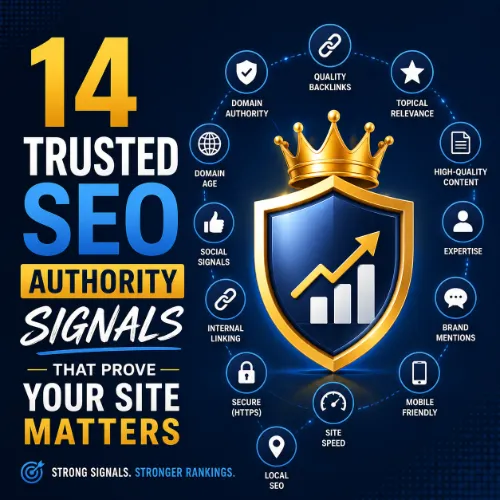
SEO authority signals Key Takeaways
Understanding SEO authority signals is essential for anyone who wants their website to rank higher and earn lasting trust from both search engines and readers.
- SEO authority signals like backlink quality, domain age, and content depth directly influence how Google evaluates your site.
- Signals such as E-E-A-T (Experience, Expertise, Authoritativeness, Trustworthiness), site speed, and user engagement metrics separate authoritative sites from the rest.
- Consistently building these signals leads to better rankings, higher click-through rates, and stronger brand credibility.
Why SEO Authority Signals Matter in 2025
Every day, search engines process billions of queries, aiming to deliver the most relevant and trustworthy results. To do this, they rely on hundreds of ranking factors, many of which fall under the umbrella of SEO authority signals. These indicators help Google distinguish between a well-researched expert guide and a thin, low-trust page. For a related guide, see 10 Biggest Google Search Changes SEOs Must Know to Avoid Ranking Drops.
For website owners, marketers, and content creators, understanding these signals is no longer optional. Google’s algorithm updates continue to reward sites that demonstrate genuine authority. Whether you run a personal blog, an e-commerce store, or a corporate site, focusing on these 14 signals will give you a clear roadmap to sustainable organic growth. For a related guide, see 12 Google Algorithm Updates That Reshaped SEO Forever.
What This Article Covers
In this guide, we break down each of the 14 most impactful SEO authority signals that matter for your rankings. For every signal, you will learn what it is, why search engines care about it, and how you can improve it. We then wrap up with an actionable summary, a curated list of useful resources, and an FAQ section addressing common questions.
14 SEO Authority Signals That Matter for Rankings
Below is the complete list of 14 signals, each explained with clarity and practical advice. The signals are grouped logically to help you see how they work together.
1. Quality Backlinks from Trusted Domains
Backlinks remain one of the strongest SEO authority signals. When a reputable site links to your content, it vouches for your credibility. However, not all backlinks are equal. A single link from a high-authority domain like a government site or a major news outlet carries far more weight than dozens of links from low-quality directories.
Why it matters: Google treats backlinks as votes of confidence. Focus on earning links editorially by creating exceptional content that others naturally want to reference. Avoid link schemes, as they can trigger penalties.
2. Domain Age and History
Older domains tend to have an advantage, but it is not age alone that matters. A domain with a clean history — no spam penalties or shady practices — signals stability and trust. New domains can still rank, but they must work harder to prove their reliability.
Why it matters: Age combined with a positive track record tells search engines that your site is a long-term, trustworthy resource. If you are buying an expired domain, always check its backlink profile for spam links.
3. E-E-A-T Signals (Experience, Expertise, Authoritativeness, Trustworthiness)
Google’s Search Quality Evaluator Guidelines emphasize E-E-A-T. This means your content should demonstrate real-world experience, subject-matter expertise, a respected brand, and transparent, reliable information. For YMYL (Your Money or Your Life) topics, E-E-A-T is critical.
Why it matters: You can boost E-E-A-T by including author bios with credentials, citing reputable sources, and publishing accurate, up-to-date content. User reviews, awards, and professional affiliations also contribute.
4. Content Depth and Originality
Thin content that barely covers a topic will never earn authority. Comprehensive, original content that provides unique insights, data, or perspectives signals depth and value. Google uses natural language processing to assess whether your page thoroughly answers the user’s intent.
Why it matters: Aim for articles that are at least 1,000 words for most topics, but focus on thoroughness rather than word count. Include original research, case studies, or expert interviews whenever possible.
5. Site Speed and Core Web Vitals
Page speed is a confirmed ranking factor, and Core Web Vitals (LCP, FID, CLS) measure real-world user experience. Fast-loading pages reduce bounce rates and increase the likelihood of engagement, which indirectly boosts authority.
Why it matters: Use tools like Google PageSpeed Insights to identify issues. Compress images, leverage browser caching, and choose a reliable hosting provider to improve your scores.
6. Mobile-Friendliness and Responsive Design
With mobile-first indexing, Google primarily uses the mobile version of your site for ranking and indexing. A responsive design that works seamlessly across devices is no longer optional.
Why it matters: Test your site with Google’s Mobile-Friendly Test. Ensure buttons are tappable, text is readable without zooming, and content fits the screen width.
7. On-Page SEO Fundamentals
On-page elements such as title tags, meta descriptions, header structure (H1-H4), and keyword placement help search engines understand your content. Proper use of SEO authority signals in on-page areas reinforces your topic relevance.
Why it matters: Write unique, descriptive title tags for every page. Use your focus keyword naturally in the first paragraph, at least one H2, and the conclusion. Avoid keyword stuffing.
8. User Engagement Metrics (CTR, Dwell Time, Bounce Rate)
How users interact with your site after clicking a search result sends strong signals. A high click-through rate (CTR), long dwell time (time spent on page), and low bounce rate suggest that users find your content valuable and relevant. For a related guide, see 15 Trusted SEO Ranking Factors That Matter More After AI Search.
Why it matters: Write compelling meta descriptions and use structured data to earn rich snippets, which can boost CTR. Improve content readability and internal linking to keep visitors engaged longer.
9. Social Signals and Brand Mentions
While Google has stated that social signals like shares and likes are not direct ranking factors, they correlate with authority. Brand mentions across the web — even without a link — signal that your site is a recognized name in your niche.
Why it matters: Cultivate an active social media presence and encourage organic sharing. Use tools to monitor unlinked brand mentions and turn them into backlink opportunities.
10. Internal Linking Structure
A well-planned internal linking strategy distributes authority throughout your site. It helps both users and search engines discover related content, and it signals which pages you consider most important.
Why it matters: Use descriptive anchor text for internal links. Link from high-authority pages (like your homepage or pillar content) to newer or deeper pages. Avoid orphan pages with no internal links.
11. HTTPS and Site Security
Google considers HTTPS a ranking signal. A secure, encrypted connection protects user data and builds trust. Browsers also warn users when they visit non-HTTPS sites, which can deter visitors.
Why it matters: Install an SSL certificate and ensure all pages redirect to HTTPS. Check for mixed content warnings where some elements load over HTTP.
12. Cited References and External Sources
Linking to authoritative, relevant external sources — such as academic papers, government statistics, or industry reports — adds credibility to your content. It also shows that you have done your research.
Why it matters: Always cite primary sources where possible. Use nofollow links if you are linking to a site you do not fully endorse, but for trustworthy references, dofollow links are fine.
13. Consistent NAP Information (for Local SEO)
For local businesses, Name, Address, and Phone Number (NAP) consistency across the web is a critical authority signal. Google uses this data to confirm your business exists and is legitimate.
Why it matters: Ensure your NAP is identical on your website, Google Business Profile, and all local directories. Inconsistencies can confuse search engines and hurt local rankings.
14. User Reviews and Reputation Management
Online reviews on platforms like Google, Yelp, and Trustpilot influence both user trust and search rankings. A steady stream of positive reviews signals that your business delivers on its promises.
Why it matters: Encourage satisfied customers to leave reviews. Respond professionally to negative reviews to show you care about customer experience. Fake reviews can backfire.
How to Audit Your Site for SEO Authority Signals
Regularly auditing your site for these 14 signals will help you identify gaps and prioritize improvements. Here is a quick checklist you can follow:
- Use a backlink checker (like Ahrefs or Moz) to evaluate your link profile.
- Run a Core Web Vitals report in Google Search Console.
- Check your mobile usability using Google’s Mobile-Friendly Test.
- Review your top pages for content depth and on-page optimization.
- Search for unlinked brand mentions and reach out to request links.
- Ensure your NAP is consistent across all local directories.
Performing this audit quarterly will keep your SEO authority signals strong and help you adapt to algorithm changes.
Actionable Summary: Build Authority Systematically
Building SEO authority signals is not a one-time task but an ongoing process. Start with the fundamentals: ensure your site is fast, secure, and mobile-friendly. Create content that is genuinely useful and earn backlinks by promoting it to the right audiences. Over time, these signals compound, making it easier to rank for competitive terms and build a loyal readership.
Remember, authority is not just about outranking competitors; it is about becoming a trusted resource that users and search engines alike rely on. Focus on quality, consistency, and transparency, and the rankings will follow.
Useful Resources
Here are two trustworthy resources to deepen your understanding of SEO authority signals:
- Google’s Guide to Creating Helpful, Reliable Content — Official guidelines on producing content that aligns with Google’s quality expectations.
- Moz’s Beginner’s Guide to SEO — A comprehensive, free resource covering ranking factors, authority signals, and best practices for all skill levels.
Frequently Asked Questions About SEO authority signals
What are SEO authority signals ?
SEO authority signals are indicators that search engines use to measure the trustworthiness, expertise, and overall credibility of a website or webpage. They include backlinks, domain age, content quality, and user engagement metrics.
How many authority signals does Google use?
Google uses hundreds of ranking signals, and many relate to authority. While there is no official number, the 14 signals covered in this article represent the most impactful ones for most websites.
Do backlinks still matter for authority?
Yes, backlinks from reputable, relevant domains remain one of the strongest authority signals. However, quality matters far more than quantity. A few high-authority links are better than hundreds of low-quality ones.
What is the fastest way to build SEO authority?
The fastest sustainable approach is to create exceptional, original content that naturally attracts backlinks and social shares. Combine this with technical SEO improvements like site speed and mobile optimization to accelerate results.
Is domain age a direct ranking factor?
Google has stated that domain age itself is not a ranking factor, but older domains tend to have more backlinks and history, which can correlate with authority. A new domain can still rank with strong signals.
What is E-E-A-T and why does it matter?
E-E-A-T stands for Experience, Expertise, Authoritativeness, and Trustworthiness. It is a framework Google uses to evaluate content quality, especially for topics that can impact a person’s health, finances, or safety (YMYL).
Can user reviews improve SEO authority?
Yes, consistent positive reviews on platforms like Google and Yelp signal trust and relevance, which can boost local SEO and overall brand authority. They also influence click-through rates from search results.
How do I measure my site’s authority?
You can use tools like Ahrefs (Domain Rating), Moz (Domain Authority), and Google Search Console for engagement metrics. A comprehensive audit covering the 14 signals in this article will give you a clear picture.
Does site speed affect authority signals?
Yes, site speed is a confirmed ranking factor and impacts Core Web Vitals, which are user experience signals that influence authority. A slow site can increase bounce rates, sending negative signals to Google.
Is mobile-friendliness an authority signal?
Absolutely. With mobile-first indexing, Google uses the mobile version of your site for ranking. A poor mobile experience can hurt both user engagement and search visibility.
What is the role of social media in SEO authority?
Social signals are not direct ranking factors, but they amplify content visibility, which can lead to more backlinks and brand mentions. An active social presence correlates with higher authority.
How many backlinks do I need to rank?
There is no fixed number. It depends on the competitiveness of your keyword and the authority of linking domains. A single link from a highly authoritative site may be enough for low-competition queries.
Can internal links improve authority?
Yes, a strong internal linking structure distributes authority throughout your site and helps search engines discover and rank all your important pages. It also improves user navigation.
What is the difference between DR and DA?
DR (Domain Rating) is a metric by Ahrefs, while DA (Domain Authority) is by Moz. Both aim to estimate a site’s backlink strength on a logarithmic scale. They are useful benchmarks but not official Google metrics.
Do guest posts help build authority?
Guest posting on reputable, relevant sites can earn quality backlinks and brand exposure. However, low-quality guest posts on spammy sites can harm your authority. Focus on editorial value, not just links.
What is a good Domain Rating?
There is no universal “good” DR; it depends on your niche and competition. A DR of 50+ is generally respectable for most industries, while 70+ indicates strong authority.
How often should I update old content for authority?
You should review and refresh cornerstone content every 6 to 12 months. Updating statistics, adding new insights, and improving readability can boost engagement and signal freshness to search engines.
Can duplicate content hurt authority signals?
Yes, duplicate content confuses search engines about which version to index and rank. It dilutes link equity and can lead to lower rankings. Use canonical tags to indicate the preferred version.
What are the most important technical SEO signals?
Key technical signals include site speed (Core Web Vitals), mobile-friendliness, HTTPS, proper indexability (no crawl errors), and a clean XML sitemap. These form the foundation for all other authority signals.
How do I recover from a penalty that hurt my authority?
First, identify the cause via Google Search Console messages. Then remove or disavow toxic backlinks, fix on-page issues, and submit a reconsideration request. Rebuilding authority takes time and consistent quality efforts.