
SEO tactics that no longer work Key Takeaways
The tactics that used to push pages to the top of search results have shifted dramatically.
- Keyword stuffing and exact-match domains are dead; semantic topic coverage wins.
- Mass link building and low-quality guest posts now harm more than help.
- Ignoring Core Web Vitals and mobile usability will tank your rankings regardless of content quality.
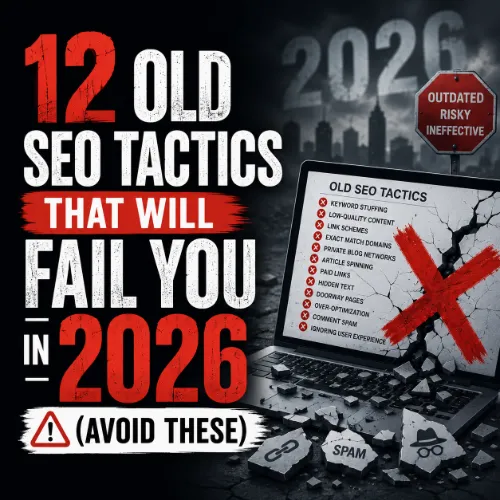
Why These 12 SEO tactics that no longer work Can Hurt Your Site in 2026
Search engines have matured into intelligent systems that evaluate content holistically. Tactics designed to game the system now trigger penalties or simply get ignored. Understanding which outdated SEO tactics to drop is just as important as learning new best practices. Here are the 12 strategies you must leave behind. For a related guide, see 8 Proven Digital PR Tactics for SEO to Boost Rankings.
1. Keyword Stuffing
Filling paragraphs with the same phrase in unnatural ways used to signal relevance. Today, natural language models understand context and synonyms. Repeating “best coffee maker” twenty times in a 500-word article will make your content read poorly and rank lower. Write for humans first and use related terms like “espresso machine” or “brewer” instead. For a related guide, see 9 Proven Ways to Earn Natural Backlinks That Actually Work.
2. Exact-Match Domains for Ranking
Buying buyredwidgets.com once gave an automatic relevance boost. Now, Google de-emphasizes exact-match domains because they are often low-quality. Your brand name and site authority matter far more. Use a clean domain that represents your business, not a keyword string.
3. Mass Directory Submissions
Submitting your site to hundreds of low-quality directories used to build quick backlinks. Most of those directories are now spam nests filled with nofollow links or are simply ignored by Google. A handful of high-quality, niche-specific directories can still offer value, but automated submissions will waste your time.
4. Article Spinning for Scale
Rewriting an existing article with synonym swaps to create dozens of similar pages no longer works. Google’s duplicate content detection catches spun content, and AI-generated rewrites often lack coherence. Invest in one strong, original article instead of ten weak, spun versions.
5. Targeting Only Exact-Match Long-Tail Keywords
Focusing only on exact long-tail queries like “buy organic dog food in Austin Texas 2026” misses the bigger picture. Users search with varied phrasing, voice queries, and implied intent. Build topical authority on “organic dog food” as a whole, covering feeding guides, ingredient comparisons, and local availability.
6. Building Links from Any Page with High DR
Link builders used to chase any page with a high Domain Rating, regardless of relevance. Today, relevancy and contextual placement outweigh raw authority. A link from a DR 80 pet site on your coffee shop article is nearly worthless. Aim for links from pages topically related to your content.
7. Ignoring Search Intent for Variety
Creating one blog post for every keyword without considering whether the user wants information, a product, or a local business is a common mistake. Informational queries need guides; transactional queries need landing pages. Matching intent directly improves click-through rates and dwell time.
8. Over-Optimizing Anchor Text
Using the exact target keyword as the anchor text in every backlink used to boost rankings. Now, that pattern looks unnatural and signals manipulation. Mix branded, naked URL, and generic anchor text (like “click here” or “this guide”) to keep your link profile organic.
9. Publishing Thin Content for Freshness
Posting short 300-word articles daily to show Google your site is active is counterproductive. Thin content dilutes your site’s authority and often gets indexed but never ranks. Fewer, longer, well-researched pieces of 1500+ words outperform dozens of fluff posts.
10. Relying Solely on Google My Business Listings for Local Results
Claiming your GMB profile and doing nothing else used to dominate local search. Now, local packs pull from citations, reviews, and on-page local signals. Build local backlinks from community sites, get consistent NAP across directories, and create hyperlocal content about your service area.
11. Using Private Blog Networks (PBNs)
PBNs — networks of sites used only to link to your main site — were a gray-hat staple. Google now aggressively deindexes PBNs and hands manual penalties to linked sites. The risk far exceeds any short-term gain. Invest in earned links through guest posting on real, editorially-vetted publications.
12. Ignoring User Experience Metrics
Only focusing on keywords and backlinks while neglecting page speed, mobile friendliness, and Core Web Vitals is a fatal oversight in 2026. Google uses real-user metrics from Chrome to assess whether visitors have a good experience. Use PageSpeed Insights to fix large content paint (LCP) and cumulative layout shift (CLS) issues.
How to Replace SEO tactics that no longer work With Modern Strategies
Instead of chasing shortcuts, build a sustainable SEO foundation. Focus on creating comprehensive topic clusters, earning editorial links from journalists, optimizing for featured snippets and People Also Ask, and regularly conducting technical site audits. Use tools like Ahrefs or Semrush to identify content gaps and monitor your site’s health. The sites that thrive in 2026 are those that treat SEO as a user experience discipline, not a checklist of tricks.
Useful Resources
- Google’s Helpful Content System Guide — official guidance on creating people-first content that aligns with modern ranking signals.
- Ahrefs: Most Common SEO Mistakes — practical breakdown of frequent errors and how to fix them, with real data.
SEO Entities and Their Functions
When analyzing why certain SEO tactics that no longer work fail, it helps to understand the entities that power modern search analysis. These are the nouns and data points that tools like Ahrefs surface for decision-making.
- Keyword entities (organic keywords, keyword difficulty, search volume, SERP features) help identify demand and competition. High KD doesn’t mean a keyword is impossible; it means you need strong topical authority.
- Backlink entities (referring domains, anchor text distribution, dofollow/nofollow ratio, broken backlinks) reveal link profile quality. If most links come from low-relevance domains, that’s a red flag.
- Page entities (top pages by traffic, best by links, broken pages) show which URLs actually perform. Thin pages with no traffic should be consolidated or improved, not added to.
- Technical SEO entities (crawl issues, redirect chains, Core Web Vitals, indexability status) expose blockers that make even great content invisible.
- Competitor entities (competing domains, content gap opportunities, shared keywords) let you find where rivals succeed and where you can capture untapped traffic.
Frequently Asked Questions About SEO tactics that no longer work
What are the most outdated SEO tactics that no longer work?
Keyword stuffing, exact-match domains, mass directory submissions, article spinning, and private blog networks are among the most outdated. They are either ignored or penalized by modern algorithms.
Does meta keywords tag still matter?
No. Google stopped using the meta keywords tag years ago. It is completely ignored and serves no purpose for ranking.
Is link building still effective in 2026?
Yes, but only high-quality, earned links from relevant, authoritative sites. Low-quality directory links and link exchanges are ineffective.
Can I still use exact-match anchor text?
Sparingly. Using the exact target keyword as anchor text for more than a small percentage of your backlinks looks manipulative and can trigger penalties.
Are private blog networks effective?
No. Google actively detects and deindexes PBNs. Sites connected to PBNs risk manual penalties or ranking drops.
Does domain age still affect SEO?
Not directly. An older domain may have more trust, but a new site with great content and strong backlinks can outrank old, neglected domains.
Should I still submit my site to search engines?
Submitting directly is unnecessary if your site has a proper sitemap and internal linking. Google will find new pages naturally through crawl.
Is keyword research still important?
Yes, but the focus has shifted from exact-match keywords to topics and search intent. Understanding what users want is more valuable than finding a low-competition phrase.
Does duplicate content hurt SEO?
Yes. Significant duplicate content across your site can dilute rankings. Use canonical tags properly and avoid copying large blocks of text from other sources.
Are reciprocal links bad?
Occasional reciprocal exchanges on relevant sites are fine, but widespread link trades for ranking purposes violate Google’s guidelines and are ineffective.
Should I avoid JavaScript for SEO?
Not entirely, but heavy JavaScript can block crawling if not properly handled. Use dynamic rendering or server-side rendering for critical content.
Does social media directly boost rankings?
Social signals are not a direct ranking factor. However, social sharing can lead to more visibility and backlinks, which indirectly help.
Is it worth optimizing for voice search separately?
Voice search optimization overlaps with natural language and featured snippet targeting. Separate keyword lists for voice are no longer necessary if you write conversationally.
Does the number of words per page matter?
Quality and coverage matter more than word count. A 600-word answer that fully addresses user intent can outrank a 3000-word article that rambles.
Should I use the same keyword in multiple H2s?
Using your focus keyword in multiple H2s can help with relevance, but avoid overuse. Include the keyword once or twice in headings and let LSI terms cover the rest.
Are footer links still useful?
Footer links are usually devalued because they are sitewide. Use footers for navigation, not for link building.
Does having multiple H1 tags hurt SEO?
HTML5 allows multiple H1s, but for clarity and best practice, stick to one H1 per page that describes the main topic.
Is image optimization still necessary?
Yes. Proper alt text, compressed file sizes, and WebP format improve accessibility and page speed, both ranking factors.
Should I still write for Google or for humans?
Write primarily for humans. Modern algorithms are good enough to understand natural, helpful content. Writing solely to trick search engines will backfire.
Will these tactics ever work again?
Unlikely. Google’s direction is toward understanding content quality and user satisfaction. Shortcuts from 10 years ago are permanently retired.