AI SEO predictions Key Takeaways
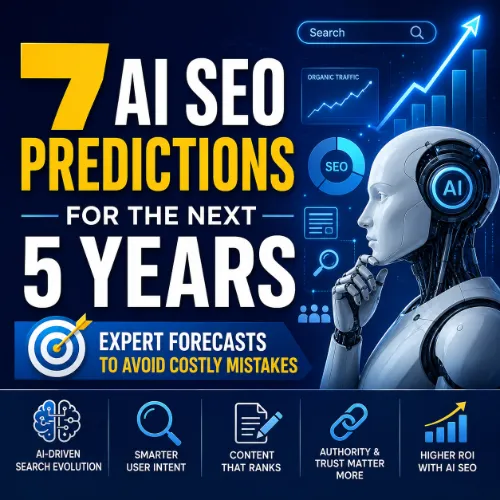
The next five years will bring a fundamental shift in how search engines evaluate and rank content, driven by generative AI, personalized experiences, and new SERP features.
- AI SEO predictions show that content depth and topical authority will matter more than ever as AI models learn to assess expertise directly.
- Search will become more conversational and multi-modal, requiring structured data and entity-rich content to win featured snippets and AI Overviews.
- Technical SEO will expand to include model interpretability and content provenance, making transparency a ranking factor by 2029.
Why AI SEO Predictions Matter for Modern Marketers
The search landscape is transforming faster than most practitioners realize. Google’s March 2024 core update emphasized helpful content and diminished thin AI-generated pages. Meanwhile, Bing’s integration of GPT-4 and Google’s Search Generative Experience (SGE) are rewriting the rules for visibility. Understanding these AI SEO predictions helps you avoid investing in tactics that will lose effectiveness within two years. For a related guide, see 10 SEO Trends That Will Dominate 2026: Smart Predictions.
Consider this: in 2023, Google processed over 8.5 billion searches per day. By 2028, generative AI could assist with 40% of those queries, either through direct answers or augmented snippets. The brands that prepare now will own the distribution channels of tomorrow.
Prediction 1: AI Models Will Directly Evaluate Content Quality
Historically, Google used proxy signals like backlinks and click-through rates to infer quality. Within five years, large language models will analyze content for factual accuracy, readability, and completeness at scale. This means your pages must satisfy the full range of user intent, not just target a keyword phrase.
What This Means for Your SEO Workflow
Start auditing content for depth. A 1,500-word article that barely scratches the surface will rank below a 3,000-word guide that includes case studies, data tables, and expert quotes. Tools like Ahrefs’ Content Gap can help you identify what authoritative competitors cover that you miss.
Prediction 2: SERP Features Will Rebalance Toward AI Overviews
AI Overviews already appear for 15-20% of queries in early 2025. By 2029, they may cover 60% of searches. This will reduce organic click-through rates for some informational queries but create new opportunities for brands that earn placement inside these summaries.
How to Win in an AI-Overlay SERP
Optimize for snippet-style content: clear definitions, ordered lists, and concise tables. Use AI SEO predictions to influence your FAQ schema and question-based H2s. For instance, if you run a local bakery, a page answering “What is sourdough fermentation time?” could appear in an AI answer box above traditional results.
Prediction 3: Personalization Will Fragment Search Results
Search engines already personalize based on location, browsing history, and device. The future will bring session-level personalization, where the same query returns different results for the same user depending on previous interactions that day. This makes universal “number one ranking” less meaningful.
Actionable Takeaway for Marketers
Invest in brand identity and direct traffic channels. When personalization dominates, strong brand search volume and newsletter subscribers become your moat. Monitor your branded vs. unbranded organic traffic split in Google Search Console monthly.
Prediction 4: Structured Data Becomes a Ranking Prerequisite
Currently, schema markup helps with rich results but isn’t required for ranking. By 2028, structured data will help AI models understand your content’s subject matter, relationships, and freshness. Pages without proper entity markup will struggle to compete, especially for knowledge-panel-bearing queries.
Getting Started with Entity Schema
Implement schema.org types like Article, FAQPage, HowTo, and Product. Use Ahrefs’ Site Audit tool to check for structured data errors. Add organization, person, and local business schema if applicable. This connects your content to the broader knowledge graph.
Prediction 5: Content Provenance and Transparency Will Become Signals
Google’s 2024 update emphasized “people-first content” partly by rewarding clear authorship and factual sourcing. In the next five years, expect search engines to verify content origin via cryptographic signatures or metadata that proves the content wasn’t churned by an untrained model. For a related guide, see 11 Proven Ways to Optimize for AI Search Engines in 2026.
How to Prepare
Always cite primary sources for data claims. Add author bios with credentials for YMYL topics. Consider using tools like Content Credentials (C2PA standard) to attach provenance metadata to your published content. This will become a trust signal that differentiates trustworthy publishers from AI farms.
Prediction 6: Visual and Voice Search Will Converge
By 2028, users will routinely search by uploading an image and then asking a spoken question about it. This multi-modal interaction will require your content to include detailed alt text, image captions, and transcript-friendly writing. Google Lens already handles 12 billion visual searches monthly; that number will triple.
Optimizing for Multi-Modal Discovery
Write alt text that describes the image’s content and its context. Include descriptive captions under every figure. For voice queries, structure content with direct answers at the top of paragraphs, as voice assistants often read the first sentence of a matching passage.
Prediction 7: The Role of Links Will Evolve, Not Disappear
Backlinks remain a strong authority signal, but AI models will weigh context and relevance more heavily than raw quantity. A link from a thematically related industry publication will matter more than a generic directory link. Additionally, internal linking structure will be used by AI to understand content clusters.
Future-Proofing Your Link Strategy
Use Ahrefs’ Link Intersect tool to find competitors who link to your rivals but not to you. Prioritize editorial outreach to sites with topical relevance rather than high DR alone. Build content hubs with pillar pages and supporting cluster articles linked internally.
SEO Entities and Their Functions
Understanding how search engines parse content requires knowing the entities they recognize. Here are the key ones for AI-era SEO:
- Website entities (root domain, subdomain, URL): determine authority distribution. A link to
example.com/blog/helps the blog section, not the whole domain. - Keyword entities (organic keywords, KD, search volume, traffic potential): reveal demand and competition. Use Ahrefs’ Keywords Explorer to find gaps.
- Backlink entities (referring domains, anchor text, dofollow/nofollow, broken backlinks): evaluate link quality. Monitor lost backlinks with the Site Explorer tool.
- Page entities (top pages by traffic, best by links, broken pages): show which URLs earn visibility and need repair.
- Content entities (authors, topics, published dates, social shares): help assess editorial quality and timeliness.
- SERP entities (featured snippets, People Also Ask, AI Overviews): indicate what format Google rewards for a query.
- Technical SEO entities (crawl issues, redirect chains, Core Web Vitals): expose barriers to indexability and page experience.
- Competitor entities (competing domains, content gap, shared keywords): show where rivals win traffic and where you can improve.
- Metrics entities (DR, UR, traffic value, organic traffic): summarize authority and market value at a glance.
Useful Resources
For deeper dives into search behavior and AI impact, review these authoritative sources:
- Search Engine Land’s analysis of Google’s AI Overviews offers ongoing coverage of SERP evolution.
- Ahrefs’ AI SEO guide provides practical strategies for optimizing content for generative search engines.
Frequently Asked Questions About AI SEO predictions
What are AI SEO predictions ?
These are evidence-based forecasts about how artificial intelligence will change search engine algorithms, user behavior, and content optimization over the next five years.
Will AI replace SEO entirely?
No. AI will automate certain tasks like keyword clustering and content brief creation, but strategic decision-making, brand building, and relationship-based link earning require human expertise.
How do AI Overviews affect organic traffic?
For informational queries, click-through rates may decline. However, brands that appear inside AI Overviews can gain visibility and referral traffic from the summary itself.
When will AI-based ranking start?
Google already uses AI models like RankBrain and MUM. Full-scale quality evaluation by LLMs will likely be standard by 2027-2028.
Do I need to write long-form content for AI SEO?
Length alone is insufficient. Depth, originality, and comprehensive coverage of subtopics matter more. Longer content tends to cover more ground, but concise depth also works.
What structured data should I implement for the future?
Focus on Article, FAQPage, HowTo, Product, and Organization schemas. Add Person schema for author pages to establish expertise.
Will backlinks still matter in 2029?
Yes, but their weight will shift from count to contextual relevance. Links from topically related domains will carry more authority.
How can I prepare for personalized search?
Strengthen brand signals and direct traffic channels. Email lists, branded search volume, and direct site visits become competitive advantages.
What is content provenance?
It’s verifiable metadata that shows when, where, how, and by whom content was created. It helps differentiate original work from AI-generated or scraped content.
Does voice search require special optimization?
Yes. Structure content with direct answers to conversational questions. Use natural language and include question-and-answer format within your text.
What tools can help with future AI SEO?
Ahrefs for keyword research and competitor analysis, Google Search Console for performance monitoring, and schema testing tools like Rich Results Test by Google.
Will AI create unlimited content opportunities?
AI can generate volume, but search engines will reward quality. The opportunity lies in vetting, enriching, and adding unique insights to AI-assisted drafts.
How do I balance AI efficiency with human quality?
Use AI for research and outlines, then have a subject matter expert review, edit, and add original perspectives. This hybrid approach scales without sacrificing quality.
What is a content gap in AI SEO?
A content gap is a topic or question your competitors rank for but you don’t. Identifying these gaps with tools like Ahrefs reveals opportunities to create authoritative content.
Should I update old content for AI SEO?
Yes. Refresh outdated statistics, add recent examples, expand thin sections, and improve schema. Freshness is a recognized signal in AI-driven rankings.
Will Google’s SGE replace traditional search results?
Not entirely. SGE will coexist with classic blue links, especially for transactional and navigational queries where users need to visit a specific page.
How does entity optimization help AI SEO?
Entity markup helps search engines understand the people, places, and things in your content, improving visibility in knowledge panels and AI answers.
What are the biggest AI SEO mistakes to avoid?
Relying solely on AI for content creation without human review, ignoring structured data, and failing to diversify traffic sources beyond organic search.
Do AI SEO predictions apply to local businesses?
Absolutely. Local packs will incorporate AI-generated summaries, and proximity combined with entity alignment will be key for local rankings.
How often should I revisit my AI SEO strategy?
Review quarterly. The field evolves rapidly with each major search engine update and AI model release. Stay flexible and test hypotheses.