
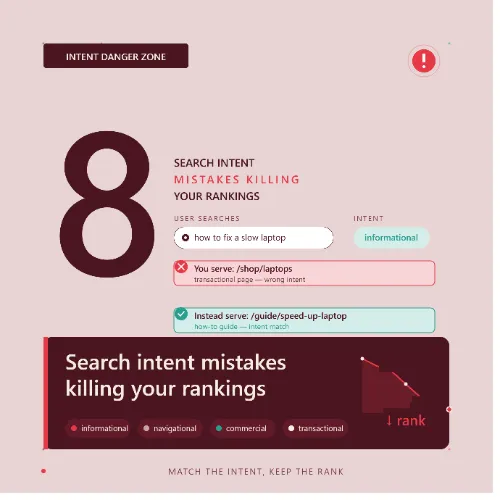
search intent mistakes Key Takeaways
Many SEO campaigns fail because they target keywords without understanding what the searcher actually wants.
- Mismatched intent — such as serving a transactional page for an informational query — causes high bounce rates and low rankings.
- Fixing intent errors requires analyzing SERP features, content formats, and user behavior signals.
- Aligning content with intent improves organic visibility and increases the chance of earning featured snippets and other SERP enhancements.
Why search intent mistakes Undermine Your SEO Strategy
Search intent — sometimes called user intent — is the reason behind a query. When you optimize for keywords without matching the intent, you send the wrong signal to Google. The result: lower rankings, fewer clicks, and a poor user experience. Even a well-written page can fail if it answers a question nobody asked at that stage.
Understanding intent helps you create content that satisfies the searcher from the first sentence. It also helps you choose the right format — a listicle, a comparison table, a product page, or a step-by-step guide. When you get intent right, you signal relevance, which is a core ranking factor.
Mistake 1: Treating All Keywords as Informational
One of the most common search intent errors hurting rankings is assuming every keyword has an informational intent. For example, the query “buy running shoes online” clearly signals commercial intent. Writing a blog post about “how to choose running shoes” might be related, but it won’t satisfy a user ready to purchase. For a related guide, see 7 Technical SEO Fixes for eCommerce: Avoid These Costly Mistakes.
How to Fix It
Use tools like Ahrefs or SEMrush to check SERP features. If you see product listing ads, shopping results, or a local pack, the intent is likely transactional or commercial. Build a product category page or a comparison guide rather than a pure informational article.
Mistake 2: Ignoring the Format the SERP Rewards
Google examines the user’s desired format — a video, a list, a how-to, or a single answer. Publishing a long-form guide when the top results are all 60-second videos is a classic search intent mistake.
How to Fix It
Search your target keyword in incognito mode. Look at the top five results. Note whether they are product pages, blog posts, videos, or tools. Match your content format to the dominant pattern. If videos dominate, embed a high-quality video summary and supplement it with text.
Mistake 3: Overlooking Navigational Intent
When a user searches for “Facebook login” or “Ahrefs blog,” they want to reach a specific site or page. Creating a generic guide about social media login best practices for that keyword confuses both users and search engines.
How to Fix It
Identify navigational queries by looking at branded terms and domain-specific language. If your brand doesn’t own the destination, consider targeting a different keyword. If you own the destination, keep the page simple and functional.
Mistake 4: Confusing Commercial Investigation with Transactional Intent
A user searching “best CRM for small business” is still researching — they may not be ready to buy. Pushing a signup page before they’ve compared options is a search intent error hurting rankings because the user leaves quickly.
How to Fix It
Create comparison content, review roundups, or feature lists for commercial investigation queries. Include affiliate links or free trial buttons without forcing an immediate decision. Nurture the user toward conversion rather than rushing it.
Mistake 5: Publishing Thin Content for Informational Queries
For queries like “what is search intent,” users expect a thorough explanation. Short, incomplete answers signal low quality and fail to cover related subtopics. Google often demotes pages that don’t fully satisfy the user’s information need.
How to Fix It
Before writing, open the “People Also Ask” box and the top-ranking pages. List every sub-question they answer. Cover those questions in your article. For example, include examples, reasons why intent matters, and how to apply it.
Mistake 6: Forgetting the Buyer’s Journey Stage
Intent is not static — it shifts from awareness to consideration to decision. Using a top-of-funnel keyword like “SEO tips” for a bottom-of-funnel offer (e.g., “buy our SEO tool”) feels pushy and irrelevant.
How to Fix It
Map your keyword list to the buyer journey stages. Create awareness content for informational queries (e.g., “what is keyword research”), consideration content for commercial investigation (e.g., “best keyword research tools”), and conversion content for transactional queries (e.g., “keyword research tool pricing”). For a related guide, see Ai Saves Time In Seo: 5 Costly Mistakes to Avoid in 2026.
Mistake 7: Writing for Search Engines Instead of People
When you stuff keywords, write unnatural sentences, or add fluff, you may rank temporarily but fail to satisfy real readers. Google’s Helpful Content Update specifically targets content that doesn’t demonstrate genuine expertise or address user intent.
How to Fix It
Write as if you are answering a friend’s question. Use natural language, real examples, and clear structure. After writing, read your draft aloud — if it sounds robotic, rewrite it. The best way to fix search intent for SEO is to prioritize readability first.
Mistake 8: Neglecting Post-Publish Intent Monitoring
Intent can shift over time. A keyword that was informational last year may now have commercial results. Ignoring this change means your once-relevant page becomes outdated and loses traffic.
How to Fix It
Set a quarterly reminder to audit your top-performing pages. Re-check the SERP to see if new features — videos, AI Overviews, local packs — have appeared. Update your content format, title, and meta description to match the new intent pattern.
SEO Entities and Their Functions
Understanding how different SEO entities relate to search intent mistakes helps you analyze and adjust your strategy with precision.
- Keyword entities — Organic and paid keywords, along with metrics like Keyword Difficulty (KD) and search volume, show demand and competition. Use them to validate whether a keyword supports your targeted intent.
- SERP entities — Featured snippets, People Also Ask, AI Overviews, and video results reveal the format searchers expect. Matching your content to the dominant SERP feature is a core part of fixing intent mismatches.
- Content entities — Authors, topics, publication dates, and social shares help evaluate whether existing content matches the freshness and authority needed for a given intent.
- Competitor entities — Competing domains and content gap opportunities show where rivals satisfy intent better. Use gap analysis to build content that fills unmet user needs.
- Metrics entities — Domain Rating (DR), organic traffic, traffic value, and referring domains give you a snapshot of authority and visibility. Low traffic from a high-volume keyword often signals an intent mismatch.
Checklist to Avoid search intent mistakes
Use this checklist before publishing any new content or optimizing existing pages:
- Identify the primary intent: informational, commercial, transactional, or navigational.
- Review the top 5 SERP results for format, length, and angle.
- Match your content type — list, guide, product page, video — to the dominant pattern.
- Map the keyword to the correct buyer journey stage.
- Write naturally, answer every sub-question from People Also Ask.
- Avoid keyword stuffing and fluff.
- Monitor SERP changes quarterly and update accordingly.
Useful Resources
To deepen your understanding of search intent and how to apply it, check these resources:
- Ahrefs: Search Intent Guide — A comprehensive breakdown of the four intent types with real SERP examples.
- Moz: How to Optimize for Search Intent — Practical tips for aligning content with user expectations.
Frequently Asked Questions About search intent mistakes
What are search intent mistakes ?
Search intent mistakes occur when your content targets a keyword but fails to match the underlying reason for the search — informational, commercial, transactional, or navigational. This mismatch reduces relevance, increases bounce rate, and harms rankings.
How do search intent errors hurting rankings affect SEO?
When Google detects a mismatch between the query and your content, it interprets the page as less relevant. This can cause lower click-through rates, shorter dwell time, and diminished ranking positions over time.
Can I fix search intent for SEO without changing the entire page?
Yes. Often adjusting the title, meta description, introduction, and adding a new section can realign the intent. For major mismatches, rewriting the core content is more effective.
What is the fastest way to detect search intent mistakes ?
Analyze the top 5 SERP results for your target keyword. Look at page types — blog posts, product pages, videos — and the presence of SERP features. If your page type doesn’t match the dominant pattern, you likely have an intent mistake.
How does search intent differ from keyword difficulty?
Keyword difficulty measures how hard it is to rank for a term based on backlinks and authority. Search intent focuses on the user’s goal. Both are essential, but intent must be correct before you consider difficulty.
Do search intent mistakes affect local SEO?
Absolutely. A user searching “coffee shop near me” has local transactional intent. Publishing a general blog about coffee beans instead of a local page with hours and directions is a classic intent error.
Can YouTube or video content fix intent mismatches?
Videos can help for how-to and entertainment queries. If the SERP shows video carousels, embedding a video and supplementing with text can align with the dominant format and improve performance.
Are there tools that detect search intent mistakes automatically?
Some SEO tools — like Ahrefs, SEMrush, and Surfer SEO — label intent categories and show SERP feature data. However, manual review of the top results is still necessary to confirm the intent pattern.
How often should I audit my content for intent shifts?
Quarterly is a good cadence. Google algorithm updates and changes in user behavior can shift intent. Regular audits catch pages that have drifted out of alignment.
What is the difference between commercial and transactional intent?
Commercial investigation means the user is comparing options (e.g., “best CRM for small business”), while transactional intent means the user is ready to buy (e.g., “buy Salesforce CRM”). Confusing the two causes high bounce rates.
Should I target one intent per page or multiple intents?
One primary intent per page is best. Trying to serve both informational and transactional intents on the same page can dilute the focus and confuse both users and search engines.
Do search intent mistakes affect conversion rates?
Yes. When a user arrives expecting a comparison guide and finds a checkout page, they leave without converting. Matching intent increases trust and nudges users smoothly through the funnel.
How do I determine intent for a broad keyword like and quot;SEO and quot;?
Broad keywords often have mixed intent. Check the SERP — top results may include guides, tools, and courses. In this case, create a comprehensive pillar page that covers multiple intent angles, with clear internal links to deeper guides.
Can internal linking help fix search intent for SEO ?
Yes, internal linking can guide users from an informational page to a relevant commercial page, but the landing page itself must still match the intent of the initial search query.
What is a navigational intent mistake?
Optimizing a generic guide for a branded navigational query like “Facebook login” is a mistake because the user wants to reach a specific destination, not read an article.
How does search intent relate to content length?
Informational queries often reward comprehensive, long-form content. Transactional queries may need concise, punchy copy. The format and depth should match the user’s need.
Do AI Overviews change how we should think about intent?
Yes. AI Overviews pull answers directly from content. Structuring your content with clear, direct answers increases the chance of being featured, even if the user never clicks. Intent alignment remains critical.
What is the biggest search intent error hurting rankings in 2025?
Publishing thin content for informational queries remains the biggest mistake. Users expect depth, and Google’s Helpful Content Update penalizes pages that don’t deliver genuine value.
How can I test if my content matches search intent?
Run a small user test: ask a friend unfamiliar with SEO to search your target keyword, look at your page, and say what they think it offers. If their answer doesn’t match your goal, adjust the intent signal.
Is it possible to rank without fixing intent first?
You can rank temporarily if you have high authority or strong backlinks, but the page will likely underperform in click-through and engagement. Over time, Google adjusts rankings to favor intent-aligned content.